Roof and structure
T18 and T35 trapezoidal sheets: working out the weight of a delivery
In brief
To correctly estimate the weight of T18 or T35 trapezoidal sheet, you must first establish which surface area the given unit mass refers to. Check whether the product data sheet states kilograms per square metre of covering or per square metre of the sheet’s total area – these two values lead to different results. The designations T18 and T35 describe profile families, not one identical product, so weight can vary with steel thickness and geometry. To calculate delivery weight, sum the weight of all sheets according to their actual dimensions, then add the weight of packaging and accessories.
Why is there no single weight for T18 and T35?
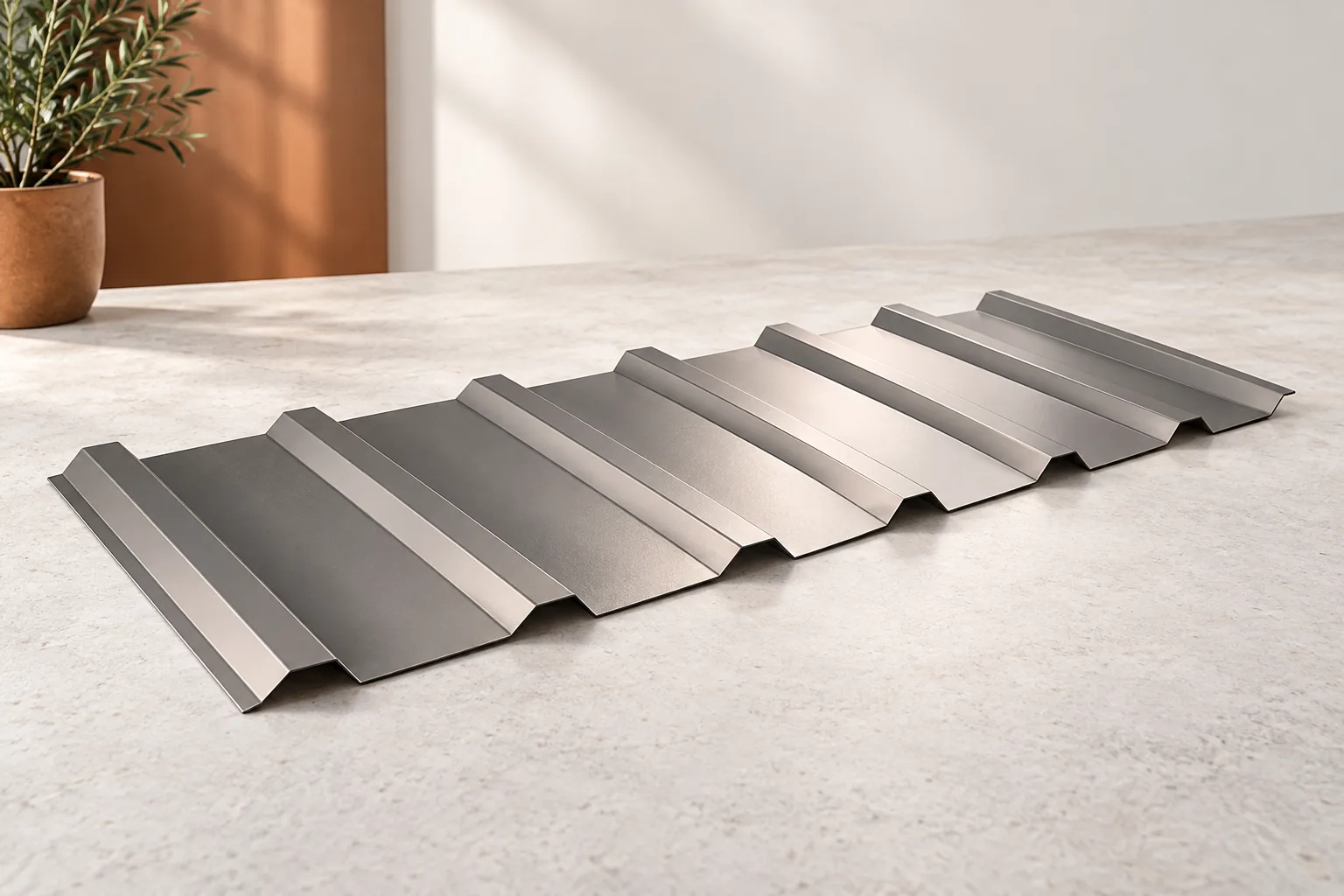
The designations describe profile families, not one identical product. They differ in the width of the input strip, rib arrangement and steel thickness. The same trade name of the category therefore does not guarantee the same weight. The value for calculations should be read from the data sheet or price list of the specific product being ordered.
The weight increases with the sheet thickness, but the basis of comparison must be watched. Two profiles with different cover widths use different amounts of steel per metre of finished roof surface. A higher profile may have a different developed width than a lower one. Measuring the trapezoid height alone is not enough to calculate the weight.
What does weight per square metre of coverage mean?
The effective area corresponds to the part of the sheet that covers the roof after the overlap is made. The total area also includes the portion hidden under the adjacent sheet. The same piece has one weight, but dividing it by two different areas gives two different results.
Therefore, before multiplying, check the unit description. If the data sheet specifies kilograms per effective metre, use the cover area of the given sheet. If the document refers to the total area, calculate accordingly. Mixing these values leads to errors in the transport schedule and when comparing offers.
What are example values for 0.5 mm sheet?
In a verified technical and price schedule dated 28 October 2026, one roof variant of T18 with a thickness of 0.5 mm has a weight of 4.43 kg per square metre of covering. For the roof variant of T35 specified there with the same thickness, 4.71 kg per square metre of covering is given. These are examples of specific products, not fixed values for all T18 and T35.
For 100 m² of effective area of such sheets, this gives approximately 443 and 471 kg of sheet metal alone, respectively. The calculation does not include flashings, screws, packaging or additional material from offcuts. Nor is it the weight of the entire finished roof.

How do you calculate the weight of one long sheet?
Multiply the sheet length by the width corresponding to the unit in the data sheet, and the result by the unit weight. If a sheet is 6 m long and 1.10 m wide in effective width, its covering area is 6.60 m². At 4.43 kg/m² this gives approximately 29.2 kg. This calculation is for the assumed dimensions and the stated weight.
A long sheet of this weight is not a convenient package to carry on your own. The length, susceptibility to bending and wind also determine how the work is organised. The number of people and the method of support are determined in accordance with the instructions. Improper lifting can permanently damage the sheet.
What should be added to the transport weight?
Add up all sheets by actual lengths and number of pieces. Add flashings, accessories and packaging. The pallet or supports may matter when planning unloading. The package weight is best confirmed with the supplier, especially when transport includes several types of material.
Also check how the load is arranged and what the lifting equipment can do. The permissible weight alone does not say whether a trolley or sling is suitable for a long package. The support spacing, centre of gravity and securing against slipping are important. These conditions must be established before the delivery arrives.
Is the weight of the sheet metal sufficient to verify the structure?
No. The structure also carries other roof layers, snow, wind and the additional loads envisaged. For installations, concentrated forces also matter. The low weight of the covering is an advantage, but it does not mean that any spacing of purlins or rafters will be safe.
Load tables for sheets distinguish self-weight from other loads and apply specific support conditions. Design values must not be confused with characteristic values. If the aim is a load-bearing assessment, a designer and the profile documentation are needed. Simple multiplication of kilograms serves a different purpose.
What data should be entered in the order?
Record the profile, thickness, lengths, number of sheets and effective width. Ask for the unit weight and the estimated package weights. Establish whether the supplier gives values for covering, total area or linear metre. One clear set of data avoids mistakes.
On delivery, check that the markings match the order. Do not estimate thickness or material quality solely by weighing a single sheet. The weight also depends on dimensions and tolerances. Assessing the product requires documents and proper measurements, not just the impression that the package seems light.
7 branches. Materials closer to your project.

- SEROCK — Dzierżenin 34 E
- BŁONIE — ul. Sochaczewska 138A
- RADOM — ul. Grobickiego 8
- ŁÓDŹ — Natolin 8
- OLSZTYN — Barczewo, ul. Prosta 9
- WROCŁAW — ul. Jerzmanowska 10C
- GORZÓW WLKP. — ul. Zielona 33/34