PIR insulation
Therma TF70: a warm floor does not depend on lambda alone
At a glance
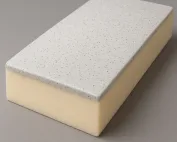
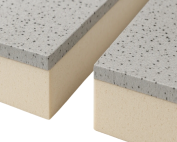
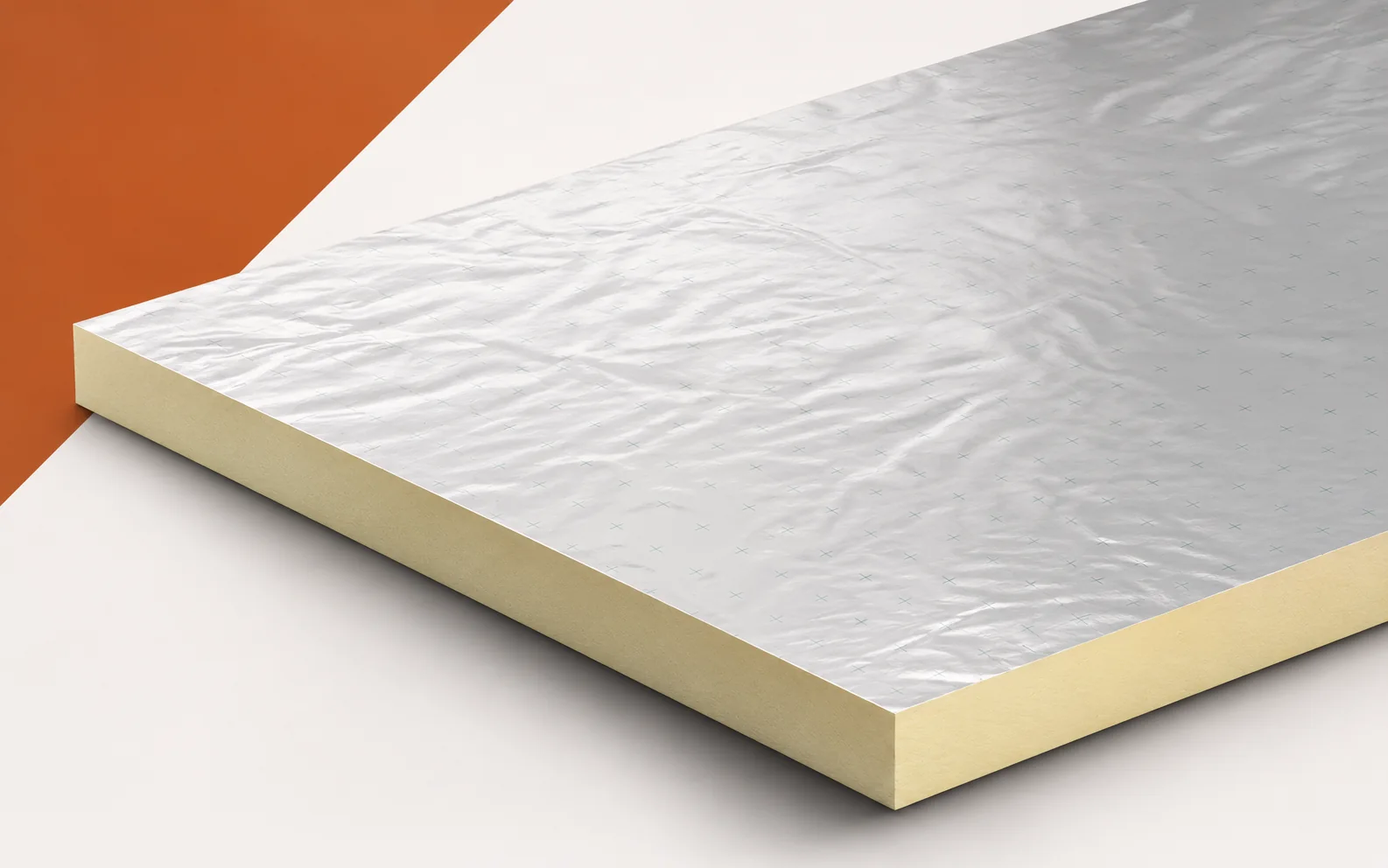
The answer to the question of a warm floor begins by separating the properties of the board from the behaviour of the entire building element. Kingspan Therma TF70 is a PIR board for insulating heated and unheated floors, with a multi-layer facing containing aluminium on both sides. Its rigidity does not, however, mean arbitrary pressure on the finished floor: it is worth establishing how CS was determined and what function the layers above the insulation perform. The floor level must be agreed with the space for TF70, the screed and the final finish, and for the finished building element it must be matched to the doors and adjacent rooms, so that the appearance of the surface does not replace an understanding of the material’s function.
First, identify the function
Reducing only one layer without analysing the cross-section can compromise the requirements of the entire floor. Well-chosen PIR boards should allow the required thermal resistance to be achieved without inadvertently changing the level of finished transitions. During the inspection, compare the height of the available cross-section, the planned finish and the levels at doors and stairs with the documentation or with the condition before the change.
How to interpret the values
For Therma TF70, lambda is 0.022 W/(m·K), and the catalogue states RD 3.60 m²K/W at a thickness of 80 mm and 4.50 m²K/W at 100 mm. Polyurethane boards must be compared on the same basis, so a comparison of these two TF70 variants only makes sense if the thickness and the thermal resistance relate to the same product.
The thermal resistance of TF70 must be separated from the calculation of heat flow through the complete floor on the ground, because the figure in the offer alone does not explain the conditions of its use. Similar-looking values do not always mean the same thing, since the way heat flows through the ground is not described solely by the reciprocal of the insulation’s thermal resistance. Before assessing the savings promise, ask for the TF70 thickness, the catalogue thermal resistance and how the floor connects to the perimeter of the heated building.
CS120 in the TF70 data comes from a test at 10% deformation, so it does not prove that every support will bear such a pressure without serviceability effects. The finished floor places different demands on shape retention and the durability of the finish, and to this are added the duration of the load and the behaviour of the screed. This value must therefore be related to the entire floor system, not to the board alone.
A symptom does not always indicate the cause
A floor with Therma TF70 still requires the protective and separating layers envisaged for the given build-up; the board’s facing does not resolve the junctions at walls or pipe penetrations. If water or moisture problems are suspected, therefore, check the connection of the floor insulation with the protective layers at the wall and at the pipe penetrations.
Before attributing the cause to the product name or facing, check whether the designed protective and separating layers have been maintained around the perimeter of the floor. The phrase “polyurethane foam” alone explains nothing, because the laminate on the board does not create a sealed solution for all gaps in the layer. Compare the course of the protective layers, their connection at the perimeter and the protection of service penetrations with the history of the problem — this allows the floor build-up to be protected without attributing the function of the entire waterproofing to the TF70 surface.
Where to look for discontinuities
The standard format of Therma TF70 is 1200 × 600 mm, and the edges are straight. However, the board layout must also provide support at installations and around the floor perimeter. When looking for the cause of a local discontinuity, inspect the support of the TF70 where the installation runs and the unevenness of the existing substrate.
TF70 boards require a substrate prepared with the grooves dealt with, even when the surface looks level and finished. The rigidity of the board does not exempt you from checking the joints: a void beneath a point of later pressure changes the way support is provided. Identifying the condition of the substrate allows the layer to be laid evenly and cuts at the perimeter of rooms to be planned. To assess the performance of the polyurethane insulation, the condition of the substrate, the treatment of the grooves and the position of the joints relative to installation obstacles are needed.
Assessment of the material’s condition
The Therma TF70 datasheet specifies at least 120 kPa at 10% deformation and reaction to fire class E. However, the service pressure is also borne by the screed and the other layers above the board, so the insulation parameter alone does not describe the finished floor. With a heavy piece of furniture or equipment, it is necessary to analyse where its load falls relative to the TF70.
The CS120 result comes from deformation and is not an automatic approval of such pressure in the finished floor. The screed and the layers above TF70 must distribute the anticipated service load; without this, the required layer for spreading the force over a larger area cannot be determined. Where there are discrepancies, it is worth establishing the anticipated equipment, the dimensions of the supports and the requirements for the durability of the floor finish, instead of settling for a general assurance about the quality of the board.
Matching the solution to the problem
When purchasing Therma TF70, the level of the finished floor and the insulation thickness must be established. The quotation also covers substrate preparation, cutting, protection and edge connections. If the offer speaks of “polyurethane insulation”, it is worth checking whether the scope of work extends from substrate preparation for TF70 to the handover of the insulation for the subsequent layers.
In the bill of quantities for TF70, cutting, protection of the material and substrate preparation must be included, because without this any conclusion about profitability or the completeness of the offer is premature. Omitted preparatory work can change the final price despite a similar rate per board, which is why the lack of a detailed scope makes assessment difficult. Compare offers that lead to an equally prepared floor of the required height, checking the quantity of full boards, the scope of substrate levelling and responsibility for protection during further work.
7 branches. Materials closer to your project.

- SEROCK — Dzierżenin 34 E
- BŁONIE — ul. Sochaczewska 138A
- RADOM — ul. Grobickiego 8
- ŁÓDŹ — Natolin 8
- OLSZTYN — Barczewo, ul. Prosta 9
- WROCŁAW — ul. Jerzmanowska 10C
- GORZÓW WLKP. — ul. Zielona 33/34