PIR insulation
Why don’t all UNILIN boards have a lambda of 0.022? Roof BM explained
At a glance
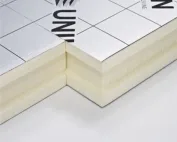
The different lambda values of Utherm Roof BM do not automatically mean contradictions in the data. The datasheet distinguishes between thicknesses, and a different facing distinguishes this product from other PIR boards. Correct identification allows the difference to be explained before any assessment of quality or price. Utherm Roof BM is a PIR board with different facings on both sides. One surface is finished with a bituminised glass fleece. The terms “polyurethane boards” and “polyurethane foam” are broader than the precise designation of the PIR product. When assessing the performance of the building envelope, it is worth checking two different surfaces of Utherm Roof BM: the bituminised and the mineralised one. Before assessing the solution, the orientation of the bituminised and mineralised side of Roof BM must be established.
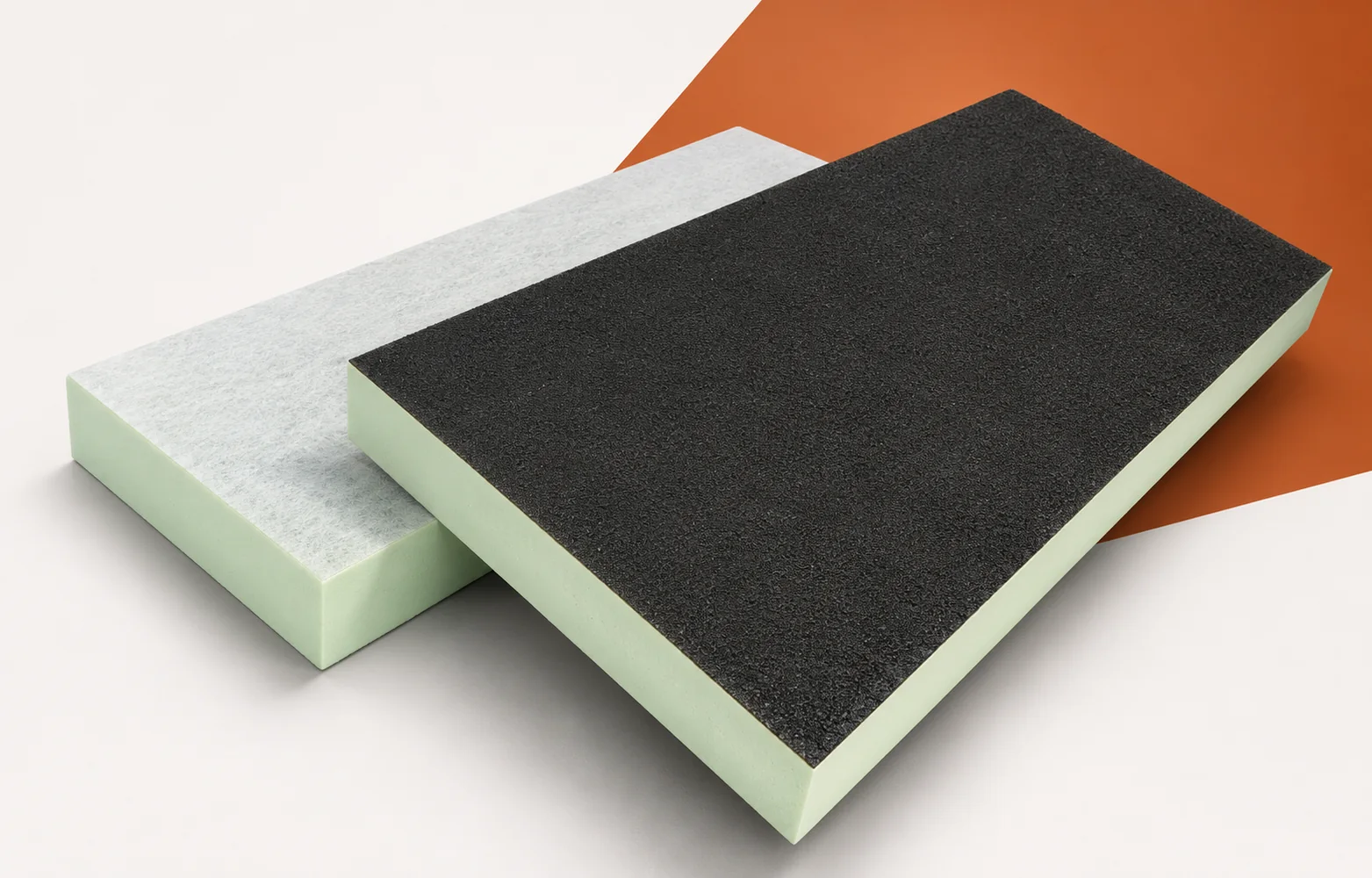
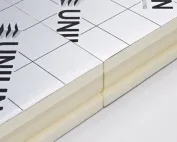
PIR Roof BM boards with two different facings
It is easy to confuse the functions of the components if one overlooks the fact that the vapour-permeable fleece should not be equated with the aluminium laminate. A correct diagnosis should make it possible to assign to each side of the board the correct contact with the adjacent layer. During the inspection, compare the description of the facings and the technology used for the joint with the covering against the information on how it was executed.
Lambda of Roof BM depends on thickness
The lambda value of Roof BM is not uniform across the entire thickness family. The technical data sheet assigns 0.027 W/(m·K) to the 30–70 mm items, 0.026 to 80 and 100 mm, and 0.024 to 120–150 mm. Therefore, when explaining discrepancies, first establish which range the assessed board comes from; the transition from 0.026 for 100 mm to 0.024 W/(m·K) for 120 mm results from the change in thickness, not from an error in the data.
For a correct interpretation, the parameters of each Roof BM thickness variant under consideration must be read separately. A similar notation does not have to mean the same thing, because the quotient d/λ must not use the lambda of a different thickness range of this board. Such a distinction makes it possible to compare thermal variants without transferring the best result to the entire family. Before drawing a conclusion, ask for the declared R_D of 3.80 for 100 mm and 5.00 m²K/W for 120 mm, so that the figures refer to the actual layer.
Polyurethane insulation with straight edges
The 1200 × 600 mm format and straight edges are features of the board itself, which only acquire executional significance in the building component. Before assessing the layout, confirm the orientation of the surfaces and the requirements of the waterproofing system, and then inspect the course of the straight edges of Roof BM in this format in order to separate the properties of the product from the manner of laying.
When planning and assessing the installation, it is worth planning offset joints and Roof BM cut-offs at roof elements. The installation rules must be checked separately, because a straight edge has no factory shiplap that could be matched in the adjacent row. Establishing the cause should allow continuous contact between the boards to be maintained and the layer to be correctly finished at the edges. When assessing the polyurethane insulation, check the joint layout, the support of the edge elements and how the penetrations are formed before accepting the completed joint.
Contact with the covering and the sequence of works
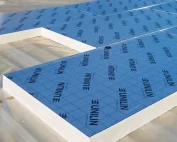
The condition of the contact between the insulation and the covering is identified by adhesion, cleanliness and dryness of the surface, while the fixing is checked separately in the central, edge and corner zones of the roof. In Roof BM, establish the method of connecting the covering to the bituminised surface of the board, because this — alongside the preparation of the substrate — determines whether the identified defect concerns the contact layer or the entire assembly.
Before a repair is specified, the documentation of the first layer of covering above Roof BM must be checked. It should not be concluded from appearance alone, because the presence of bitumen in the facing does not constitute consent for arbitrary work with a burner. The information gathered should allow compatible contact materials and the sequence of works to be selected for the actual roof. Before specifying the repair method, check the type of adhesive or fixing as well as the conditions of surface preparation and the history of previous works.
CS150 and class F within the correct scope
Two Roof BM declarations concern separate properties: the compressive stress CS is at least 150 kPa at 10% deformation, and the reaction to fire class is F. When reading the documentation, do not combine them into a single indicator; relate each property to the correct field of the data sheet.
When reading the scope of the declaration, the result of the Roof BM test must be separated from the requirements for a complete roof covering. A conclusion drawn too far would be unjustified, since the compressive value and the reaction class describe different phenomena and do not prove any arbitrary load-bearing capacity. The explanation should allow the loads and fire protection to be assessed within the appropriate scope. In case of doubt, the product data must be checked together with the support solution, the fixing and the classification of the system, instead of settling for a general assurance of quality.
Insulation with polyurethane: Roof BM selection and pricing
An enquiry for a quotation for Roof BM should include the full product designation, the thickness and the type of waterproofing. “PIR board” alone does not indicate the variant. When assessing an offer or completed works, check whether they relate to the correct bonding side and the correct thickness of Roof BM.
Before assessing quality or price, it is worth linking the Roof BM delivery with the materials needed for a compliant covering. Without this, the result is difficult to compare, since the same name PIR does not mean interchangeable facings or an identical lambda. Identifying the scope should make it possible to compare complete solutions once the required thermal insulation performance has been established. Base any conclusion about cost or quality on data covering the full board designation, a description of the contact layers and the scope of work at the details.
A case worth considering
The difference in thermal result between Roof BM and a board in a laminate does not prove an error in the documentation. The variants may have different facings and lambda values. It is worth comparing the exact thicknesses and the intended use. Even within Roof BM itself, the parameter varies across ranges. Reading the data sheet correctly makes it possible to explain the discrepancy without attributing a single figure to all PIR boards.
7 branches. Materials closer to your project.

- SEROCK — Dzierżenin 34 E
- BŁONIE — ul. Sochaczewska 138A
- RADOM — ul. Grobickiego 8
- ŁÓDŹ — Natolin 8
- OLSZTYN — Barczewo, ul. Prosta 9
- WROCŁAW — ul. Jerzmanowska 10C
- GORZÓW WLKP. — ul. Zielona 33/34