Roof and energy
Is a lightweight photovoltaic roof less durable than a heavy covering?
In brief
The mass of a covering is not a simple measure of its durability. A lightweight steel system can perform its function well if it has been properly selected and installed. A heavy material also requires a suitable structure and details. With a photovoltaic roof, the whole system must be compared, including the active layer, connections, supports and loads. Kilograms per square metre alone do not determine the choice. A lighter covering can reduce the permanent load on the structure compared with a heavier variant. This is a valuable feature, particularly in some renovations. However, it does not mean that assessment of the roof truss can be dispensed with. The condition of the timber, the spacing of the members and the way forces are transmitted still require checking by the person responsible for the design.
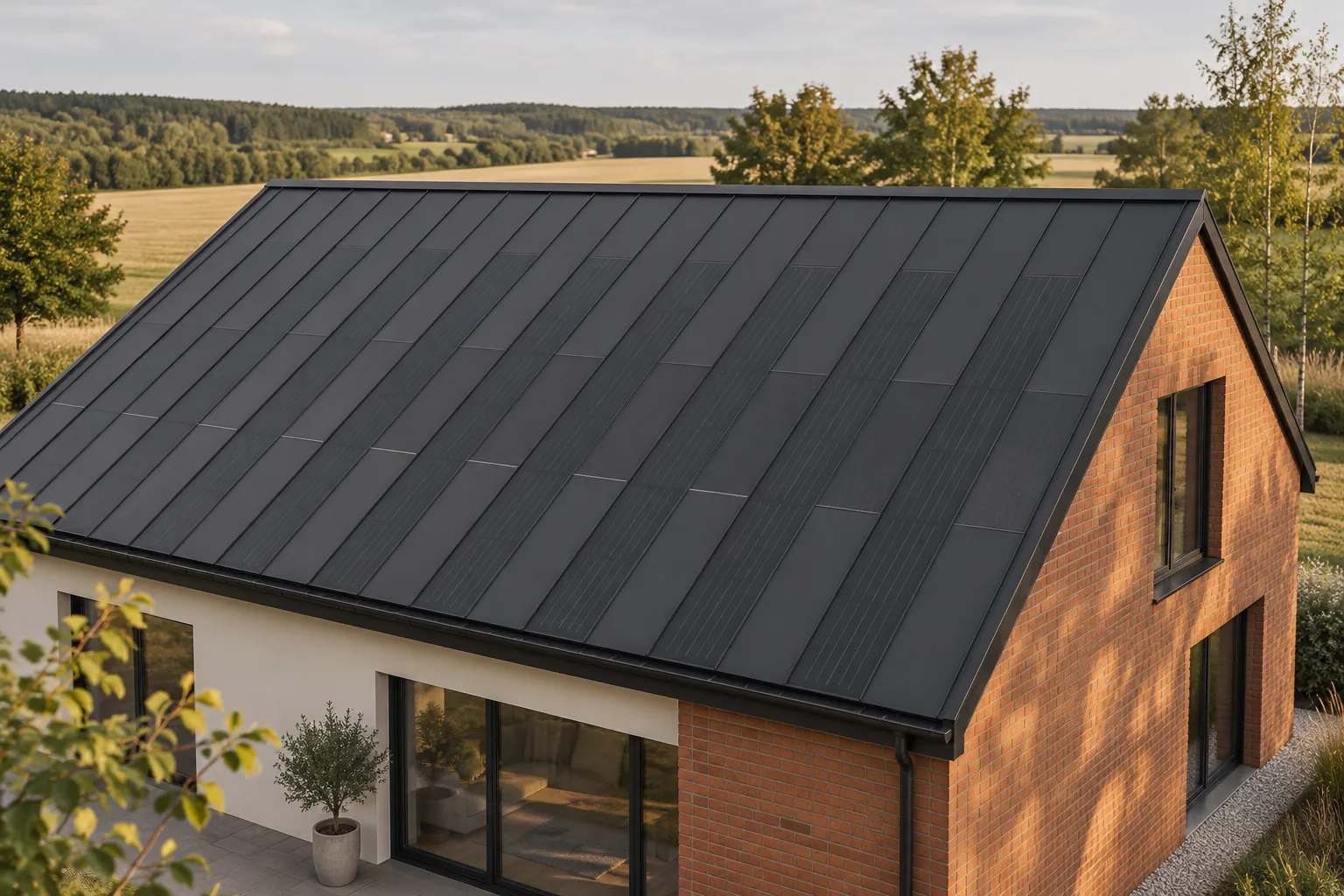
What does low weight really mean?
In an integrated system, the full assembly must be counted, not just the thin steel sheet or the cell layer. The required supports, accessories and other parts add to the weight. When comparing with a covering plus separately added modules, all components must also be included. Only such a comparison is meaningful.
Why is wind resistance a separate question?
Wind does not only press on the roof but can also generate uplift forces. Zones near edges and corners are often sensitive. The fixings, the spacing of supports and the building geometry determine how the covering behaves. A large mass alone does not replace a proper connection design, just as lightness does not automatically mean poor resistance.
Ask for confirmation that the selection takes account of the location and the specific shape of the house. A general statement from a catalogue may relate to a particular type of support. If a different one was used on site, the compatibility of the solution must be checked. It is not worth treating the test result for a single component as permission for any installation.
The design should clearly distinguish between the product test result and the calculation for the building. These are two necessary but separate confirmations.
How should snow and local loads be assessed?
Snow load depends on the location and the roof layout. Drifts near higher sections or obstructions can create local conditions different from those on an open slope. The designer therefore assesses the structure and the fixing of the covering as a system. It is not enough to choose the product with the highest figure in the table without checking how that figure was determined.
Human access, the placing of tools or the later installation of equipment also create local loads. A roof is not a floor, and the active surface should not be treated as a walkway. The permissible support points and the method of access are set out in the instructions. Proper maintenance helps preserve durability regardless of mass.
What ages in an integrated covering?
Different materials work within a roof. The steel coating, the active layer, the seals and the electrical components each have their own conditions of use. Temperature, moisture and the local environment can affect them differently. Therefore a single long durability statement does not automatically describe every component to the same extent.
Check the intended purpose of the coating and the environmental restrictions. A building close to the sea or in surroundings with aggressive pollutants may require a separate assessment. There is no need to rule out a steel solution in advance. However, confirmation of the application and of the maintenance conditions appropriate to the specific location must be obtained.
Can integration reduce the number of components?
If the roofing and the photovoltaics are planned as one system, no additional substructure is needed to raise the modules above a finished roof. This simplifies the external composition and allows the details to be resolved earlier. However, the supporting structure does not disappear, nor does the need to correctly fix every roofing element.
The benefit is the ability to plan active and passive areas and installation routes together. This limits improvisation during the subsequent stages of the works. This advantage should not lead to the conclusion that every integrated roof will be lighter than every traditional assembly. The comparison must relate to two complete designs.
How should you ask the contractor the right question?
Instead of asking only how much the roof weighs, ask for an explanation of how it transfers loads and on what basis it was selected. Ask about the required supports, fixings, the scope of testing and access for repairs. This information will show whether the offer is suited to the house. It also provides a basis for later inspection of the workmanship.
Lightness can be a clear advantage of a steel photovoltaic roof, but it is not the only criterion. A well-chosen system combines suitable construction, weather protection and predictable cell performance. Durability understood in this way results from the solution as a whole. It cannot be read from the weight of a single sample alone.
Examples of companies and brands in roof-integrated photovoltaics are ML System, MDM NT (MyRoof), Terrán, 3S Swiss Solar Solutions, SunRoof, LUMA Solar, SolRoof, Electrotile, GAF Energy and Wienerberger Wevolt.
7 branches. Materials closer to your project.

- SEROCK — Dzierżenin 34 E
- BŁONIE — ul. Sochaczewska 138A
- RADOM — ul. Grobickiego 8
- ŁÓDŹ — Natolin 8
- OLSZTYN — Barczewo, ul. Prosta 9
- WROCŁAW — ul. Jerzmanowska 10C
- GORZÓW WLKP. — ul. Zielona 33/34