Roof and energy
Does an integrated photovoltaic roof replace insulation?
In brief
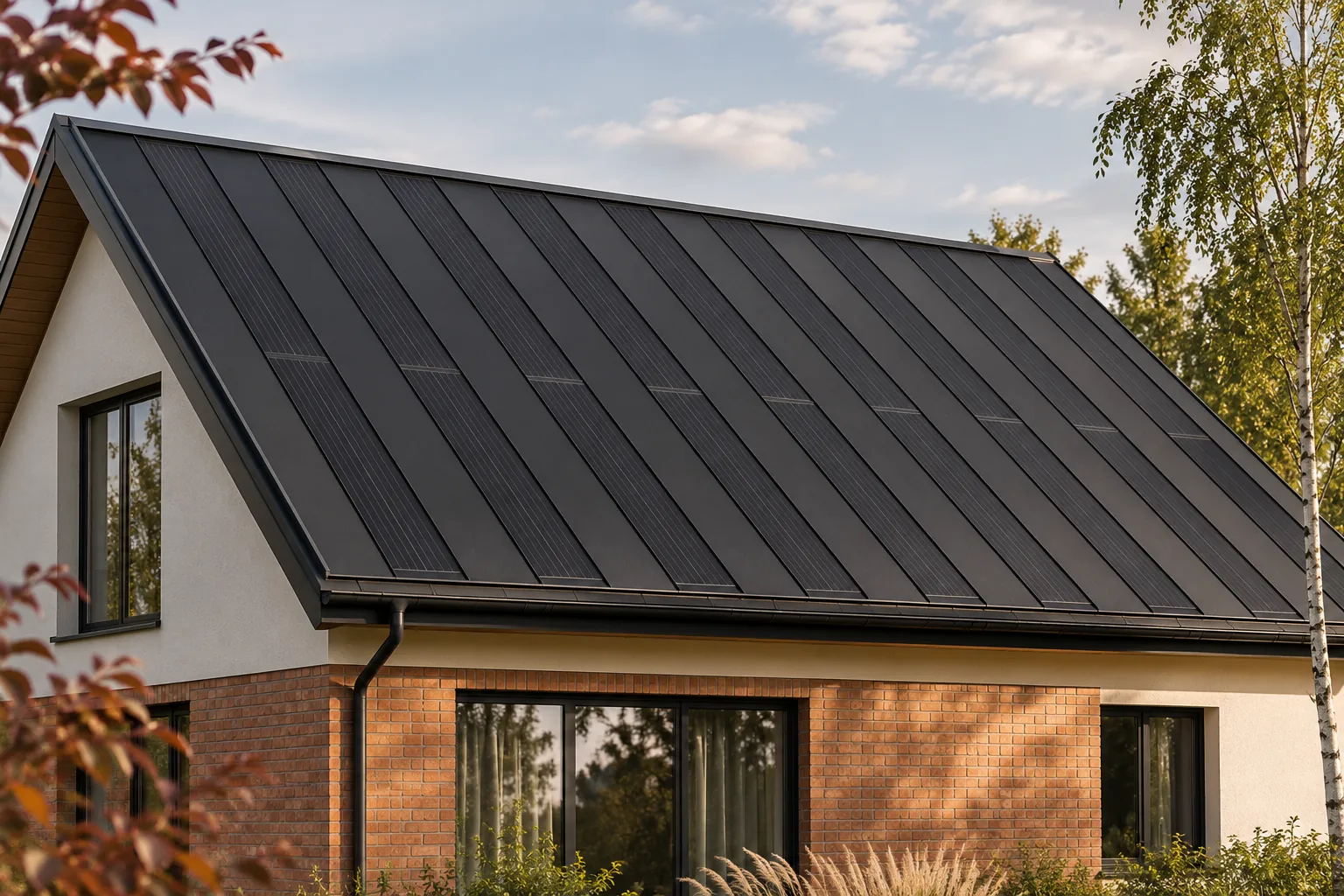
A photovoltaic roof can replace part of the traditional covering while generating energy. This does not mean it takes over the task of thermal insulation. Warmth in winter and comfort in summer depend on the entire building envelope, including insulation, airtightness and protection against moisture. Integrating the cells organises the outer layer of the roof, but does not remove the need to design what lies beneath it. The covering primarily shields the building from the weather. In its active version it additionally produces electricity. Thermal insulation limits heat flow. The other layers can control the movement of water vapour, drain moisture and provide airtightness. A single shared term ‘roof’ does not mean a single material function.
Which layer is responsible for which task?
In a steel integrated system, a second complete covering is not usually laid solely to raise the modules above it. However, the required substrate and the other layers of the building envelope are still installed. Their type is determined by the designer with reference to the specific system, the way the loft is used and the conditions of the building.
A cross-section with a description of each layer helps here. It allows you to check whether the offer covers the complete building envelope or only its outer covering.
Will energy from the cells heat the attic?
Electricity can power a heating appliance, but this is a separate process from retaining heat in the home. A roof that produces a lot of electricity in summer does not have to cover winter heating needs. Production and demand follow different seasonal patterns. The annual energy balance alone does not explain what happens on a frosty evening.
Limiting losses through the roof matters even when the home uses its own photovoltaics. Lower demand makes it easier to size the installation and reduces the need to purchase energy. It is worth first establishing the condition of the building envelope and its requirements, and then selecting the active area. The reverse order can lead to oversizing a costly system.
Why does the attic heat up in summer?
Comfort is affected by solar exposure, roof windows, insulation, airtightness and air exchange in the rooms. The colour and temperature of the covering are only part of this system. A cool loft cannot be promised on the basis that the roof contains cells. Part of the incoming solar energy is still converted into heat.
Protection against overheating must be considered for the whole room. Sometimes correct shading of the glazing or eliminating leaks brings a greater effect than changing the type of covering. If an offer combines photovoltaics with the promise of a specific temperature reduction in the home, ask for the calculations and the conditions for which they were performed.
Is ventilation under the covering enough?
A ventilation gap beneath the covering is not the same as ventilation of the used loft. The first concerns the operating conditions of the roof layers. The second provides air exchange in the rooms. Closing or accidentally connecting these spaces can cause moisture problems instead of improving the occupants’ comfort.
The required airflow beneath the active elements must be maintained in accordance with the design. This space must not be filled with additional insulation simply because it appears unused. On the other hand, arbitrary holes should not be made in the sealing layers. Every air path should have a defined location and purpose.
What should be checked during a renovation?
When replacing an old covering, it is worth assessing the condition of the insulation and timber, signs of dampness and the continuity of the insulation. Covering an existing defect with a new roof does not remove the cause. The period when the building envelope is open is precisely a good moment for planned repairs. Afterwards, access may require dismantling part of the photovoltaic system.
The inspection should lead to a specific design decision. It is not always necessary to replace all layers, but it must not be assumed in advance that they are suitable for retention. In the case of an occupied attic, protection of the interior during the works must also be planned. The cost of these works should be included alongside the purchase of the active covering itself.
Where does integration actually help?
Joint planning of the roof and photovoltaics makes it easier to determine cable penetrations, eaves details and the layout of the active fields. As a result, the installation does not become a late addition for which freshly completed layers have to be disturbed. The benefit is better coordination of works, not a miraculous replacement of insulation by the cells.
Ask for a layer drawing and a description of the contractors’ responsibilities. It should be clear who is responsible for airtightness, insulation, covering and electrical circuits. This makes it easier to choose a solution suited to the house. An attractive roof surface and a sensibly designed roof interior should be created in the same process.
Participants in the photovoltaic roof market include SunRoof, MDM NT (MyRoof), BIPVco, Electrotile, Dyaqua, SolRoof, SoliTek, GAF Energy, Wienerberger Wevolt and ML System.
7 branches. Materials closer to your project.

- SEROCK — Dzierżenin 34 E
- BŁONIE — ul. Sochaczewska 138A
- RADOM — ul. Grobickiego 8
- ŁÓDŹ — Natolin 8
- OLSZTYN — Barczewo, ul. Prosta 9
- WROCŁAW — ul. Jerzmanowska 10C
- GORZÓW WLKP. — ul. Zielona 33/34