Insulation and energy
Which roofing membrane belongs where in the roof build-up?
In brief
The key is to establish whether the chosen membrane is to act as the underlay beneath the covering or as the layer on the room side – these roles are not interchangeable. The owner should check the intended use of the loft, the existing layers, the type of boarding and how moisture is drained away. During renovation, it is worth opening up the roof to determine what is actually beneath the covering, rather than relying on the colour of the old membrane. The designer decides the build-up, while selection rests on the scope of use and the documentation for the specific product.
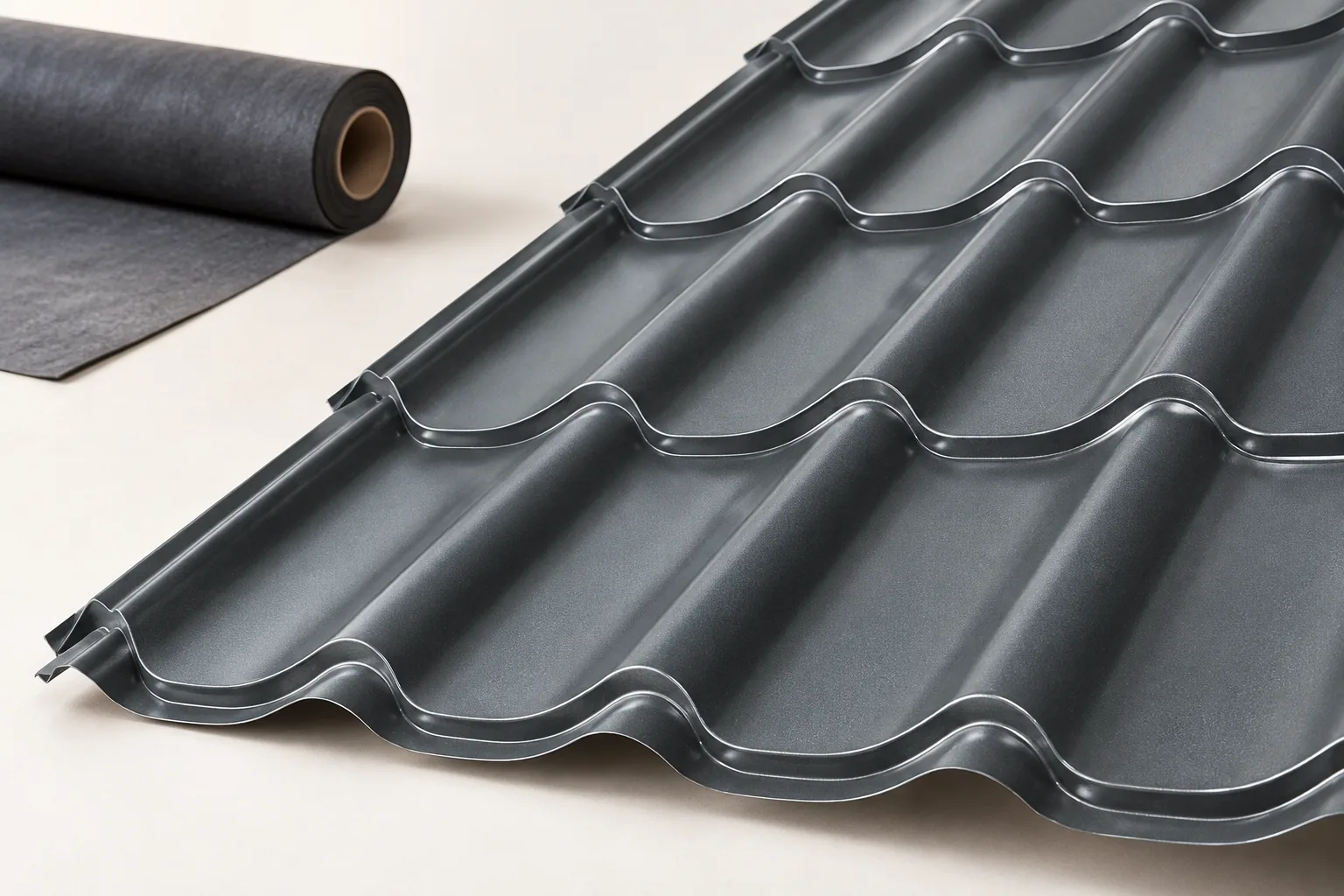
On which side of the insulation should the material be located?
First, it must be determined whether this concerns the underlay layer beneath the metal sheet or the layer on the interior side. The former participates in draining incidental water and protects the insulation from the outside. The latter contributes to airtightness and controls vapour transport. A similar appearance does not mean similar diffusion resistance or interchangeable use.
In the roof of a used attic, both layers work together with the insulation and ventilation. In an unheated building, the assembly may be different. It is not worth selecting a roll on the basis of the term ‘for metal sheet’ alone. Information is needed on the intended use of the attic, the existing layers, full boarding and the method of moisture drainage.
What does the Sd parameter mean?
The Sd value describes the material’s resistance to water vapour diffusion by reference to the equivalent air layer thickness. A lower value means easier vapour flow. However, it is not an assessment of waterproofness or mechanical strength. A membrane with low Sd does not have to be suitable for every substrate, and a high grammage does not indicate how quickly the material allows vapour through.
On the room side, solutions are used that are selected according to the moisture balance. They may have a fixed or variable diffusion resistance. A product with variable properties also requires suitable conditions of use. It is not a universal remedy for poorly laid layers. In an unusual renovation, with unknown old insulation or a sealed outer layer, a design analysis may be necessary.
When can the membrane be laid directly on the insulation?
The possibility of contact with the insulation must arise from the documentation for the specific membrane. Not all older underlays have the same intended use as modern high-permeability membranes. In some assemblies, an additional gap is required. Merely adding thicker mineral wool up to the underside of the membrane can then disrupt the performance of the roof.
Similarly, suitability for full boarding and contact with other materials must be checked. High temperatures under dark coverings and the agents used to protect the timber may be relevant to durability. A product is selected according to its scope of application, not a single highlighted number. The instructions should correspond to the actual roof variant.

Which parameters are worth comparing when purchasing?
For the layer beneath the covering, water resistance, tensile and tear strength at fastenings, temperature range and the permitted exposure time are checked. Preservation of properties after ageing is important. Grammage can help in comparing similar products, but does not replace these data. A heavier roll does not always solve the most important problem of a given roof.
A period of resistance to solar radiation does not necessarily mean the material may be left as a temporary roof in any weather. The conditions for such use and the required seals must be checked. The installation date of the covering must also be taken into account. The membrane should be covered in accordance with the instructions before construction conditions impair its properties.
Why are tapes and penetrations just as important as the membrane?
The layer works across the entire surface only when its connections are also continuous. Laps, junctions with the wall, the chimney and service penetrations require suitable tapes or seals. From the room side, a leaky opening can let moist air through regardless of the membrane’s good Sd value. A stretched and poorly bonded corner remains a weak point.
Accessories must be matched to the type of substrate and the installation conditions. Dust, moisture and excessively low temperatures can impair adhesion. Not every construction tape has confirmed compatibility with a given surface. The cost estimate should therefore include the full set of connections instead of comparing only the price per metre of membrane.
How can mistakes be avoided during renovation?
Before purchase, it is worth opening up the structure and establishing what is actually beneath the covering. The colour of the old membrane does not allow its properties to be reliably identified. If there is no documentation, one should not guess. The condition of the timber and insulation must also be checked. A new airtight layer does not remove water previously trapped in the assembly.
The selection is complete only after the roof’s drying path and the room ventilation method have been checked. It is worth recording the material type name, its parameters and the places of application in the documentation. Photographs of the connections before they are covered will facilitate later work. A well-chosen membrane is part of a considered assembly, not an add-on chosen at the till.
7 branches. Materials closer to your project.

- SEROCK — Dzierżenin 34 E
- BŁONIE — ul. Sochaczewska 138A
- RADOM — ul. Grobickiego 8
- ŁÓDŹ — Natolin 8
- OLSZTYN — Barczewo, ul. Prosta 9
- WROCŁAW — ul. Jerzmanowska 10C
- GORZÓW WLKP. — ul. Zielona 33/34