Façades and aesthetics
Exterior steel window sills: five benefits and installation details
In brief
A steel external window sill drains water from beneath the window and shields part of the façade, but its durability is not determined by the type of sheet alone. At handover, check above all the coating, the support that limits vibration and deflection, the fall away from the window, and the connection to the frame and reveals. Make sure water drains outwards and does not stand at the frame, and that the side ends direct it onto the sill. Remember that a lightweight element does not remove the need for stable support.
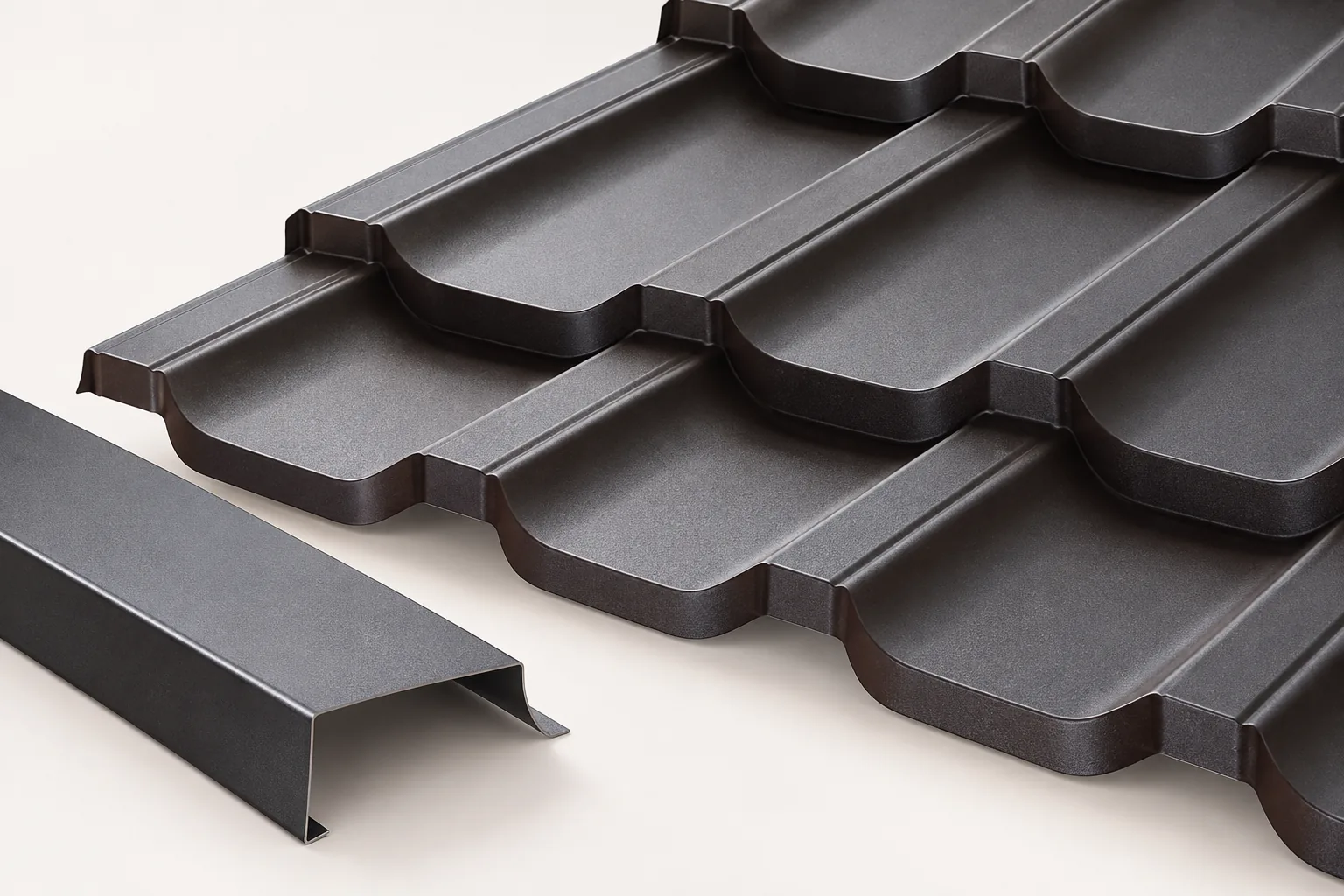
The first advantage is low weight
A thin steel sheet window sill does not load the substrate like a massive stone element. This makes transport and work at the window easier. It can be a convenient choice during modernisation when efficient fitting of components matters. However, low weight does not mean the sill can be left without stable support.
The support should limit vibration and deflection. A wide element projecting beyond the façade requires particular attention. It must not be treated as a step to stand on when cleaning windows. The profiled sheet serves a protective function and does not replace a structure designed to carry a person’s weight.
The second advantage is the ability to adapt dimensions
The sill can be made to a specific window width and façade thickness. This is important in old buildings, where openings do not always have repeatable dimensions. The measurement should take into account the side terminations, the connection point to the frame and the projection beyond the wall face. Measuring the glass width alone is not enough.
The depth is selected after determining the final insulation and plaster layer. A sill that is too short can direct water onto the façade. Too large a projection makes support difficult and increases vibration. It is worth establishing these details before forming the reveals, so that everything does not have to be adapted to a randomly purchased element.
The third advantage is easy colour matching
Coated steel allows sills to be coordinated with the roof covering, gutters and joinery. This means that even a simple façade can look coherent. Sometimes a single restrained shade for all flashings is more advantageous than a separate colour for each element. The choice should be based on actual samples.
A similar colour designation does not guarantee identical gloss and texture. Also check the appearance of the side terminations. In the shade under the window, differences are less visible than in sunlight, but on a longer sill they can be clearly noticeable. Do not make a decision based solely on the colour displayed on a screen.

The fourth advantage is surface protection through coatings
The steel core is protected by coating layers. Their selection affects resistance to external conditions and colour retention. It is worth checking the intended use of the material, especially in locations exposed to salt, pollutants or constant dampness. Not every decorative coating has the same properties.
During installation, the surface must be protected from scratching. Drill swarf is removed immediately, and damage is protected in accordance with the recommendations. Improper cutting can destroy the edge protection. The sill should not be soiled with aggressive mortar residues, whose subsequent washing off will damage the finish.
The fifth advantage is straightforward ongoing maintenance
The smooth surface is easy to inspect and clean without specialist refurbishment. Usually a mild agent suitable for the coating, a soft cloth and rinsing are sufficient. Dried-on dirt should not be scraped off with a sharp tool. Regular cleaning also makes it possible to notice scratches and minor damage.
Check that water drains away and does not stand at the frame. Plant pots can retain moisture and scratch the surface, so their placement requires attention. Leaves accumulating at the side end should also be removed. Care applies to the entire detail, not only the visible central part of the sheet.
Why are the slope and drip edge so important?
The sill is to drain precipitation outwards. It needs a slope away from the window and a distinct termination that detaches water from the underside. If water curls under the bottom and returns to the render, the material is not fulfilling its function. The dimensions of the detail and the projection must be matched to the chosen installation solution.
The connection at the frame must not block the window’s drainage openings. The side ends should direct water onto the sill and allow for the intended movement of the material. A strip of sealant alone on poorly laid sheet metal will not provide lasting protection of the wall against dampness.
What should you check at handover?
Assess evenness, stability and the direction of drainage. Check the side ends and the connection to the frame. Note whether the element is stressed and whether film has been left in a place from which it cannot later be removed. Any scratches are best recorded before the façade work is completed.
A steel sill is practical when it has been matched to the opening and correctly installed. Saving on the support or the side ends can lead to greater costs for repairing the render. So choose a complete detail, not just an attractive sheet colour.
7 branches. Materials closer to your project.

- SEROCK — Dzierżenin 34 E
- BŁONIE — ul. Sochaczewska 138A
- RADOM — ul. Grobickiego 8
- ŁÓDŹ — Natolin 8
- OLSZTYN — Barczewo, ul. Prosta 9
- WROCŁAW — ul. Jerzmanowska 10C
- GORZÓW WLKP. — ul. Zielona 33/34