Renovation and maintenance
Safe snow clearance on sheet metal roofs
In brief
Safe snow removal from a metal roof requires planning the work at height and controlling the load on the structure, not merely judging snow depth from the yard. You should check the snow’s mass and distribution, the condition of the covering, and the loads envisaged for the specific structure, because there is no single safe number of centimetres. The task should be carried out by properly prepared people with suitable equipment, protecting both themselves and the metal coating. In case of doubt, a technical assessment is needed, and design decisions are left to the designer.
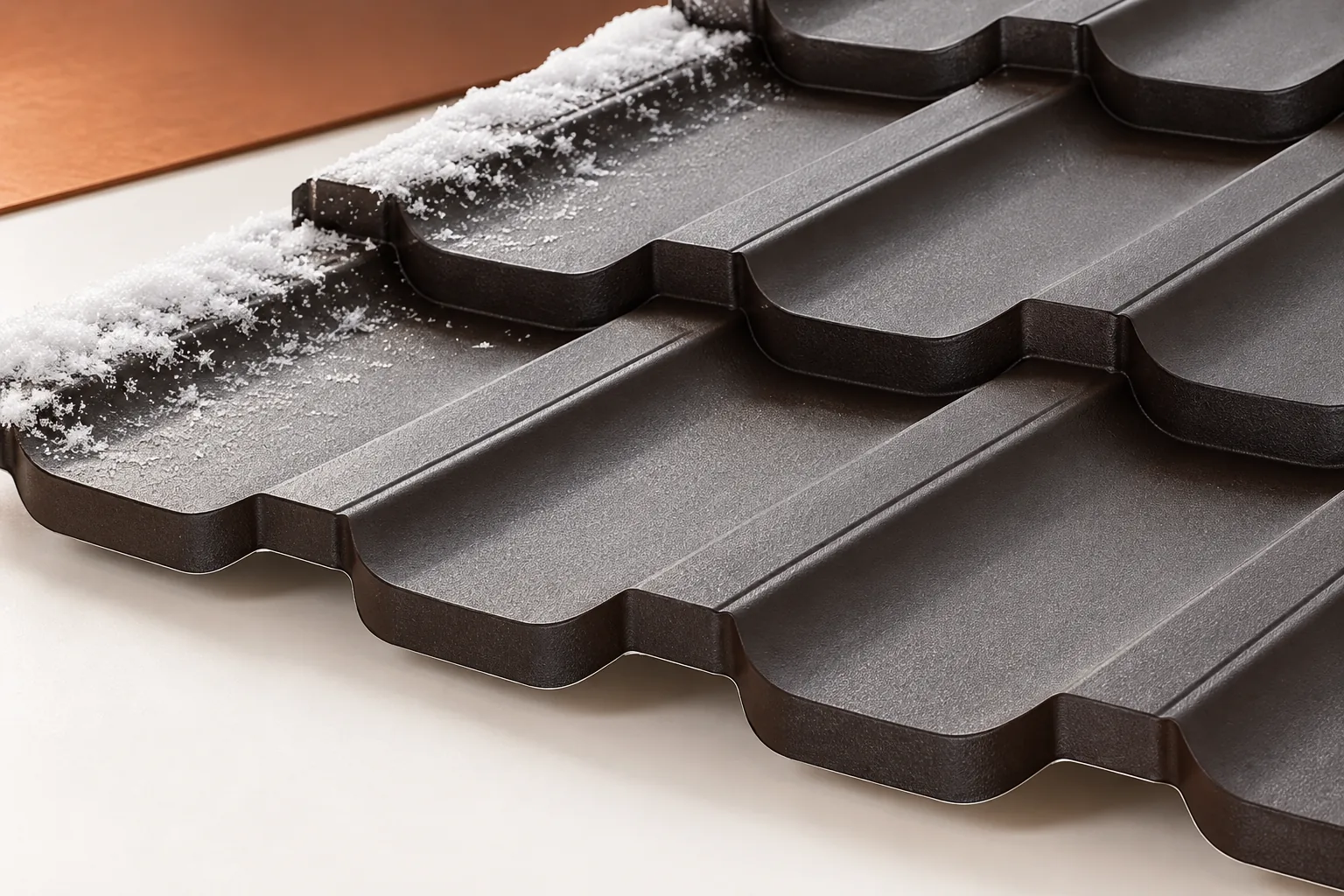
When does snow require intervention?
There is no single safe number of centimetres for every roof. Fresh powder, wet snow and an icy layer have different densities. Wind can create drifts at parapets, higher parts of the building or equipment. The assessment should refer to the loads envisaged for the specific structure.
The owner or manager is responsible for ensuring the safe use of the building. The need to remove snow should also be assessed with regard to the danger to people at the eaves. Overhangs and icicles can be dangerous even when the load on the entire structure has not reached its limit value. In case of doubt, a technical assessment is required.
Why does the order of removal matter?
Abruptly relieving one part and leaving heavy snow on another changes the way the structure works. The plan should take into account its layout and existing drifts. Snow should not be moved into large piles on the roof slope. Such action may locally increase the load instead of reducing it.
For large roofs, an established organisation of the works, work areas and the method of removing the cleared snow are required. Skylights, openings and areas of limited load-bearing capacity must be taken into account. A snow-covered surface may look uniform even though there are elements underneath that must not be stood on.
How to protect people on the roof and below it?
Workers need safe access, fall protection and equipment suited to the conditions. Safety lines must not be attached to a random gutter, snow guard or roof batten. The anchor point must be intended for this function. Frozen sheet metal further increases the risk of slipping.
At ground level, the zone into which snow and ice may fall must be marked out and secured. Entrances, walkways, vehicles and neighbouring structures must be taken into account. Merely warning a passer-by at the last moment is not an organised safety measure. The works should have an established method of communication between the team on the roof and the people on the ground.

How not to damage the sheet metal coating?
Tools and technique are selected according to the type of covering. Sharp metal edges can scratch the coating or damage the overlap. Ice must not be chipped off by striking the sheet or torn off together with the flashing. The aim is to safely reduce the load, not to achieve a perfectly exposed surface at any cost.
Do not use random salts, aggressive agents or hot water. They can damage materials, and the water can freeze again. Particular attention is required for seals, gutters and installation components. The working method should correspond to the recommendations for the covering and the assessment of the person responsible for snow removal.
Do snow guards solve the problem?
Snow guards limit uncontrolled sliding of snow in the designed arrangement. They do not remove its mass from the roof. Their presence is therefore not proof that the load does not need to be monitored. Brackets and fastenings also require inspection after an intense season.
Similarly, photovoltaics can change the distribution of snow and hinder access. Tools must not be rested on the modules, nor their frames treated as handles. The snow removal plan should take the installation and its servicing requirements into account. Damage to a cable or connector creates an additional hazard.
What to prepare before winter and check after the work?
Before the season, it is worth establishing contact with the contractor, the method of access and access to the structural documentation. Check that drainage is clear and the condition of the safeguards. For a large facility, a plan for monitoring conditions is needed. Reacting only when doors cannot be opened or large deflection is visible is definitely too late.
After snow removal, inspect the covering, flashings and fastenings. Document any damage found and the scope of work. If cracking, clear deformations or other signs of structural hazard occur, people must be moved away from the danger zone and help called. Do not go onto the roof to check on your own whether it will still hold.
During thaw, also observe gutters and outlets. Water from melting snow must have a clear drainage path. An ice blockage can direct it to places that are not loaded in the same way during ordinary rain. Removing such a blockage also requires a careful method and safe access.
7 branches. Materials closer to your project.

- SEROCK — Dzierżenin 34 E
- BŁONIE — ul. Sochaczewska 138A
- RADOM — ul. Grobickiego 8
- ŁÓDŹ — Natolin 8
- OLSZTYN — Barczewo, ul. Prosta 9
- WROCŁAW — ul. Jerzmanowska 10C
- GORZÓW WLKP. — ul. Zielona 33/34