Purchase and cost comparison
Choosing stock panel lengths for a pavilion used all year
In brief
With a ready-made batch of panels, the available dimension must be reconciled with the roof’s working conditions. Length affects joints, transport and the method of lifting. Colour and the temperature of the facings also matter. In an all-year pavilion, it is worth assessing these elements together rather than simply choosing the longest available piece. Confirmation of the number of pieces and their dimensions is needed. General information about availability does not show whether the batch suits the roof. Check the module, thickness, profile and edge condition. The listed features must relate to the elements that will be delivered.
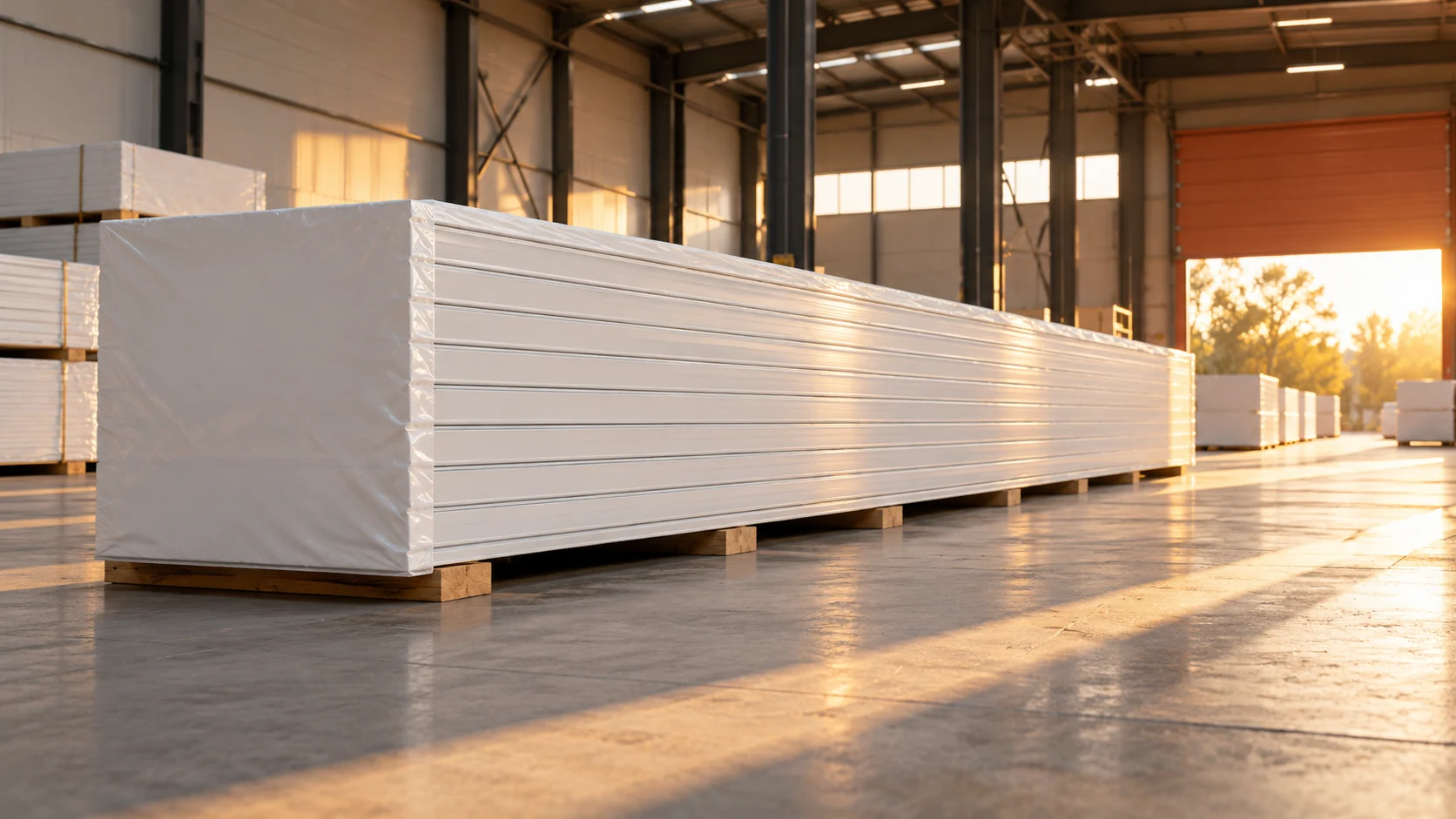
What does available length mean in a specific offer?
Production length and stock length are different pieces of information. For one family of PIR roof panels, a maximum of 16.5 m is given, subject to the conditions for selecting a specific variant. This does not mean that such a panel is present in the current range or suitable for every building.
Do not equate length with span without supports. A long element may require several purlins. Their arrangement results from loads and panel data. Buying material from stock does not provide grounds to change the structure without verification.
How do colour and temperature influence the decision?
The outer steel sheet heats up in the sun and cools as conditions change. A dark surface can reach a higher temperature than a light one. The temperature difference between the facings affects the behaviour of the panel. Permitted lengths and installation must be checked for the correct variant.
Do not copy a solution from a light-coloured warehouse to a dark-coloured pavilion just because the thickness is the same. The arrangement of supports is also important. The conditions in the documentation define the range in which the element may be used.
If the pavilion will be heated, take into account the interior temperature and the continuity of seals. The panel dimensions will not repair a gap in the sealing layer. At connections, a solution must be provided that is consistent with the design and the intended behaviour of the enclosure.
When is it worth cutting longer ready-made elements?
Let us take an example of eight panels with a cover width of 1 m. The roof requires a length of 4.40 m, and the batch under consideration is 4.80 m. The purchase covers 38.40 m², and after simple shortening 35.20 m² will remain. The difference is 3.20 m² of material.
This is only a quantitative model. Before cutting, the side of the interlock, the preparation of the ends and the required notches must be checked. Not every edge can be shortened in the same way. Removing a section of the factory end may require recreating the correct detail.
When comparing prices, add the work for cutting and handling offcuts. Short pieces do not automatically become fully usable stock. They must have a specific, permissible application. If there is no such plan, they remain part of the roof cost.

Will shorter panels be more convenient in a small building?
Smaller dimensions can make transport to a tight site and manual handling easier. However, this does not mean that any arbitrarily short panel will give a cheaper roof. An additional joint requires a solution for the overlap, support and seals. The labour for making it is also added.
On a low-pitch roof, longitudinal joints must be checked with particular care. The conditions of the specific family apply. It must not be assumed that two short elements will replace one long one by simply butting the edges together.
In a pavilion used all year round, airtightness and the joint’s resistance to water are important. Every new joint should have a correct detail. It is worth comparing the convenience of delivery with the cost and the requirements of the additional joint.
How to order material that actually fits?
Prepare a layout of the panels on the supports and confirm the lengths after measuring the structure. Then assign a specific piece from the batch to each field. Mark the ends requiring cutting and the joint locations. This makes it easier to detect a missing element.
Establish the conditions for unloading and lifting. A long panel requires suitable equipment and space for manoeuvring. It should not be lifted at random points. Packaging and delivery sequence should be adapted to the possibilities of a small site.
Before purchase, compare the full cost of a ready batch and of material prepared to size. Include waste, new joints, transport and installation. Confirm availability at the time of ordering. The right length is the one that suits the roof and its operating conditions, not just the free space in the warehouse.
After unloading, check the markings and lengths of the selected pieces. Also inspect the packaging and visible edges. Any discrepancy with the cutting plan should be clarified before cutting, when the condition of the delivery can still be clearly established.
What else is worth asking
Is the maximum length from the product data sheet an off-the-shelf availability offer?
No. It describes what is possible within a given family and under specific conditions. The current number of pieces, thickness, colour and length must be confirmed for a specific order.
Can a light-coloured panel be swapped for a dark one without checking the length?
This should not be assumed. Colour affects how the facing heats up, and the conditions of use may vary. The documentation for the variant and the arrangement of supports and fixings must be checked.
7 branches. Materials closer to your project.

- SEROCK — Dzierżenin 34 E
- BŁONIE — ul. Sochaczewska 138A
- RADOM — ul. Grobickiego 8
- ŁÓDŹ — Natolin 8
- OLSZTYN — Barczewo, ul. Prosta 9
- WROCŁAW — ul. Jerzmanowska 10C
- GORZÓW WLKP. — ul. Zielona 33/34