Insulation materials
PIR or XPS for a flat roof: what determines the choice?
In brief
On a flat roof, the layer build-up is chosen first, and only then the insulation. A material beneath the waterproofing performs differently from a material laid above it. PIR and XPS can have different applications and parameters. Comparing λ alone ignores water, load and usage. These conditions are crucial for the durability of the roof. In a typical traditional build-up, the thermal insulation is located beneath the waterproofing layer. In an inverted roof the order is different: the thermal insulation lies above the waterproofing. It is therefore exposed to different moisture conditions. It requires a material intended and proven for such an application.
How does a traditional roof differ from an inverted roof?
One board should not be transferred between these systems simply because it has a similar thickness. The correct water, thermal and mechanical properties are needed. A flat roof must still drain water. The name does not mean that designed falls, outlets and parapet details can be omitted.
When can PIR be a beneficial solution?
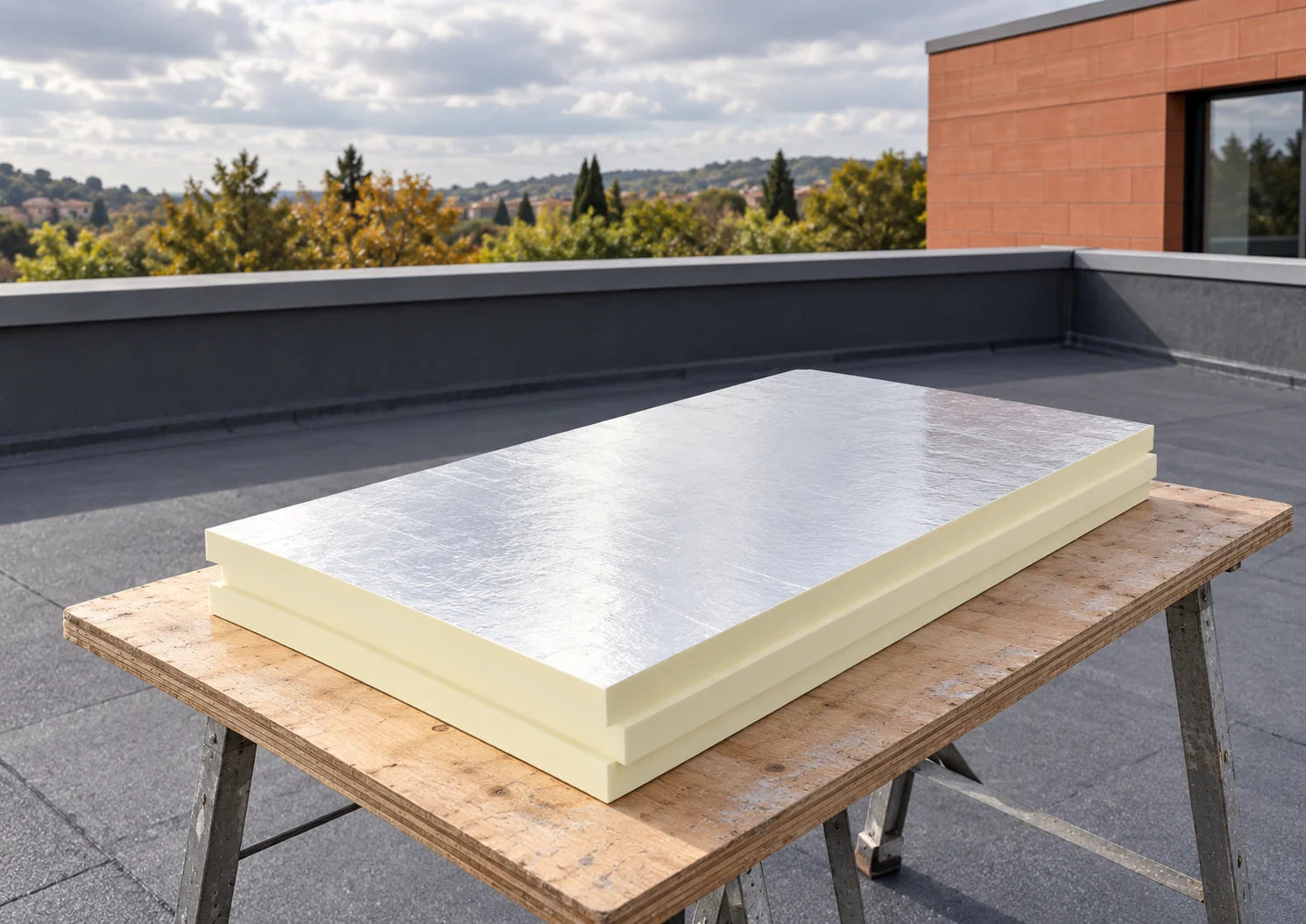
In a properly designed system beneath the waterproofing, PIR can reduce the insulation thickness required. For an example board with λ 0.022, a 120 mm layer has a calculated thermal resistance of approximately 5.45 m²·K/W. This helps where the parapet height or the threshold of a terrace door limits the space for layers.
However, a facing compatible with the covering and the method of fixing must be selected. Not every adhesive or membrane is suitable directly for every board surface. Classifications for the whole roof also matter. Good thermal insulation does not replace checking fire, loads and resistance to wind suction.
Why is a suitable XPS used in inverted roofs?
Extruded polystyrene has a closed-cell structure. Variants intended for inverted roofs are selected with regard to, among other things, contact with water and loads. This does not mean that any XPS with any surface is the right choice. A declaration and the scope of application for the specific product are needed.
The layers above the insulation must provide the required drainage and stability. With ballasting, the load on the structure and the wind action must be calculated. Any layer of gravel cannot be regarded as sufficient. The details follow from the design of the whole roof, its height and its surroundings.
How to compare resistance to load?
The CS(10) parameter describes the stress at a defined deformation in the test. It is not simply the permissible permanent working load. A roof with a terrace, equipment or ballast requires an assessment of the material’s long-term performance. Creep and load distribution are significant.
A unit’s foot can load a small area much more heavily than a uniform layer. Suitable load-distributing elements or independent support are needed. Insulation should not be selected solely by the highest kPa figure on the packaging. The parameter must be related to the actual assembly.

What else needs checking during the renovation?
Assess the existing covering, moisture and load-bearing capacity of the substrate. Moist layers should not be sealed under a new roof without analysis. Check the height of flashings, outlets and service penetrations. Adding insulation changes the geometry of these locations and may require their reconstruction.
In an inverted roof, thermal calculations take into account the conditions specific to that solution. In a traditional roof, proper vapour control on the interior side is important, among other things. Replacing a single λ value in an old cost estimate is not sufficient. Changing the material may require reassessment of the entire cross-section.
How can the cost of both options be compared?
Price the complete set of layers for the same roof function. Add fixings, separation layers, waterproofing, flashings and drainage. If ballast is required, include its transport and weight. A thin variant may limit parapet modification. Another may better suit the intended terrace use.
It is not possible to identify a single winner for all buildings. The roof of a small technical pavilion and a terrace above a heated room place different demands. The choice should follow from the designed assembly and only then from a comparison of full quotations. The price of the insulation alone shows only part of the cost.
What changes with the planned installation of equipment?
If a unit or solar installation is to be placed on the roof, include it before selecting the layers. Weight, wind forces and service access matter. The unit’s support must not accidentally puncture the waterproofing or cause excessive pressure on the thermal insulation. Sometimes a separate structure is needed. The mere fact that the board has high compressive strength does not resolve the connection of the unit to the building.
What else is worth asking about?
Can foil-faced PIR simply be laid over the membrane?
Not without confirmed suitability for the entire assembly. A board intended for use under waterproofing is not automatically a material for an inverted roof.
Can a roof with rigid insulation be used permanently as a terrace?
A terrace function requires the design of the use layers, loads and protection of the waterproofing. The rigidity of the board alone does not provide such confirmation.
7 branches. Materials closer to your project.

- SEROCK — Dzierżenin 34 E
- BŁONIE — ul. Sochaczewska 138A
- RADOM — ul. Grobickiego 8
- ŁÓDŹ — Natolin 8
- OLSZTYN — Barczewo, ul. Prosta 9
- WROCŁAW — ul. Jerzmanowska 10C
- GORZÓW WLKP. — ul. Zielona 33/34