Insulation materials
What thickness of PIR can replace a layer of polystyrene?
In brief
Replacing polystyrene with PIR starts with comparing thermal resistance. There is no single fixed thickness conversion factor for all products. Two λ values and a clear comparison objective are needed. Equal layer resistance does not yet mean that the materials can be freely interchanged in a façade or internal insulation system. PIR comes with different facings and declared properties. λ may also depend on the thickness range. Polystyrene is also not a single variant with a common parameter. Therefore, the statement “half the thickness is always enough” omits the data that determine the result. Specific materials must be compared.
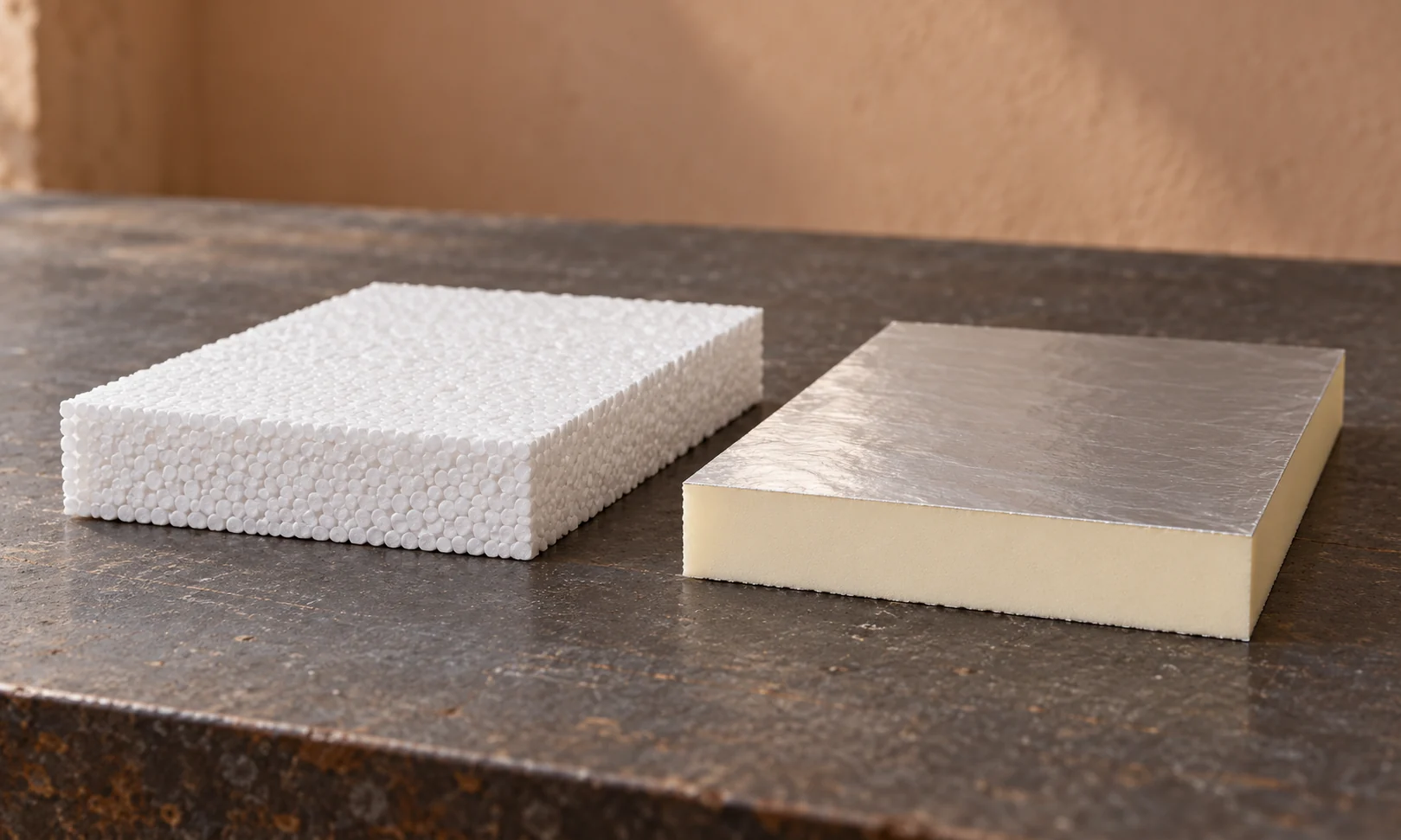
Why does a centimetre of PIR not have one fixed value?
First check the declared λ and the intended application of both products. Do not confuse core values with the parameter of the complete insulated panel with steel facings. Here we are talking about the insulation layer. A board for insulating a wall and a finished building envelope panel are different products.
How do you perform the calculation with specific figures?
Assume 140 mm EPS with λ 0.038 W/(m·K). The calculated thermal resistance is 0.14/0.038, i.e. approximately 3.68 m²·K/W. To achieve the same resistance, multiply it by the λ of the chosen PIR. For a value of 0.022, the required thickness is approximately 81 mm. For 0.025, we get approximately 92 mm.
These are calculation results, not ready-to-order thicknesses. An available variant must be selected and its parameter checked again. If λ changes with thickness, the result cannot be rounded without this check. The required resistance should be achieved by the board actually offered.
What does the comparison of equivalent resistance show?
| Example material | Assumed λ | Calculated thickness for R 3.68 |
|---|---|---|
| EPS | 0.038 | 140 mm |
| PIR in the appropriate variant | 0.022 | approximately 81 mm |
| PIR in another variant | 0.025 | approximately 92 mm |
The table shows only the thermal relationship. It is not a list of substitutes within a render system. In particular, λ 0.025 must be confirmed for the thickness adopted. If a given product only achieves it from 120 mm, it must not be used to calculate its 92 mm version.
In the example with a family of λ 0.026 in the range 80–119 mm, approximately 96 mm is required. The available 100 mm board then has an R of approximately 3.85. Such a check removes the apparent precision of the result and ties the calculation to a real product.
Does identical R give the same wall U-value?
If all other layers and conditions are identical, equal insulation resistance gives a similar baseline thermal result for the flat field. In a real substitution, however, fixings and details may change. The relevant corrections and thermal bridges must be taken into account. The resistance of the insulation alone must not be equated with the U-value of the entire assembly.
A change in thickness also affects window sills, reveals and the connection to the plinth. A thinner variant may make it easier to accommodate the detail, but requires it to be reworked. On a wall with many windows, the practical benefit may differ from that on a large, uninterrupted field. The calculator alone will not show this difference.

What properties need to be compared beyond thermal performance?
Check the reaction to fire, behaviour towards moisture and the permitted method of finishing. The adhesion of the layers and the type of fixing are important. It must not be assumed that adhesive and render used with EPS will suit any PIR facing. The solution should remain a compliant system with confirmed application.
With internal insulation, vapour transport and drying of the masonry are particularly important. A foil-faced board affects these processes differently from a material with lower diffusion resistance. Equal R does not mean equivalent moisture behaviour. This requires a separate assessment, especially in an existing building.
When can thinner insulation pay off?
The benefit may be preserving the width of the passage or limiting changes at the eaves. However, the cost of the finished assembly must be compared. Material, fasteners, sealants and finishing form a combined calculation. Fewer centimetres do not determine either a lower price or easier installation.
In the request for quotation, state the required effect and the complete set of conditions. This will allow two feasible variants to be compared. Do not order a thinner board solely on the basis of a slogan about replacing polystyrene. First confirm the calculations, the intended use of the product and the details that will ensure continuity of insulation.
In the cost estimate, pay attention to the unit of sale. A price per cubic metre requires multiplication by the thickness in metres to obtain the price per square metre. For example, 0.14 m³ of material corresponds to 1 m² of a 140 mm layer. The price of a whole pack, in turn, requires checking its actual coverage. Without this, the comparison may favour the wrong variant.
What else is worth asking about
Does 80 mm PIR always correspond to 140 mm EPS?
No. In the example given, for a PIR λ of 0.022, approximately 81 mm is required by calculation. Other λ values change the result, and the selection must account for real thicknesses and the entire assembly.
Is an R-value comparison sufficient to substitute a material in a project?
It allows one property to be compared. Substitution also requires checking moisture, fire, fixing and finish compatibility. Equal R does not mean full interchangeability.
7 branches. Materials closer to your project.

- SEROCK — Dzierżenin 34 E
- BŁONIE — ul. Sochaczewska 138A
- RADOM — ul. Grobickiego 8
- ŁÓDŹ — Natolin 8
- OLSZTYN — Barczewo, ul. Prosta 9
- WROCŁAW — ul. Jerzmanowska 10C
- GORZÓW WLKP. — ul. Zielona 33/34