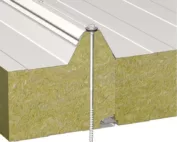
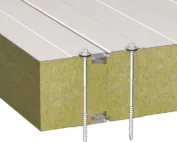
Mineral wool in panels
How to read the U-value and lambda of an insulated panel without confusing the two parameters?
In brief
Lambda describes heat conduction through a material. The U-value relates to the element or building component under consideration. In a sandwich panel, these quantities should not be used interchangeably. Selecting the thickness requires checking the parameter of the finished variant and the joints in the building. Below we show what can really be inferred from a catalogue figure. Lambda, written as λ, expresses a material’s ability to conduct heat. It is given in W/(m·K). A lower value means greater resistance of a layer of the same thickness. However, it does not describe the entire panel with its facings, joint and surface heat transfer conditions.
What does the core lambda tell you?
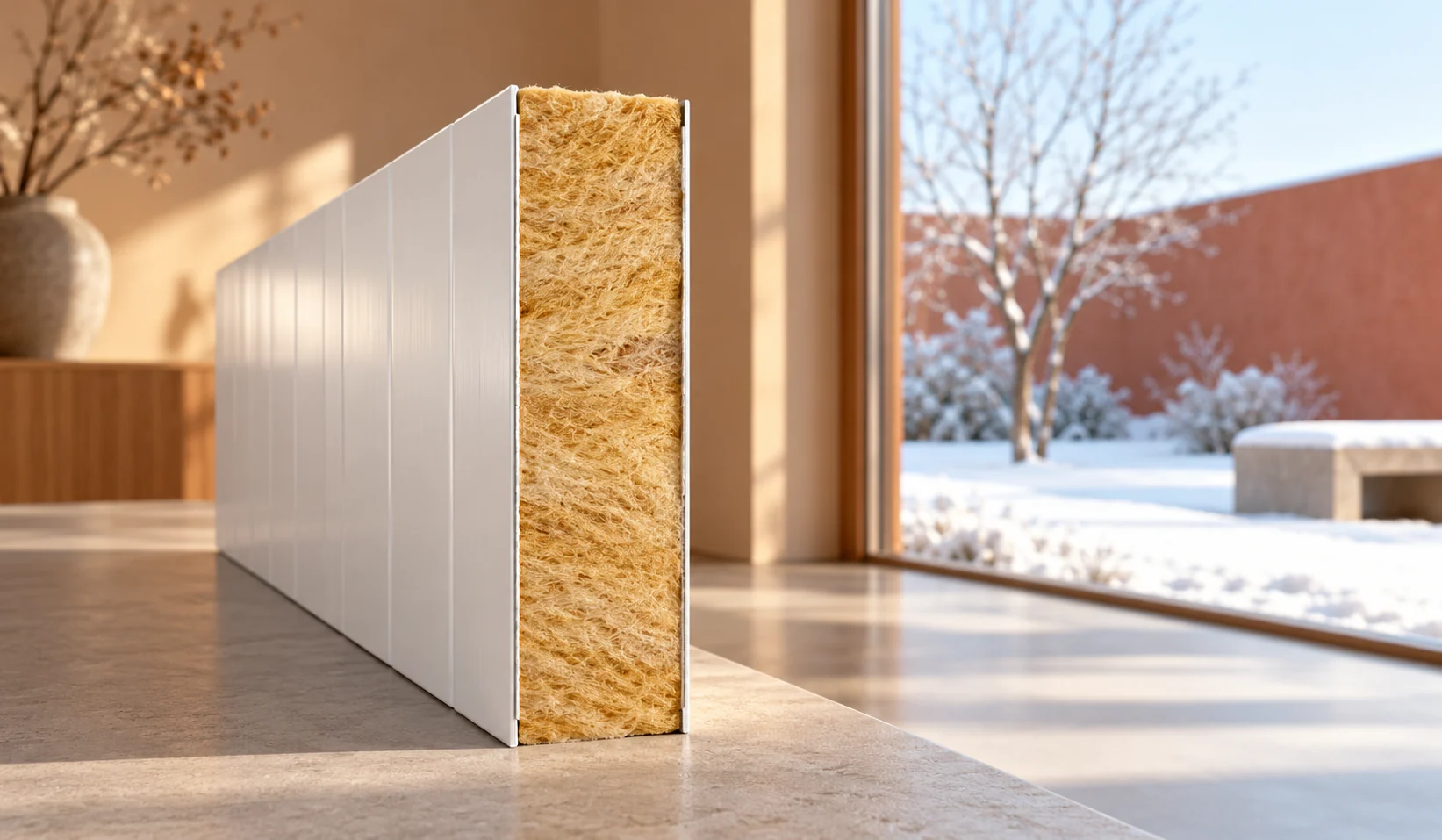
The mineral wool in a sandwich panel has a specific structure and lamella arrangement. You should not substitute the lambda of any soft mineral wool for a loft in the calculation. The parameters must be taken from the documentation of the specific core or the finished panel. Likewise, the material name alone does not allow identical properties to be assumed across every product family.
What is the U-value of a finished panel?
U describes the heat flow relative to area and temperature difference. Its unit is W/(m²·K). In panel documentation you may find designations that take into account a specific calculation method and joint geometry. You must check exactly what the given value refers to before comparing two tables.
An example family of wall panels with mineral wool and concealed fixing has U 0.56 for 80 mm, 0.44 for 100 mm and 0.37 for 120 mm. These data are not values for every panel with mineral wool. A different joint, core or cladding set can lead to different results. The comparison should relate to complete variants.
How to calculate a simple heat flow example?
Assume a homogeneous panel area of 30 m² and a temperature difference of 20 K. At U 0.44 the flow through this area is 0.44 × 30 × 20, i.e. 264 W. At U 0.37 we get 222 W. The difference is 42 W under these specific conditions. This is a calculation of instantaneous flow, not annual energy consumption.
A seasonal calculation requires temperature changes over time and the pattern of use. You cannot multiply one result by the whole year without additional assumptions. The heating bill also includes other losses, system efficiency and the price of energy. A simple example helps to compare variants but does not replace a building balance.
Why is the panel U-value not the U-value of the whole façade?
The wall contains windows, doors, plinths, corners and the junction with the roof. In these places the heat flow may differ from the middle of the panel. Linear and point thermal bridges are added. These must be taken into account in the assessment of the entire envelope. Large doors with poorer parameters can significantly change the result for a small pavilion.
Airflow through gaps acts separately. A catalogue U-value does not describe uncontrolled draughts through a poorly executed joint. That is why sealing the connections matters regardless of thickness. Adding further centimetres to the core will not fix an open gap at the plinth.

Can you calculate the thickness using the formula R=d/λ alone?
The formula allows you to calculate the resistance of a homogeneous layer if you give the thickness d in metres. It is a good tool for an initial comparison of materials. It does not automatically give the full U-value of the panel or wall. You must include the other layers, surface resistances and the effect of inhomogeneity.
For ready-made panels, it is better to use the declared parameters of the specific variant. A manual calculation with a random lambda can produce a seemingly better result. It is also worth keeping an eye on units. 100 mm is 0.10 m. A mistake between millimetres and metres changes the result a thousandfold and will not be fixed by rounding.
It is worth checking the result for physical plausibility. Increasing the thickness of the same homogeneous insulation should increase its resistance. If the calculation sheet shows the opposite relationship, you need to return to the units and the data used, rather than immediately choosing a product.
What data should be provided for the final selection?
Provide the building function, operating temperature, wall dimensions and opening plan. Include the required thermal target and the selected panel layout. The designer should check the basis of requirements for the specific project. A single threshold from a popular table should not be treated as the answer for every room and every mode of use.
In the final specification, retain the thickness, U-value, joint variant and the document identifying the product. If you change the material, compare these data again. Two panels of the same colour and thickness can perform thermally differently. Correct selection is based on the parameters you will actually receive in the delivery.
What else is worth asking about?
Does a lower lambda always mean a lower wall U-value?
With a similar layout it can help, but the result also depends on thickness, connections and the other parts of the building envelope. Comparing one material alone is not enough.
Is a percentage change in U a change in the whole calculation?
No. It relates to the comparable flow through a given field. Heating costs depend on the whole building and how it is used.
7 branches. Materials closer to your project.

- SEROCK — Dzierżenin 34 E
- BŁONIE — ul. Sochaczewska 138A
- RADOM — ul. Grobickiego 8
- ŁÓDŹ — Natolin 8
- OLSZTYN — Barczewo, ul. Prosta 9
- WROCŁAW — ul. Jerzmanowska 10C
- GORZÓW WLKP. — ul. Zielona 33/34