Steel sheet coverings
Where does water under the steel sheet come from and how do you find the right cause?
In brief
A wet patch under the roof does not show exactly where the fault is. Water can travel along the sheet, the membrane or the structure. It can also be the result of vapour condensing. First you need to establish when the moisture appears. Only then can you choose the repair. Sealing all the joints at random often makes it harder to find the problem. Note the time the patch appears and the conditions outside. A leak during wind-driven rain may point to a different place than dripping after calm, prolonged rainfall. Moisture after a frosty night, with no rain, directs attention to condensation. The operation of the heating and the amount of vapour produced inside also matter.
Does the moisture appear only during rainfall?
Begin the inspection from the safely accessible interior. Mark the edge of the dampness and take photographs for comparison. Do not immediately open up the entire lining. If water is approaching the electrical installation, an urgent risk assessment is needed. Do not climb onto a wet or icy roof to look for the gap yourself.
Which four places most often require inspection?
The first group is the fastenings. A screw may be crooked, seated outside the support, or have a damaged seal. Overtightening also causes harm. This is not repaired by further compressing every washer. The second group covers the sheet overlaps. Their direction, geometry and the sealing intended for the given pitch must be checked.
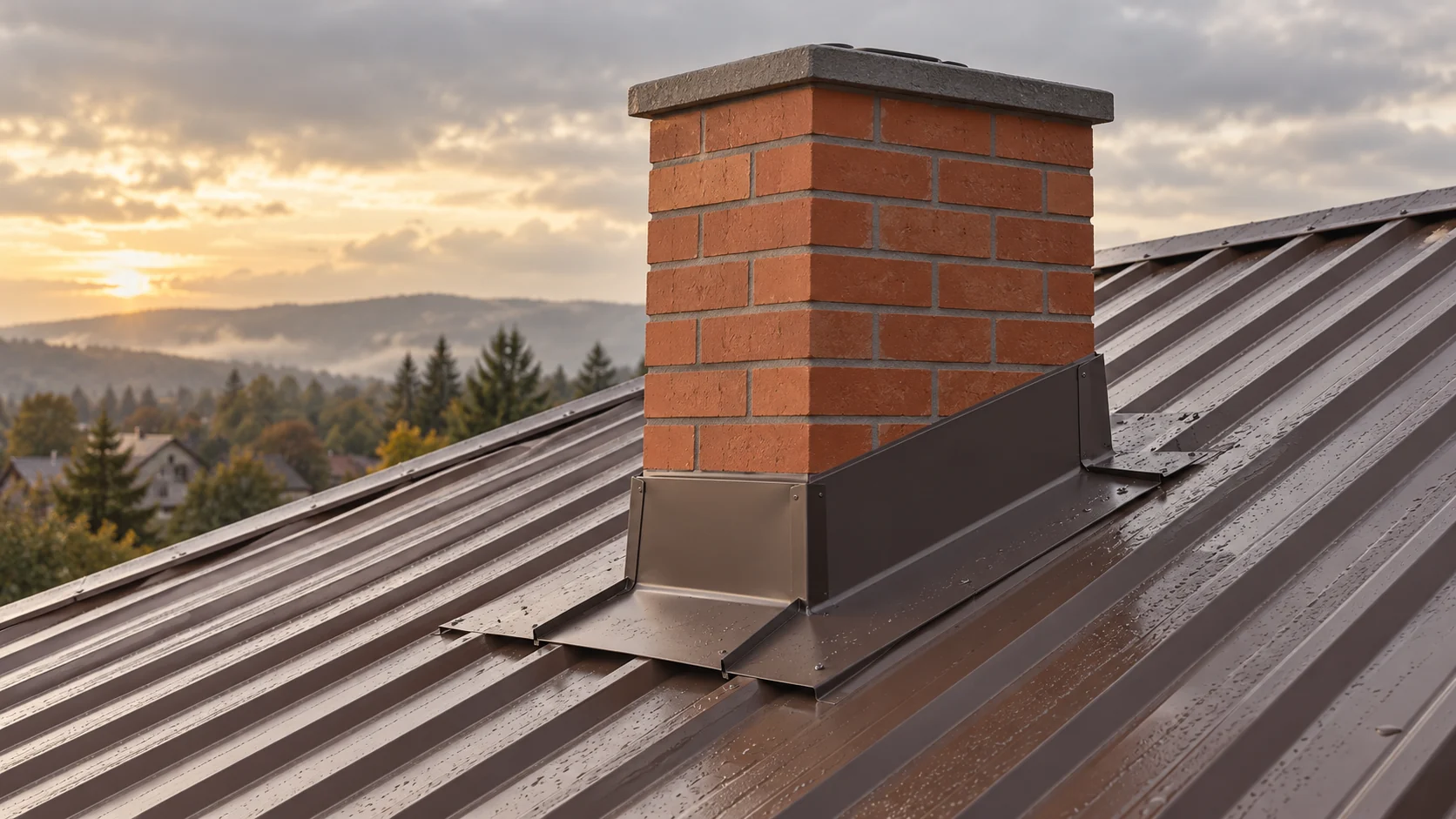
The third group is the edge flashings, roof valleys and penetrations. A fault may direct water under the covering instead of onto its upper surface. The fourth is the area around the chimney. The side facing the ridge is inspected with particular care. Leaves accumulating there obstruct drainage. A new strip of sealant over old dirt does not restore correct drainage.
What are the other four causes?
The fifth cause is sometimes damage to the sheet or coating. A deep scratch can lead to corrosion over time. The sixth concerns drainage: blocked gutters, outlets or roof valleys. Water backed up in a place not intended for it seeks a path through the joints. Blockages must be removed and their cause then assessed.
The seventh problem is incorrect pitch or local deflection of the roof slope. Even a nominally correct fall will not help if a depression has formed. The eighth cause is condensation. Warm moist air can reach the cold steel sheet through gaps in the inner layer. In that case, sealing the covering from above alone does not remove the source of the water.
How do you distinguish a leak from condensation?
A leak often depends on the rain and the wind direction. Condensation may appear over a larger area of the underside. These are indications, not a certain diagnosis. Damp insulation can release water for a long time after rainfall. A single thermal bridge can also produce a local patch.
In a heated back room, it is worth measuring temperature and humidity over several days. At the same time, ventilation and the tightness of the joints in the vapour control layer must be checked. In a difficult case, a thermal and moisture assessment of the building envelope is useful. Not every additional membrane is a correct repair. If incorrectly positioned, it can restrict drying.

Why must the repair take into account how the steel sheet performs?
The covering changes dimensions under the influence of temperature. A rigid bead of sealant in a random location can crack or block drainage. A proper repair restores the function of the joint. Sometimes this means replacing a fastener. At other times, new flashings or redoing the overlap are needed.
Repair materials must be compatible with the coating and adjacent materials. Arbitrary metals should not be combined, nor should compounds of unknown compatibility be used. If the defect concerns the structure or deflection, correcting the sheet metal alone is not enough. In such a case, the repair must be determined with the person assessing the load-bearing capacity of the entire system.
What should be checked after the fault has been removed?
After the repair, observation under conditions similar to those in which the problem occurred is needed. The disappearance of dripping on one day does not mean the insulation has dried out. Check whether the damp materials can dry and whether they have lost the required properties. Damaged built-in components may need to be replaced.
It is worth keeping a description of the cause, photos of the repair and information about the components used. With several similar pavilions, this makes it easier to inspect the remaining roofs. However, they do not need to be repaired identically in advance. The same symptom can have different sources. The best result comes from removing the specific defect and planning subsequent inspections.
What else is worth asking about
Will the felt under the sheet metal stop every leak?
No. Anti-condensation felt is intended to temporarily absorb condensation and then dry out. It does not replace a tight covering or the repair of a faulty joint.
Does every seal need to be tightened further?
No. Excessive pressure can damage the washer and deform the sheet metal. The method of correction is determined after assessing the fastener and the substrate.
7 branches. Materials closer to your project.

- SEROCK — Dzierżenin 34 E
- BŁONIE — ul. Sochaczewska 138A
- RADOM — ul. Grobickiego 8
- ŁÓDŹ — Natolin 8
- OLSZTYN — Barczewo, ul. Prosta 9
- WROCŁAW — ul. Jerzmanowska 10C
- GORZÓW WLKP. — ul. Zielona 33/34