Sheet metal coverings
When does fleece under trapezoidal steel sheet reduce condensation dripping?
In brief
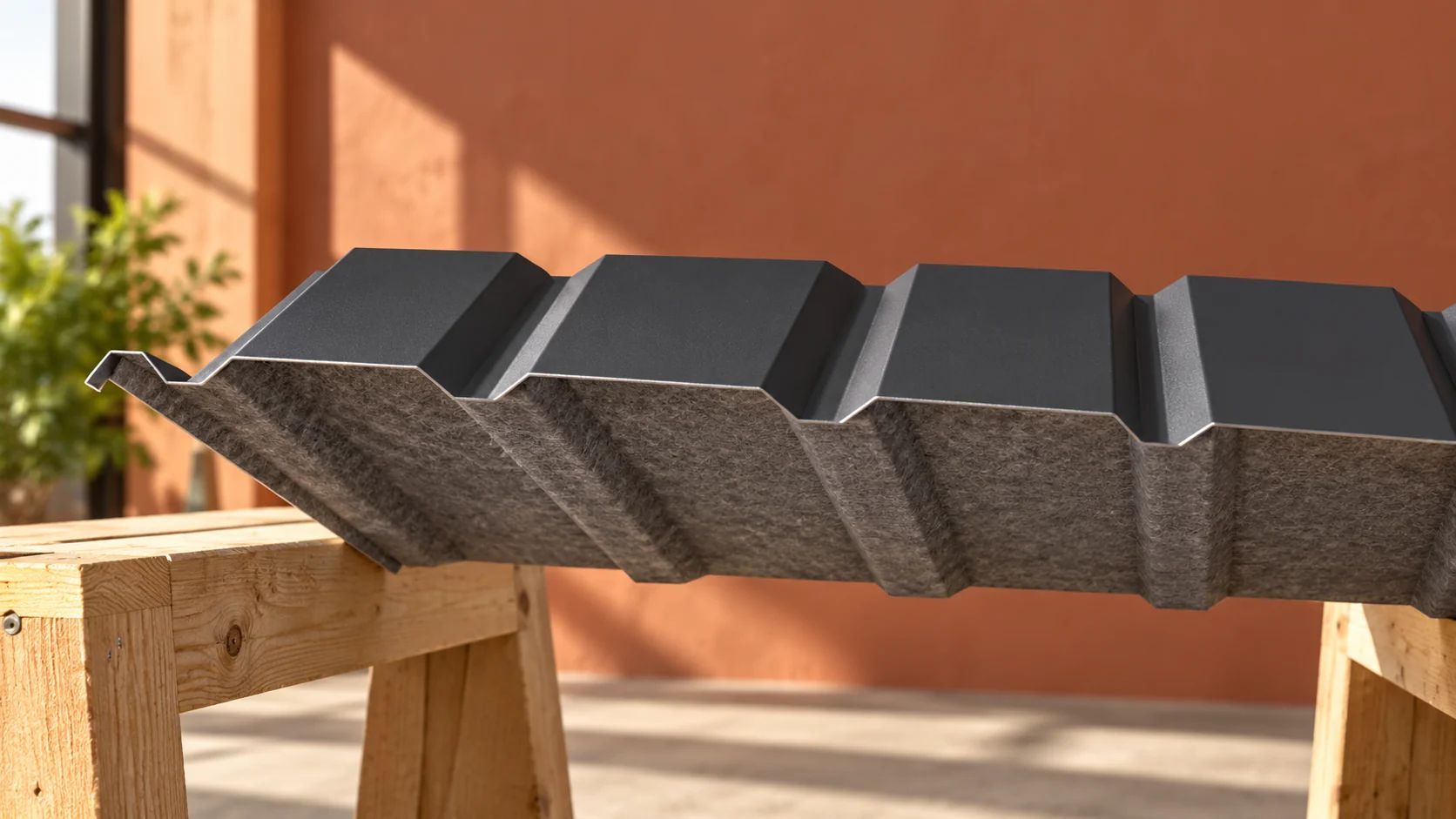
Fleece on the underside of the sheet metal can reduce dripping water from condensation. It acts as a temporary buffer. It absorbs some moisture and then must release it. Without conditions for drying, its capacity comes to an end. Therefore, the suitability of sheet metal with fleece is determined by the entire roof assembly and ventilation, not by the presence of the soft layer under the sheet alone. Moist air can come into contact with a surface colder than the dew point temperature. Then vapour condenses on the underside of the covering. The phenomenon can also occur without precipitation. Not every trace of water under the roof therefore means a hole or a defective lap.
Where does water under tight sheet metal come from?
Begin the assessment with the conditions in which it occurs. Does the water appear after a cold night, during rain, or after putting a wet car inside? Recording temperature and humidity helps identify the mechanism. Repairing a leak and limiting condensation require different measures.
What does the fleece do and where are its limits?
The layer bonded to the underside of the sheet retains a certain amount of condensate in its structure. It reduces its free dripping. However, it does not remove water from the building. The moisture must later evaporate, and the air should take it up and carry it out of the enclosed space.
The absorption capacity is limited and depends on the specific material and conditions. Do not treat the catalogue value as an everyday guarantee. If another portion of moisture appears before the previous one has dried, the buffer may become saturated. Wet felt does not act as an active dehumidifier.
What is the significance of air flow?
Clear air exchange paths are needed in line with the layout of the structure. Enclosing the carport with walls can change the drying conditions. The same applies to blocking openings with shelving or later ceiling build-ups. A solution that was correct at the start may stop working after changes.
In a small storage room, also check the sources of moisture. A wet floor, fresh concrete or stored materials can supply it continuously. Felt will not replace removing such a cause. Ventilation must be assessed for actual use, not only for an empty building.
Why do edges and laps require attention?
The fleece should not create a path for rainwater to be drawn under the covering. Therefore, the zones of laps and terminations are prepared in accordance with the instructions. A factory omission of the coating or its proper protection may be required. There is no single dimension for all sheets.
Check the eaves detail, transverse connections and cut locations. Damaged or soiled fleece may behave differently. Do not use random agents to eliminate its absorbency. The method must suit the fleece, the adhesive and the sheet coating.

Does felt replace thermal insulation or a membrane?
Thin fleece does not provide the effect of properly selected insulation. It does not turn a single sheet into a sandwich panel. In a heated room, a design for the entire roof cross-section is needed, with proper vapour control and protective layers.
The roof membrane also serves another purpose. It can form the underlay layer in the intended system. Do not automatically substitute it for fleece or vice versa. The suitability of the solution is determined by the layers, temperature, humidity and the possibility of water drainage.
If a ceiling is to be created under the sheet, check the solution before enclosing it. Covering the fleece may restrict its contact with the air. It will also be harder to notice dampness and the condition of the connections.
When is it worth paying extra for felt?
The solution can be considered for suitable unheated roofs where the problem is condensate falling onto stored items. The condition is the ability to dry out. Also check compatibility with the supports, the environment and the way the interior is maintained.
Compare the cost of the surcharge with the need to use a different roof system. If the room is to be heated later, it is worth planning the final layers straight away. Buying fleece as an ad-hoc answer to every water problem can lead to double expenditure.
How should the condition of the nonwoven be checked during use?
Observe whether the layer dries out after a period of increased moisture. Check for soiling, detachment and traces near the connections. Recurring wet spots require the cause to be identified. It should not be assumed that adding another layer of material is sufficient.
Carry out cleaning using a method permitted for the given coating. Dust and deposits can change the operating conditions. After a change in the function of the storage facility, reassess the ventilation. The inspection also covers the steel sheet, flashings and fixings, because fleece does not remove their normal maintenance needs.
What else is worth asking about
Can condensation still occur despite the fleece?
Yes. The layer has limited absorption capacity and needs time and conditions to dry out. Excess moisture or insufficient air exchange can exceed its capacity.
Does wet fleece prove the roof is leaking?
It does not determine the cause. It may result from condensation, a leak or contact with water at the edge. You need to check when and where the dampness appears before choosing a repair.
7 branches. Materials closer to your project.

- SEROCK — Dzierżenin 34 E
- BŁONIE — ul. Sochaczewska 138A
- RADOM — ul. Grobickiego 8
- ŁÓDŹ — Natolin 8
- OLSZTYN — Barczewo, ul. Prosta 9
- WROCŁAW — ul. Jerzmanowska 10C
- GORZÓW WLKP. — ul. Zielona 33/34