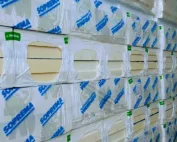
PIR insulation
SOPREMA EFYOS BLUE A: understanding PIR board specifications
At a glance
The answer to the question about the EFYOS BLUE A parameters begins by separating the product data from the behaviour of the entire building envelope. A cooler strip at the parapet does not mean that BLUE A has a poor lambda, because it must first be established whether the layer is continuous and what thickness actually reaches the termination. The thermal imprint also depends on ambient conditions, so the conclusion is based on comparing the image, the documentation and the site inspection. In the thermal insulation of a flat roof under the waterproofing, the reference point is the parapet cross-section with the levels of all layers; only against that background can it be seen whether the solution accommodated the thermal insulation layer and a correct termination of the waterproofing.
First, the question of the cause
Without such a step, it is easy to confuse a property of the board with a defect in the joint.
The actual product and the scope of its data
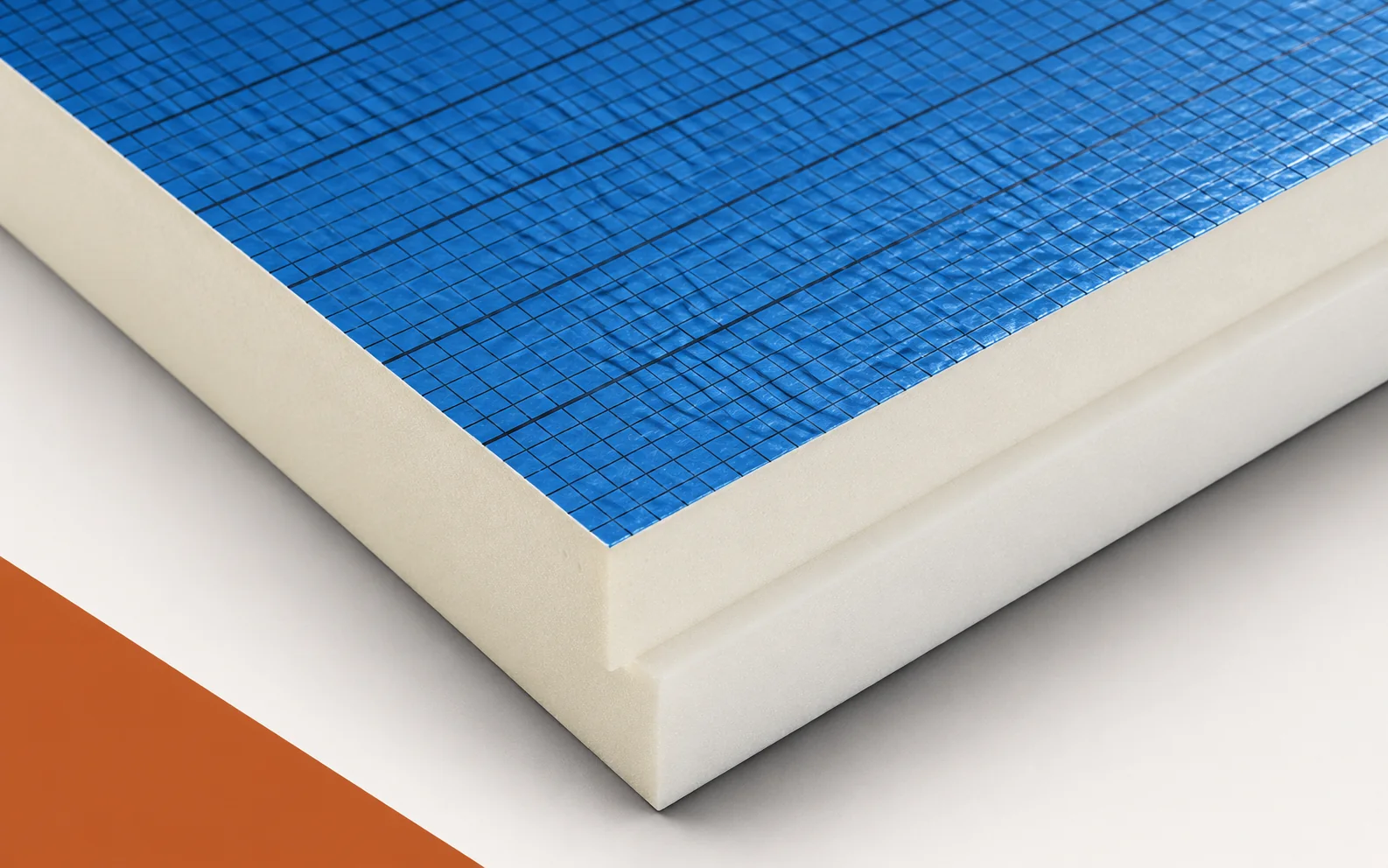
When checking that the order matches the documentation, a distinction must be made between the data for the core itself and the properties of the finished board. In EFYOS BLUE A, the PIR core is faced on both sides with 50 μm thick aluminium, and the declared λD is 0.022 W/(m·K). For 100 mm, RD 4.50 m²K/W is stated, for 120 mm 5.45 m²K/W; the product has class CS(10/Y)120 and fire reaction E. The data sheet permits straight or rebated edges, so the external format does not always correspond to the coverage area. The scope of application is thermal insulation of flat roofs beneath waterproofing, and the term polyurethane boards does not replace the full name EFYOS BLUE A.
How to read a simple example
The difference in thickness of EFYOS BLUE A from 80 to 100 mm changes the simplified resistance of the layer from approximately 3.64 to 4.55 m²K/W at a lambda of 0.022 W/(m·K). This calculation is helpful when the delivery label does not match the measurement of the exposed board. However, it does not by itself explain a cold spot at the parapet: there, the termination of the insulation and the edge profile must also be checked. The declared RD remains a separate item in the documentation.
The numerical example for EFYOS BLUE A shows the relationship between thickness and resistance, but does not explain the cause of a specific symptom. The background is the height limit during processing: a lambda of 0.022 W/(m·K) is a property of the material, not a condition of the joint. Before drawing a conclusion, compare the elevation of the covering with the processing drawing, and treat the thickness and edge variant recorded on the label as reference material. If the data deviate from reality, correct the description of EFYOS BLUE A and the condition of the layers.
Matching the action to the identified problem
Board thickness and the perimeter roof junction solve different problems, so with EFYOS BLUE A the action is assigned to the identified symptom. Assess the termination of the thermal insulation at the parapet separately from the roof field. It is a mistake to occupy the entire available height with the insulation alone. In doubtful cases, the data are assessed by the designer of the roof section, who knows the requirements of the whole; the schedule of thicknesses, edges and covering area can then become the basis for a repair or a new order.
What can be seen at the joint
At the parapet, check whether the joint corresponds to the EFYOS BLUE A variant: plain or rebated. Record the condition of the blue aluminium facing separately from any difference in print or colour — an open gap, loss of facing and permanent deformation are separate categories. Exposure is limited by the waterproofing covering lying above the board, so record whether the termination of the thermal insulation at the parapet was examined directly or inferred from the adjacent field.
How to separate a feature from a defect
EFYOS BLUE A boards require the specified support and a design for the load-distributing layers. At the parapet, these requirements must be accommodated together with the insulation and the flashing within the available height. The designer of the section should compare the levels of all layers with the result of the inspection before proposing a repair of the loaded section.
The conclusion should have limits
Supplement the record from the inspection opening at the parapet with the designation of the thickness and edge of EFYOS BLUE A and the extent of the exposed field. Mark the lack of access to the termination as a limitation of the inspection. The repair order should follow from the covering area and the available heights, so that space remains for correct upstand of the waterproofing.
7 branches. Materials closer to your project.

- SEROCK — Dzierżenin 34 E
- BŁONIE — ul. Sochaczewska 138A
- RADOM — ul. Grobickiego 8
- ŁÓDŹ — Natolin 8
- OLSZTYN — Barczewo, ul. Prosta 9
- WROCŁAW — ul. Jerzmanowska 10C
- GORZÓW WLKP. — ul. Zielona 33/34