Repair and maintenance
Roofing sheet damage: which mistakes can lead to a disputed claim?
In brief
Before you submit a claim for roof sheeting, establish whether the mark arose before installation or after the sheets were laid on the roof. Document scratches, dents and deformations together with their location, because a similar symptom can have different causes. Also check how the sheet was lifted and whether it was dragged across the pack. Examine moisture between sheets and cutting residue separately. Without data on specific reports, the most common faults cannot be reliably ranked, so diagnose your own case.
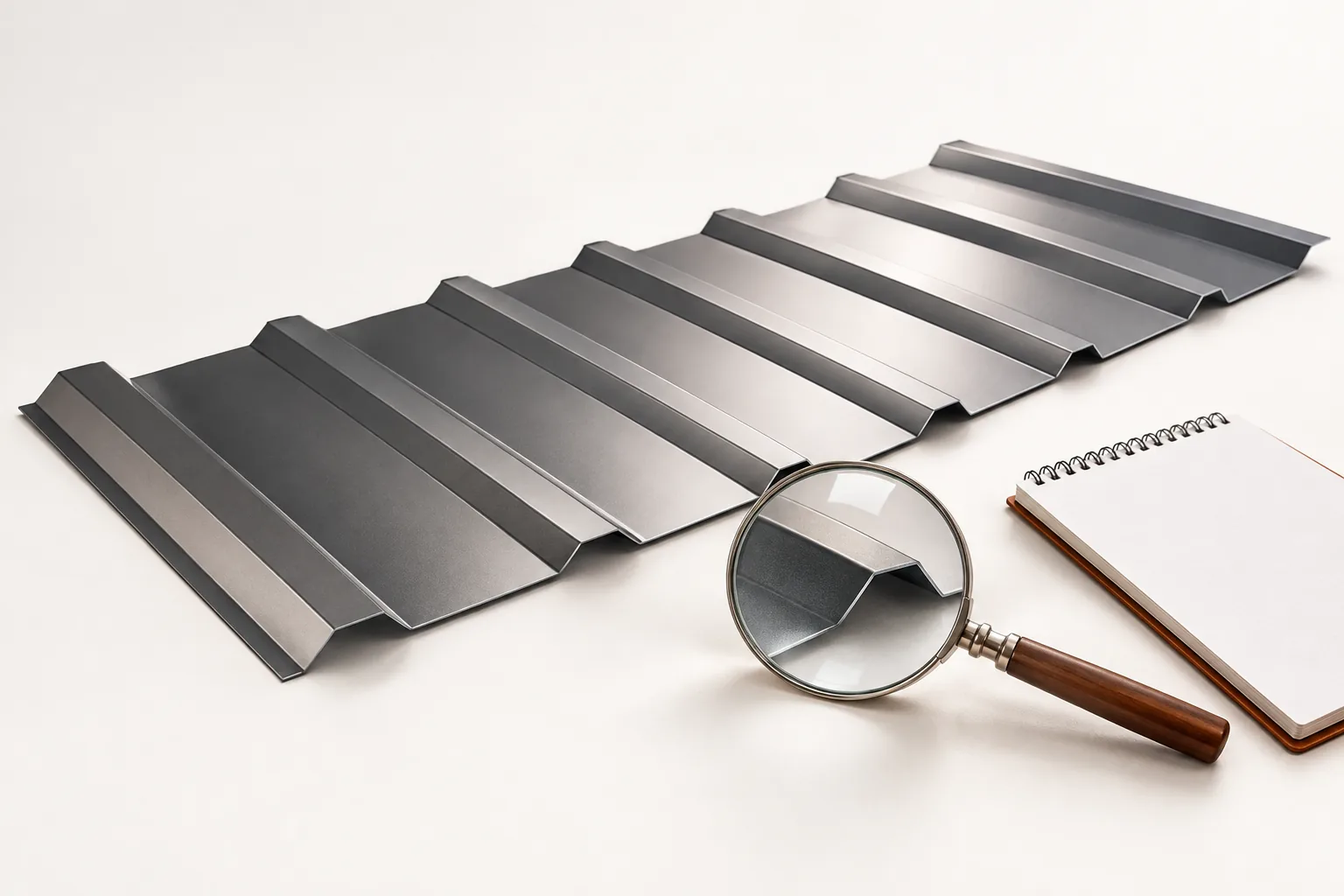
What can damage the sheeting during transport and storage?
A long sheet is easily deformed when lifted without proper support. Dragging it over a pack can scratch the coating, and a point load can damage the profiling. Such marks should be documented before installation. Their position and shape help determine whether they arose during unloading, handling or after the sheets had already been laid on the roof.
Moisture between the sheets is a separate problem. A wet pack left without proper ventilation can develop corrosion of the metallic protection. The transport film does not solve this risk. Storage periods and conditions must be observed. Removing the protective film too late can also leave marks that are not a defect of the coating itself.
Why do cutting and swarf cause so many misunderstandings?
Cutting with a tool that heats the metal can damage the edge and throw hot particles onto the adjacent surface. After time, rusty spots appear, although the roof initially looked correct. Therefore, tools approved in the instructions are used, and particles from cutting and drilling are removed promptly. They should not wait to be washed off by rain.
A rusty trace on the paint may come from a foreign metal filing, not from corrosion of the core beneath it. This requires checking before assessing the entire sheet. The spot should not be sanded manually, nor should an aggressive preparation be applied. Such intervention can enlarge the damage and make later diagnosis of the original cause more difficult.
How do fastening errors lead to leaks and deformation?
An over-tightened screw can crush the washer or deform the sheet. An under-tightened one does not provide proper contact pressure. The type of fastener, the substrate and the fixing position also matter. A hole made outside the intended zone of the profile can be difficult to repair permanently. Replacing the seal alone will not remove the incorrect geometry of the connection.
A leak may also result from an incorrect overlap, slope or flashing. Water visible under the sheet does not automatically prove a coating defect. Its path must be traced and the installation details checked. If the problem occurs only with driving rain, this points to different conditions than constant condensation on the underside of the covering.

What causes waviness and permanent dents?
Deformation can occur during handling, walking in the wrong place or forced fitting of the sheet to an uneven substrate. The support spacing and sheet thickness must correspond to the loads. Load-bearing capacity should not be assessed solely on the basis of the profile name. Two sheets described as T35 may have different parameters and geometry.
A distinction must also be made between permanent damage and an aesthetic phenomenon dependent on light and thermal movement. Assessment requires knowledge of the product type, the permissible tolerances and the method of installation. A photograph from a single sharp angle is not always sufficient. In the event of a dispute, an inspection from agreed locations and a measurement are useful, rather than comparing random photographs.
How does usage affect the condition of the roofing?
Chimney soot deposits, leaves and contamination can keep moisture on the surface. An aggressive internal environment can be a hazard for the underside of the sheet. The material must therefore be selected for the application and maintained in accordance with the requirements. The absence of visible damage from the street does not mean that the valley flashing or the area behind the chimney remains clean and dry.
Problems can also arise after additional installations have been fitted. New openings, incompatible metals, tools left on the roof and a blocked outlet change the operating conditions. It is worth documenting such work and the condition of the covering before it is carried out. This makes it possible to establish whether later damage is connected with the original roof or with subsequent intervention.
How do you find the cause without blaming prematurely?
The material designation, delivery and installation dates, photographs and a description of the conditions in which the problem appeared should be collected. Before repair, it is worth allowing the parties concerned to carry out an inspection. A product defect must be distinguished from a workmanship error, and sometimes both factors should be considered. The mere occurrence of corrosion or a leak does not determine liability.
A reliable diagnosis identifies the damage mechanism and the scope of the repair required. This may be cleaning off swarf, correcting a detail, replacing a component or a more extensive rebuild. There is no basis for stating a ranking of the “most frequent complaints” without reliable data. For the owner, it is more important to establish the cause of their own problem and eliminate it so that the fault does not recur.
7 branches. Materials closer to your project.

- SEROCK — Dzierżenin 34 E
- BŁONIE — ul. Sochaczewska 138A
- RADOM — ul. Grobickiego 8
- ŁÓDŹ — Natolin 8
- OLSZTYN — Barczewo, ul. Prosta 9
- WROCŁAW — ul. Jerzmanowska 10C
- GORZÓW WLKP. — ul. Zielona 33/34