Renovation and maintenance
Replacement coverings for an asbestos-cement roof
In brief
Replacing an asbestos roof really means two jobs: getting rid of the asbestos safely, then picking a covering that suits the roof’s condition. Lightweight metal tile or trapezoidal sheet can be a sensible choice, and in a heated building it is worth considering better insulation too. Base the decision on an inspection of the structure, the pitch and how the roof is used. Breaking, cutting or drilling old sheets releases harmful fibres, so have the removal done by a contractor equipped for this work and for handling the waste. Don’t leave broken sheets lying loose on the plot. Beforehand, check the formal requirements and any help your municipality offers.
Why not start with do-it-yourself demolition?
Old asbestos-cement sheets can release dangerous fibres when broken, cut or drilled. Their removal is not simply taking off the covering. It should be entrusted to a contractor prepared for such work and for the proper handling of waste. Do not stack broken sheets loose on the plot.
Before choosing a date, check the formal requirements and the possibility of support in the municipality. The conditions of programmes vary and may cover only part of the costs. Do not assume that the funding will cover a new roof. Determine separately the scope of dismantling, transport, disposal and installation of the new covering.
What to check under the old sheets?
Before ordering the sheet metal, the roof truss or steel load-bearing elements must be assessed. Look for signs of damp, corrosion, deformation and damaged connections. Sometimes the condition of the structure can only be fully assessed after part of the covering has been removed. It is worth allowing time for such a check in the schedule.
Old battens do not have to match the new profile. The required spacings and bearing points may differ. The lengths of the roof slopes must also be measured again. Ordering the covering solely on the basis of the dimensions of the old sheets is often a cause of mistakes at the eaves and ridge.
When is trapezoidal steel sheet suitable?
T18 or T35 can be considered for appropriately designed roofs of utility buildings, garages and houses. The profile is selected according to the support spacing and loads. A higher trapezoidal profile may be advantageous structurally, but calculations must not be replaced by the simple rule of choosing the highest available rib.
Trapezoidal steel sheet has a simple geometry and can be ordered in long lengths. This makes it suitable for large, uncomplicated roof slopes. The minimum pitch of the selected product, the overlap conditions and the type of coating must be checked. In a livestock building, the resistance of the inner side will also be important.
When is tile-effect metal roofing the better choice?
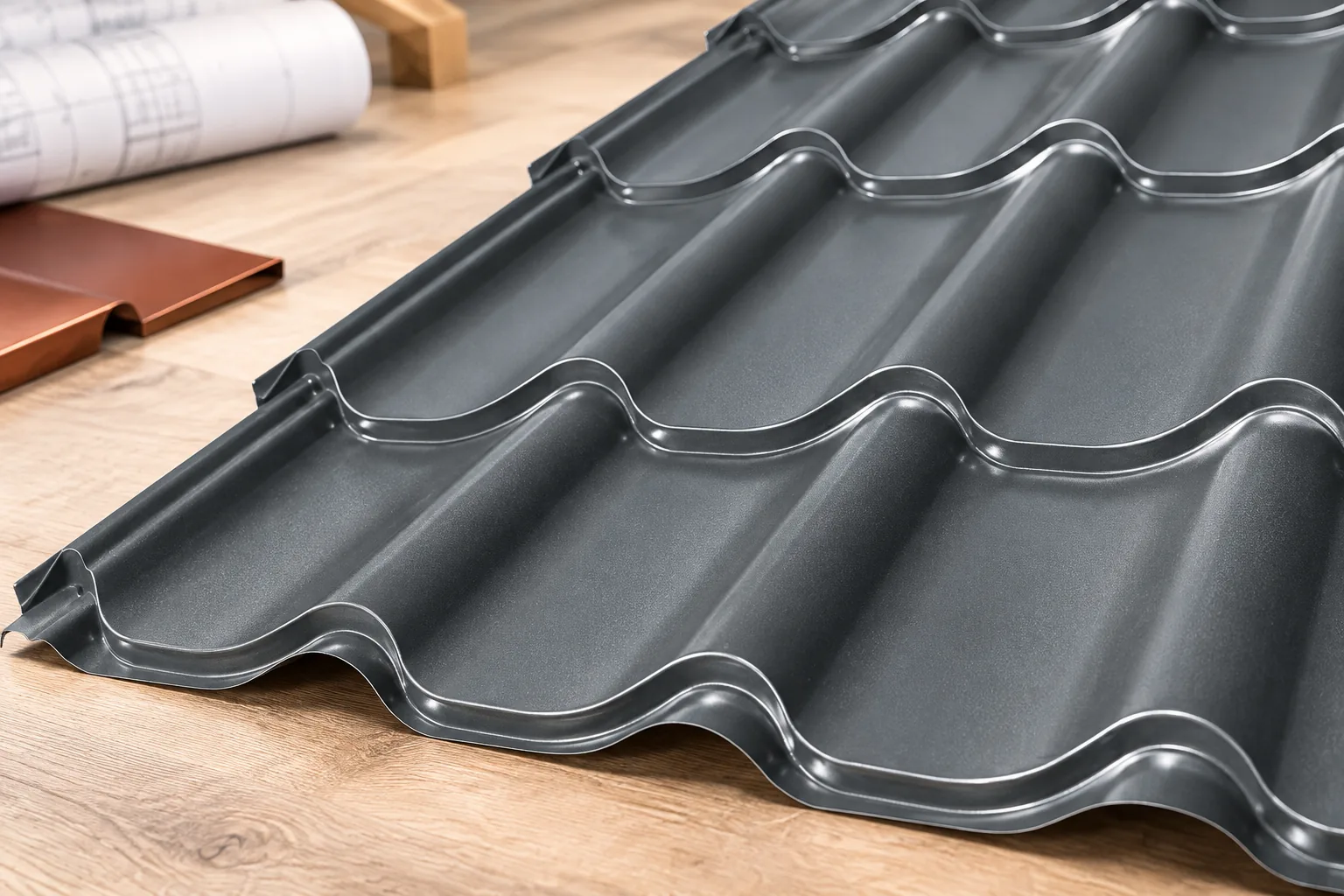
On a residential house, tile-effect metal roofing allows a more traditional rhythm of covering. Sheets cut to size are worth considering for simple roof slopes. Modules can facilitate work where there are numerous dormers and difficult access. In both variants, the correct substructure and details must be prepared.
The low weight of the covering is an advantage during modernisation, but it is not proof of good condition of the roof structure. Damaged elements should not be covered over simply because the new sheet metal weighs less. Repairing the structure before installation is usually easier than dismantling a freshly completed roof.

Is it worth improving the insulation straight away?
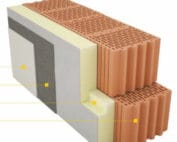
Removing the covering gives access to layers whose later improvement would be troublesome. This is a good moment to assess the membrane, ventilation and tightness of the connections. If the attic is to be heated, it is worth designing insulation for the entire building envelope. Boards or matting added locally alone will not solve the problem of thermal bridges.
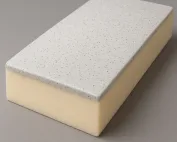
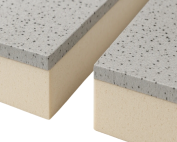
PIR boards can help where good thermal insulation is needed with limited thickness. However, they require a correct layer arrangement and fixing. In a hall, a roof sandwich panel can also be considered. It is not a one-to-one replacement for old boards, so its support and connections must be selected anew.
How to organise the replacement without unnecessary downtime?
Establish the sequence of works between the asbestos removal team and the contractor for the new roof. The material and rain protection should be ready for the agreed date. It is not worth removing the entire covering without a contingency plan. The extent of roof slope opened at one time depends on the organisation of works and weather conditions.
In the cost estimate, include scaffolding, lifting of elements, temporary covering and disposal of other waste. Separate these items from the cost of asbestos. This will allow offers to be compared and verify whether contractors understand the scope of the order in the same way.
Which documents should be kept after the work is completed?
Keep confirmation of proper waste transfer, the contractor’s documents and the settlement of works. For the new roof, collect the covering specification, instructions, labels and warranty. At acceptance, it is worth taking photos of details before they are completely covered. This is helpful for later inspections and any repairs.
The final decision should result from an assessment of the building, not merely from the similarity of the new material to the old. Replacing asbestos cement can improve the appearance and comfort of the property. The condition is safe demolition, a prepared substrate and a conscious selection of the entire roof system.
7 branches. Materials closer to your project.

- SEROCK — Dzierżenin 34 E
- BŁONIE — ul. Sochaczewska 138A
- RADOM — ul. Grobickiego 8
- ŁÓDŹ — Natolin 8
- OLSZTYN — Barczewo, ul. Prosta 9
- WROCŁAW — ul. Jerzmanowska 10C
- GORZÓW WLKP. — ul. Zielona 33/34