Costs and formalities
Planning the time needed to build a house and complete its roof
In brief
In Poland, the time needed to build a house depends on the design, technology, availability of crews and the sequence of deliveries, so there is no single timescale for every home. Before comparing schedules, establish what completion means: shell without roof, weathertight shell and a house ready for use are different scopes. Check whether the stated time includes formalities, utility connections, earthworks and finishing. Rather than generic declarations, ask about specific starting conditions and confirmed material delivery dates.
Why can a deadline from an advertisement be misleading?
A short statement about construction time usually refers to a specific stage and ready starting conditions. It may not cover formalities, utility connections, earthworks or finishing. Before comparing schedules, it is necessary to establish what completion means. Shell with open openings, weathertight shell and a house ready for occupancy are different scopes.
The size and complexity of the building also matter. A simple volume with a gable roof requires different work from a house with numerous offsets and terraces. It is not worth transferring a schedule from a neighbour’s project without comparing the designs. Access to the plot can also affect deliveries, storage and equipment use.
How should the sequence of the main stages be arranged?
First, the documentation, site and foundation works must be prepared. Then the building structure, floors and roof are erected. Subsequent works include closing the openings, installations and finishing. Some activities can be carried out in parallel, but only if they do not hinder each other and do not expose completed elements to damage.
Not all breaks can be shortened by more workers. Materials and completed layers must reach a condition that allows further work. Covering damp elements can transfer the problem into the interior of the assembly. The schedule should therefore define the conditions for starting a stage, not only the date entered in the calendar.
When should the roof covering be ordered?
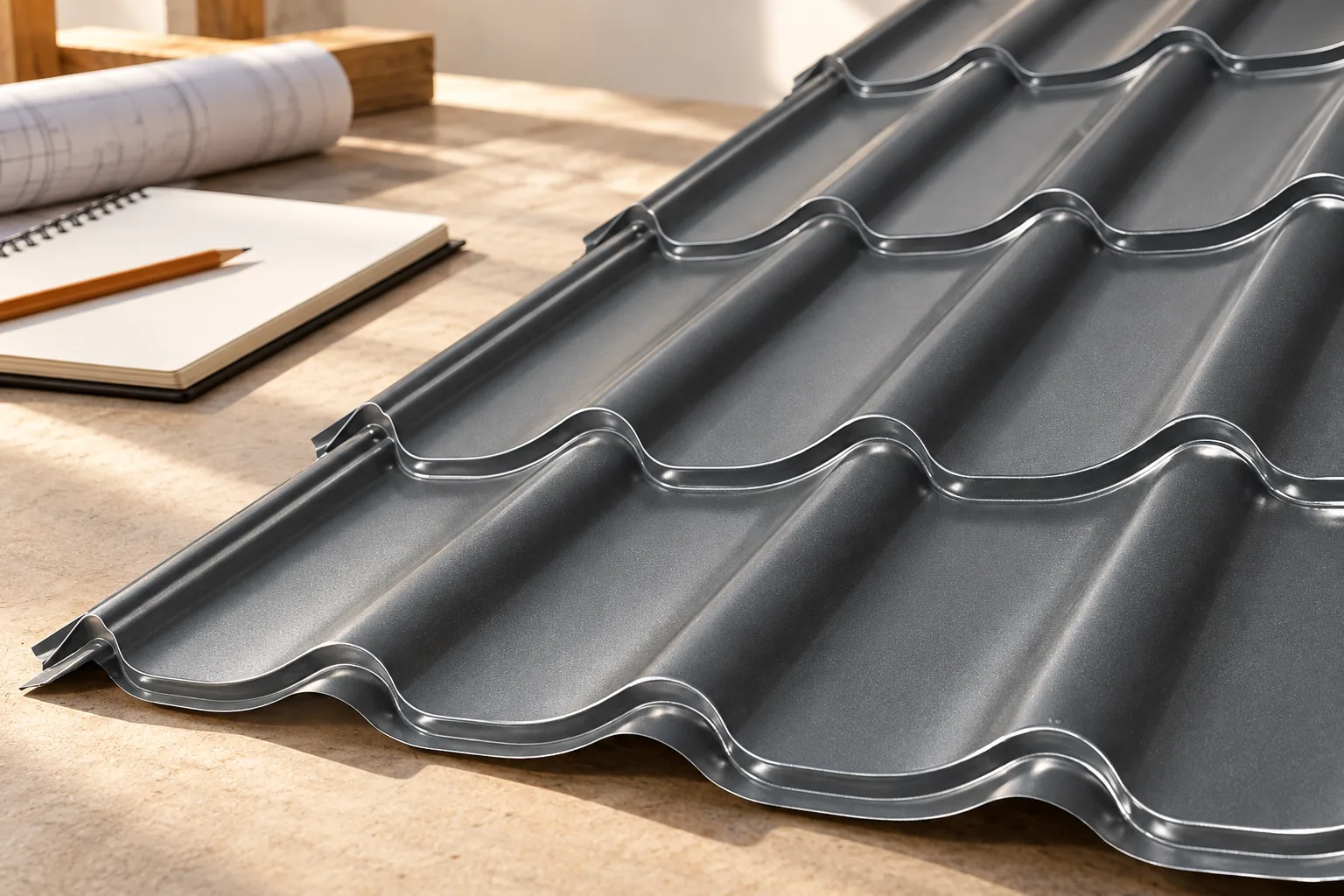
It is worth finalising the choice of system before preparing the battens and details. Final quantities should result from the design and a verified measurement. With sheets cut to length, a mistake may require re-production. They should not be ordered solely on the basis of approximate volume dimensions if the actual geometry of the roof slopes has not been confirmed.
Ask about the delivery time for a specific colour, coating and length. The availability of a popular profile does not mean that all its variants are available. Order the necessary accessories together with the covering. The lack of a few flashings, fasteners or ventilation elements can stop work even though most of the material is already on site.

What influences the time needed to complete the roof?
What matters is the preparation of the structure, the roof area, the number of roof valleys and penetrations. Simple sheets can be laid efficiently, but every chimney or window requires a separate detail. Transport to the roof also takes time. Long elements cannot be safely handled in the same way as small panels, especially with limited access.
Weather conditions may force a change in the sequence of work or bring it to a halt. Strong wind makes handling steel sheet more difficult, and wet surfaces increase the risk of slipping. It is not worth speeding up installation at the expense of safety and protecting the materials. The schedule should include contingency and a method for securing the building during any break.
How can you avoid downtime between crews?
Establish who signs off the structure before covering, who prepares the service penetrations and who is responsible for the roof windows. Pass current drawings to the crews. Changing the position of the chimney or vent after the roofing has been ordered may mean additional cutting and new flashings. These works can be avoided by agreeing the details in advance.
A checklist of handover conditions for each stage is helpful. The carpenter hands over checked geometry and connections, the roofer documents the layers before they are covered, and the loft crew knows the position of the airtight internal layer. A shared schedule does not mean everyone working at once. It should ensure access and responsibility for specific tasks.
How can you keep to schedule without compromising quality?
Divide the work into sections to be signed off and record actual progress. If a delay occurs, establish the cause and its impact on subsequent tasks. A missing delivery is treated differently from the need to repair the structure. Postponing a date may be more sensible than covering defects that are later difficult to reach.
For example, one day of measurement and inspection can prevent a multi-day wait for corrected sheets. This is not a universal schedule but a way of assessing risk. A realistic date should follow from the design, the agreed scopes and confirmed deliveries. Only then can it be determined how much time remains until the house is closed.
Also record the dates of the investor’s decisions. Choosing a colour, window or accessories at the last moment can affect the order just as much as the weather. When decisions are made earlier, the crew can focus on execution. This is one of the simplest ways to reduce downtime without shortening the necessary technical breaks.
7 branches. Materials closer to your project.

- SEROCK — Dzierżenin 34 E
- BŁONIE — ul. Sochaczewska 138A
- RADOM — ul. Grobickiego 8
- ŁÓDŹ — Natolin 8
- OLSZTYN — Barczewo, ul. Prosta 9
- WROCŁAW — ul. Jerzmanowska 10C
- GORZÓW WLKP. — ul. Zielona 33/34