Roof and energy
Is it safe to walk on a photovoltaic roof?
In brief
An integrated photovoltaic covering is not a terrace or a universal route to the chimney. The permissible way of moving across it depends on the specific product, its supports and the manufacturer’s instructions. Even a component that withstands a defined load in a test may not be intended for casually standing on its surface. Access for inspection and repairs must be planned before installation, together with fall protection. A load distributed over a sample and the pressure of a boot are two different situations. The position of the support, the way the force is applied and the shape of the component all matter. A general strength declaration therefore does not mean you may stand at any point. Two systems that look alike do not necessarily have identical access rules.
Why does a test result not mean permission to walk?
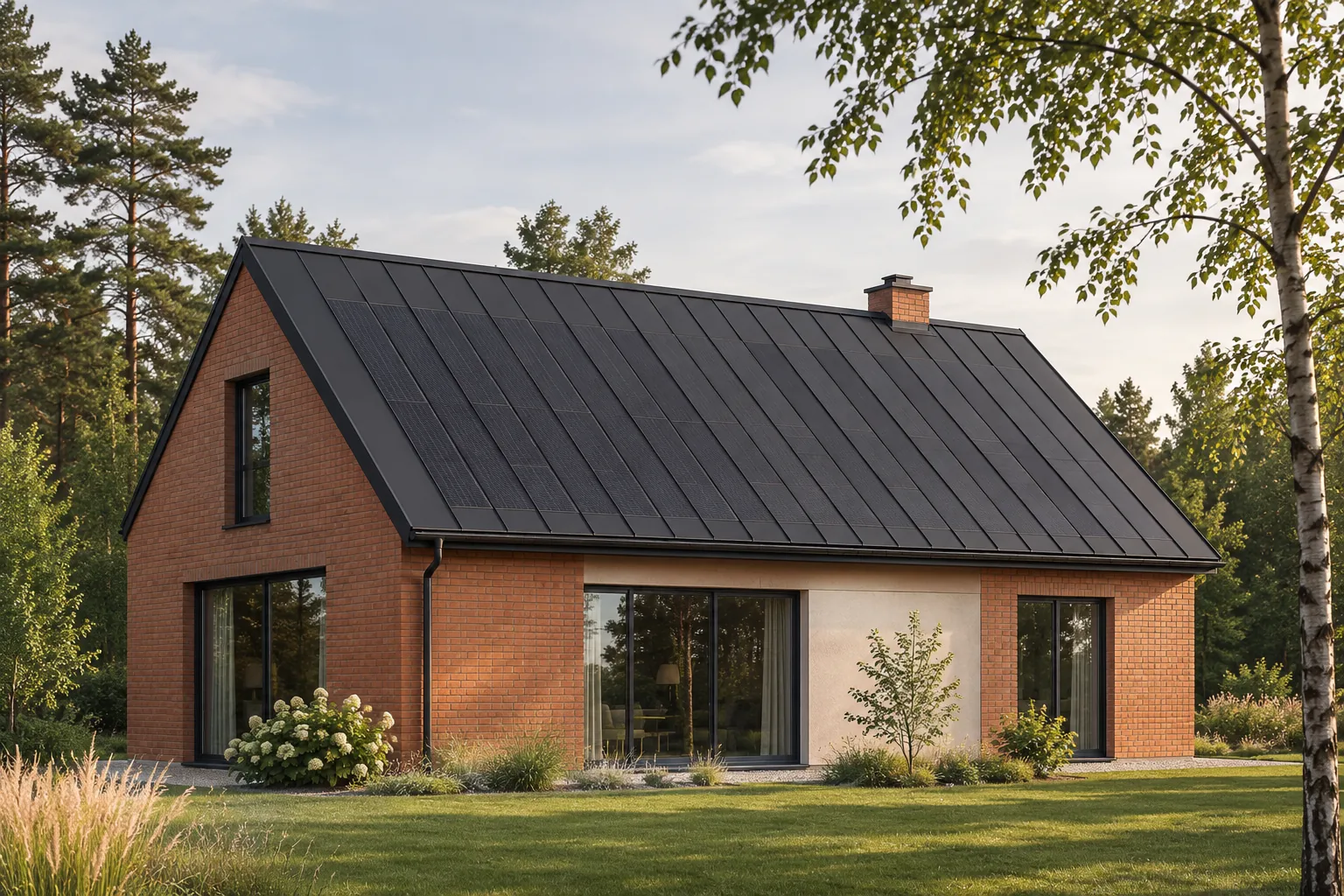
The instructions for one of the steel coverings integrated directly into the roof expressly prohibit standing and walking on the modules. For service access, they provide suitable walkways without loading their surfaces. For other products, the current requirements must be checked separately. Approval for a different type of roof tile must not be transferred to an active steel element.
What can a careless step damage?
The risk concerns both the active layer and the covering. Improper pressure can damage the surface, connections or a water-draining detail. Some effects may not be immediately visible from ground level. The absence of an immediate alarm in the app does not confirm that the roof has remained intact.
The condition of the surface must also be taken into account. Water, frost, dust and slope can increase the risk of slipping. Even a switched-off installation does not eliminate the risk of falling. For this reason, the access plan should cover not only the product itself but also the organisation of work, fall protection and the conditions under which activities may be carried out.
How to plan access to the chimney?
A chimney, roof hatch, antenna or other device requiring maintenance should be included in the layout of the active fields. The access route must not arise accidentally after installation is complete. In an integrated system, suitable zones and matched accessories can be planned during the design of the shared covering.
It should be checked how the access elements are fastened and whether they remain compatible with the given system. Random brackets must not be screwed through the active layer. Even a seemingly small hole can impair tightness or an electrical component. The solution should have a defined detail and a person responsible for its execution.
Does servicing require dismantling the roof slope?
The scope of access depends on the location of the fault and the system design. Sometimes checking the device in the technical room is sufficient, while sometimes partial removal of the covering is necessary. A well-planned roof should have a described procedure for such work. It is not advisable to accept without verification either a promise of immediate replacement or the assumption that everything must be dismantled.
Ask the installer to show how the element is identified and how its connections are accessed. Protection of the open part of the roof from the weather is important. Electrical and roofing activities must also be coordinated. Mechanical access alone does not yet mean that a circuit exposed to light can be safely disconnected.
What should be communicated to the person working on the roof?
Every contractor should know that the covering is electrically active. This also applies to the chimney sweep, the antenna installer or the team renovating the eaves. Pass on the access instructions and indicate the person responsible for the installation. Do not assume that the absence of visible panels will let you identify all the restrictions on your own.
Before commissioning, establish the scope of work and the need for roof service involvement. After completion, keep a record of the interventions and any damage. This makes it easier to assess a problem later. It also helps avoid disputes in which it is unclear who disturbed a specific section of the covering and for what purpose.
What benefits does planning access from the outset bring?
A joint roof and photovoltaics design allows aesthetics to be reconciled with the necessary maintenance. Active fields can be sensibly arranged, required zones left free and suitable accessories selected. As a result, later inspection does not require improvised solutions. This is a practical advantage of integration that is sometimes less visible than the appearance of the roof surface itself.
At handover, ask for a clear description of permitted and prohibited actions. Also record the service contact. If a leaf or small object appears on the roof, do not treat this as a reason to go up yourself. First assess with the contractor whether intervention is necessary and how it can be carried out safely.
Examples of companies and brands in roof-integrated photovoltaics are Ennogie, ML System, SolRoof, 3S Swiss Solar Solutions, SunRoof, Solartag, Electrotile, MDM NT (MyRoof), Nelskamp and Wienerberger Wevolt.
7 branches. Materials closer to your project.

- SEROCK — Dzierżenin 34 E
- BŁONIE — ul. Sochaczewska 138A
- RADOM — ul. Grobickiego 8
- ŁÓDŹ — Natolin 8
- OLSZTYN — Barczewo, ul. Prosta 9
- WROCŁAW — ul. Jerzmanowska 10C
- GORZÓW WLKP. — ul. Zielona 33/34