Roof and energy
Is every roof with concealed fixings an integrated roof?
In brief
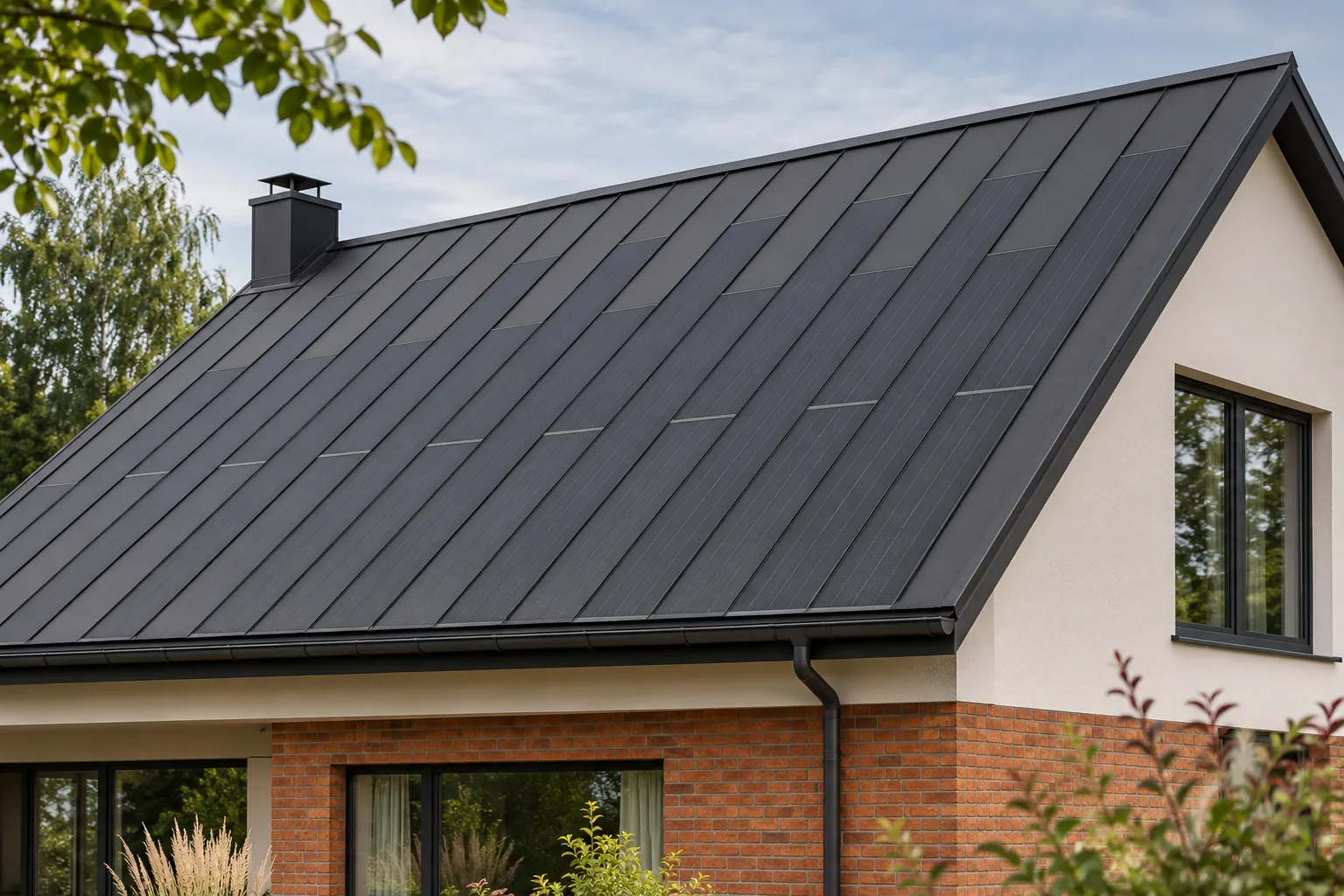
A neat installation can almost merge with the roof surface and yet remain an addition to a conventional covering. Integration is not determined by colour alone or by a hidden fixing. It must be established whether the photovoltaic element also performs a building function and what will remain once it is removed. This allows solutions to be compared by their actual construction, and not solely by photographs and the names used in advertising. Imagine removing an active section. If a complete covering remains beneath it that continues to fulfil all its functions unchanged, you most likely have an added installation. If a suitable roof element has to be inserted to restore the roof’s function, the integration has a building dimension.
How does the simple removal test work?
This is a useful starting point for a conversation about the solution.
This does not mean that there are no layers beneath BIPV. A substrate, membranes and other protective layers may still be required. The difference lies in the role of the active element within the overall assembly. A system should therefore not be judged solely by whether something is visible beneath the cells in an installation photo.
The test helps to structure the conversation, but does not replace documentation. The final assessment concerns the complete construction solution, not just one visible module.
Is recessing a module into the roof always sufficient?
Some systems integrate standard modules with a suitably designed frame, backing and flashings. Others combine cells directly with the covering element. Both approaches must be described according to the function of the whole assembly. The mere fact that the surface is low does not yet answer the question of tightness and responsibility for the roof.
Ask for a cross-section of the solution and the installation instructions. They should show where water drains, what protects the building and how the active part is connected to its surroundings. If the seller shows only a visualisation, the extent of integration is hard to assess. A well-documented detail says more than the phrase ‘panels invisible from the street’.
What distinguishes integrated steel roofing?
In this approach, the roof and the photovoltaic layer are planned together. Active fields work with matched inactive elements, and the whole retains an orderly geometry. There is no need to add a separate structure for standard modules on top of the finished covering. This helps maintain a clean line to the building’s form.
This advantage is particularly clear with a new roof or a planned replacement of the covering. However, one should not expect every location to be active or all materials to reflect light identically. The final appearance depends on the product, the layout of the fields and the details. It is worth looking at real installations, not just mock-ups.
Why does terminology matter for costs?
With a retrofit installation, you first pay for a functioning roof covering and then for the PV system including its installation. In an integrated solution, part of the expenditure covers both functions at once. Comparing the price of the modules alone with the price of a finished roof will therefore be misleading. Two complete investment variants need to be set side by side.
Repair works are similar. Replacing an active element that serves as the roof covering must take into account protecting the building. This does not rule out the solution, but it requires the right procedure and access. It is good when the cost estimate and service terms show this scope explicitly. Hiding it under one general name makes the decision harder.
Is a retrofit roof therefore bad?
The type of installation must suit the situation. On a sound, recently completed roof, an installation above the covering can be a sensible choice. When a building is only just being constructed or the covering needs replacing, it is worth comparing integration. There is no need to attribute the advantages of one technology regardless of the condition of the property.
An integrated roof particularly suits investors who want to combine an energy function with a consistent appearance. This benefit is real, although it cannot be reduced to a universal percentage saving. The choice should also take into account local service, documentation and the future availability of components.
How can we talk about integration without vague slogans?
Ask three specific questions: what serves as the roof covering, what has to be replaced after the cells are removed, and who is responsible for the sealing of that location. Then ask for a drawing and the installation terms. The answers make it possible to establish whether you are comparing an active steel roof, solar tiles or modules set into an integration system.
Use an unambiguous description of the scope of supply in the contract. It should cover active and passive elements, flashings, the required layers and the electrical part. This way, an attractive appearance goes hand in hand with clear responsibility. It is precisely this level of integration that is useful during construction and subsequent use.
Examples of companies and brands in roof-integrated photovoltaics are Solarstone, SunRoof, Ennogie, SolRoof, Wienerberger Wevolt, Electrotile, ML System, Tesla, MDM NT (MyRoof) and Megasol Energie.
7 branches. Materials closer to your project.

- SEROCK — Dzierżenin 34 E
- BŁONIE — ul. Sochaczewska 138A
- RADOM — ul. Grobickiego 8
- ŁÓDŹ — Natolin 8
- OLSZTYN — Barczewo, ul. Prosta 9
- WROCŁAW — ul. Jerzmanowska 10C
- GORZÓW WLKP. — ul. Zielona 33/34