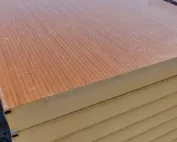
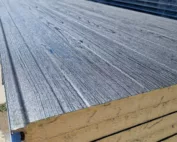
Panels in use
How do you match the thickness of a wall PIR panel to the indoor temperature?
In brief
Choosing the PIR thickness starts with the conditions of use. Temperature, heating duration and humidity matter. Next, the specific panel’s parameter and the joints are checked. More millimetres usually restrict heat flow, but do not fix a leaky joint. A good choice also covers load-bearing capacity, coatings and fire requirements. Determine the target temperature and how long it is maintained. A small service point operating daily differs from a storage room heated occasionally. Frequent door opening and ventilation also matter. The panel requirements must be linked to the whole building’s balance.
How do you describe how a room is heated?
Do not choose the thickness solely on the slogan “for winter”. Also describe summer conditions and any cooling. In an enclosed pavilion with large glazing, a thick wall alone will not eliminate overheating. Solar shading and proper air movement may be needed.
What differences does a specific panel family show?
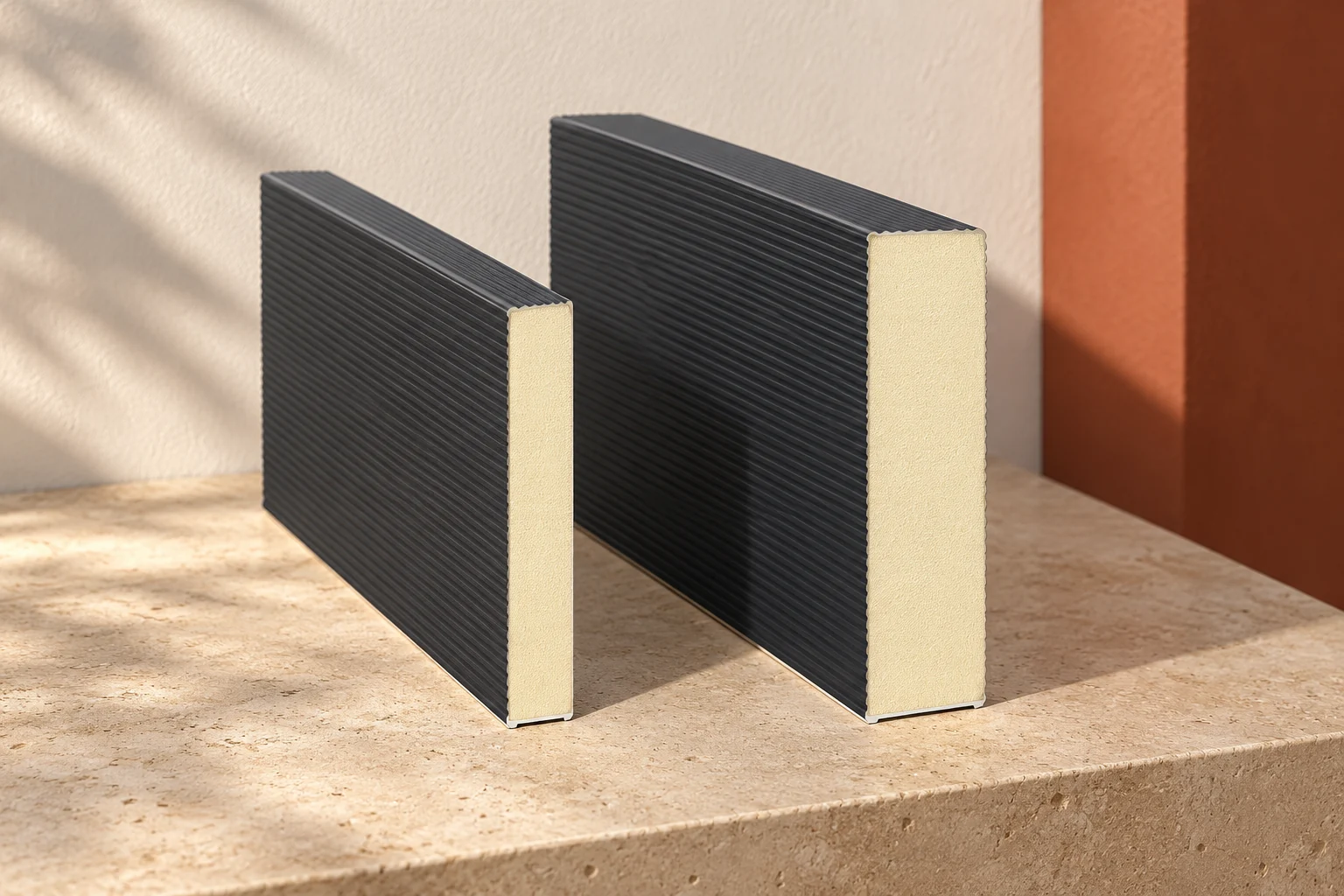
In the selected family of wall PIR panels, thicknesses of 60, 80, 100 and 120 mm have U-values of 0.33, 0.24, 0.19 and 0.16 W/(m²·K) respectively. These are values for actual variants, not a rule for every PIR. Before purchase, the exact product from the offer must be checked.
A lower U-value means less heat flow per unit area at the same temperature difference. It should not be confused with the lambda of the core. Lambda describes the material, whereas U refers to a specific element or building component. The units and data ranges are different.
How do you calculate the significance of a thickness change?
Assume 50 m² of full panel area and a temperature difference of 20 K. For U 0.33 W/(m²·K), the heat flow will be 330 W. At U 0.16 it will be 160 W. The difference in this simplified comparison is 170 W. We calculate using U × area × temperature difference.
This is not an annual energy saving or the heating output of the entire pavilion. Thermal bridges, windows, doors and air exchange have been omitted. The outdoor temperature also changes over time. The example shows the direction of change without promising a specific seasonal bill.
Annual assessment requires climate data, a temperature schedule and system efficiency. The instantaneous result should not be multiplied across the whole year without these determinations.
Why can the joints change the result?
At plinths, corners and openings, continuity of insulation and airtightness must be maintained. A leaky joint lets air through. A local thermal bridge increases heat flow. A thicker panel does not automatically eliminate these problems, because they concern a different part of the building envelope.
In a small room, the proportion of edges and openings relative to full walls can be large. It is worth refining the details in parallel with the choice of thickness. The parameter of the panel alone is important, but it does not constitute a finished result for the entire façade after installation.

How should humidity and surface temperature be taken into account?
Vapour can condense where the surface is sufficiently cool relative to the air humidity. The check covers indoor conditions and local thermally weakened points. It is not possible to ensure the absence of condensation with a single thickness number for every room.
An interior that is regularly washed or used by many people requires adequate ventilation. Temporarily switching off the heating also changes the conditions. The choice of panels and the way they are used should complement each other. Supply air vents should not be sealed merely to reduce the heating bill.
What should be checked beyond thermal insulation performance?
Thickness affects the geometry of the connections, the weight and the method of fixing. The load-bearing capacity must be confirmed for the specific facings and support spacing. A change from 80 to 120 mm does not entitle arbitrary enlargement of the span. The load table is still required.
Check the reaction to fire and the required resistance of the building envelope. PIR should not automatically be described as non-combustible. The classification applies to a specific assembly. The coatings on both sides are equally important, particularly with moisture, chemicals or intensive cleaning.
How can the surcharge for a thicker variant be compared?
Assume the same area and the full scope of supply. For the agreed difference of €4.17 net per m² and 50 m² of panels, the surcharge will be €208.50 net. This is a calculation exercise. The actual difference may also include longer fixings, other processing and logistics.
Assess the surcharge relative to the project objective and the service life. If the building will be heated for many years, it is worth calculating the energy balance. If it is seasonal, the priorities may be different. However, legal and technical requirements are determined for the specific project.
What else is worth asking about
Is 100 mm PIR a good choice for every heated pavilion?
There is no universal answer. You need to know the product parameter, the requirements for the building and the other building elements. Thickness alone does not describe windows, joints and the method of ventilation.
Does a better lambda allow you to reduce the thickness without checking?
No. It helps with the thermal selection, but the parameter for the whole panel is needed, along with an assessment of the other requirements. A thinner variant may have different load-bearing or fire classification characteristics.
7 branches. Materials closer to your project.

- SEROCK — Dzierżenin 34 E
- BŁONIE — ul. Sochaczewska 138A
- RADOM — ul. Grobickiego 8
- ŁÓDŹ — Natolin 8
- OLSZTYN — Barczewo, ul. Prosta 9
- WROCŁAW — ul. Jerzmanowska 10C
- GORZÓW WLKP. — ul. Zielona 33/34