PIR insulation
EFIGREEN ALU+: why one product family has different lambda values
At a glance
The answer depends on whether the properties of the board itself are being compared or the result for the entire building element. The EFIGREEN ALU+ family includes variants with different thicknesses and formats, and the declared lambda is assigned to a specific thickness — it cannot be transferred to another variant without checking the data. Before concluding that the material is failing, it is necessary to establish which variant and format was actually installed and which values were adopted for the calculations. The discrepancy may lie in the input data rather than in the board itself.
First, the question of the cause
Compare the layer arrangement with the cutting diagram for the given ALU+ or XL format. Check whether the solution combines the correct thermal parameter with a sensible board cutting layout. Without this, a board characteristic is often mistaken for a joint defect.
The actual product and the scope of its data
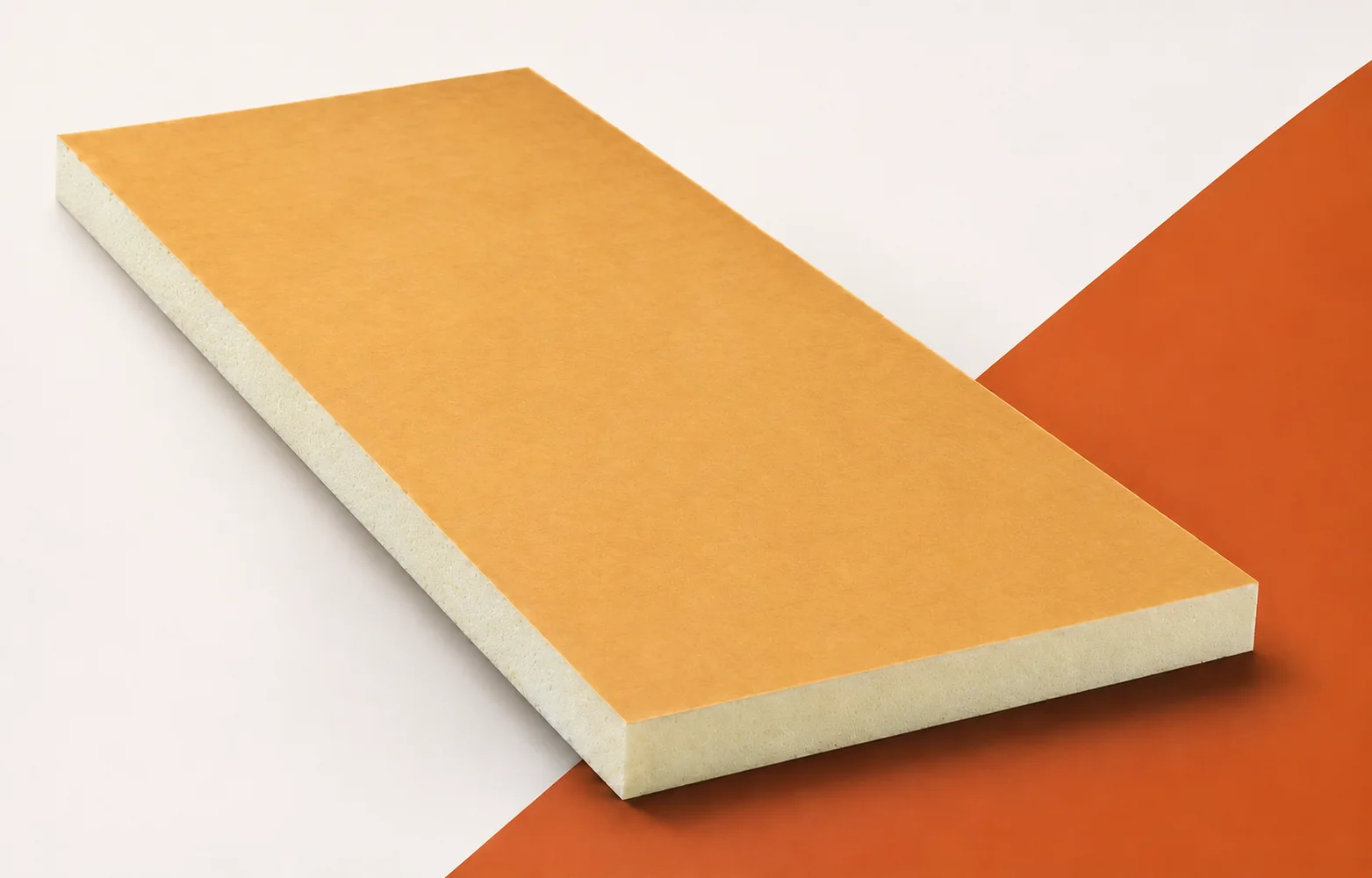
When asking about the different lambdas in the ALU+ family, first establish what the data refer to: EFIGREEN ALU+ has a PIR core in a composite kraft–aluminium–PE facing, and the lambda of 0.023 W/(m·K) applies to 30–35 mm, while 0.022 W/(m·K) applies to the stated range of 40–160 mm. The data sheet specifies CS(10/Y)200, and the Polish page marks the reaction to fire as NPD, i.e. no declaration of that property. The basic format is 600 × 600 mm, while ALU+ XL has different dimensions depending on the variant. When checking an order, the term polyurethane boards does not replace the full name EFIGREEN ALU+. The PIR core and the properties of the complete board with facings are not the same, just as the scope of application, which is the thermal insulation of a roof slope divided by numerous service penetrations, is not the same.
How to read a simple example
Let us compare two incorrectly equated records for the thin ALU+ variant. For 35 mm and the correct lambda of 0.023, the simplified quotient d/λ is approximately 1.52 m²K/W. Using 0.022 would give approximately 1.59 m²K/W. The difference here comes solely from changing the input data, not from measuring a damaged board. These are not the declared RD values copied from the table. At 40 mm, the documentation already indicates a different lambda range. Before assessing the result, the thickness must therefore be confirmed rather than assuming one value for the whole family. The sheet format and cutting layout are then considered as a separate matter.
A large number of short offcuts around installations affects the consumption of EFIGREEN ALU+. Calculate the number of sheets after marking the openings, not just from the area of the entire roof slope. The dimension and thickness used in the cutting layout must correspond to the full variant name and the documents of the actual delivery.
Matching the action to the identified problem
The 600 × 600 mm format and the XL variant offer different cutting possibilities between installation bases. A narrow field requires a separate measurement with offcuts and waste. Do not attribute to the thinner board the lambda value of the thicker variant; the person preparing the delivery should check the format, thickness and access to the laying location at the same time.
What can be seen at the joint
During the inspection of EFIGREEN ALU+, check whether the straight edge requiring precise butting of offcuts has been maintained and what condition the composite of kraft paper, aluminium and PE foil is in. A different print or colour does not replace the finding of an open joint, a missing facing or permanent deformation. Compare with the record of the full variant name, thickness and delivery format. On the opposite side there is, or is to be created, the agreed covering with the intended fastening, which may restrict access to the damage. Note whether the narrow field between two installation bases was checked directly, or whether the conclusion concerns only the surface visible between the devices.
How to distinguish a feature from a defect
Under short pieces of EFIGREEN ALU+ at penetrations, check the stability of the substrate. The choice of ALU+ or XL format alone does not eliminate a void under an offcut. Transfer the inspection result onto the cutting plan so that the person compiling the delivery can identify elements requiring different support or a change of layout.
The conclusion should have limits
The repair schedule for EFIGREEN ALU+ should separate the surface area of the required elements from the waste. For each narrow field between installations, note the identified variant, thickness, format and access restrictions under the covering. This allows the thermal calculation to be linked to a feasible sheet layout, instead of ordering material solely on the basis of the square footage.
7 branches. Materials closer to your project.

- SEROCK — Dzierżenin 34 E
- BŁONIE — ul. Sochaczewska 138A
- RADOM — ul. Grobickiego 8
- ŁÓDŹ — Natolin 8
- OLSZTYN — Barczewo, ul. Prosta 9
- WROCŁAW — ul. Jerzmanowska 10C
- GORZÓW WLKP. — ul. Zielona 33/34