Insulation and energy
Choosing roof insulation: PIR boards, mineral wool or EPS?
In brief
The choice of roof insulation material depends primarily on the roof construction, the available thickness and the working conditions. PIR provides high thermal resistance in a thin layer, mineral wool fits well into the space between rafters, and suitably selected EPS is widely used in flat roofs. Before purchase, check the product’s intended use, declared lambda, reaction to fire and mechanical and moisture-related parameters. Also establish the layer build-up and ventilation method, because no material can replace a correct design and airtight execution.
Are you insulating a pitched roof or a flat roof?
In a pitched roof, insulation can be placed between the rafters, beneath them or above them. Each variant uses the available space differently and requires different details. In a flat roof, the boards can be laid on the ceiling or on the trapezoidal steel deck, beneath the waterproofing layer.
When renovating, the existing layers must first be identified. A tight covering, the condition of the timber and the type of ventilation can restrict the choice. Insulation should not be added to a damp assembly without establishing the cause. Even a material with good lambda cannot fix a leak or a gap through which moist air enters from the room.
When is it worth considering PIR boards?
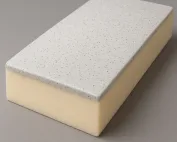
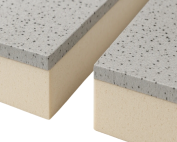
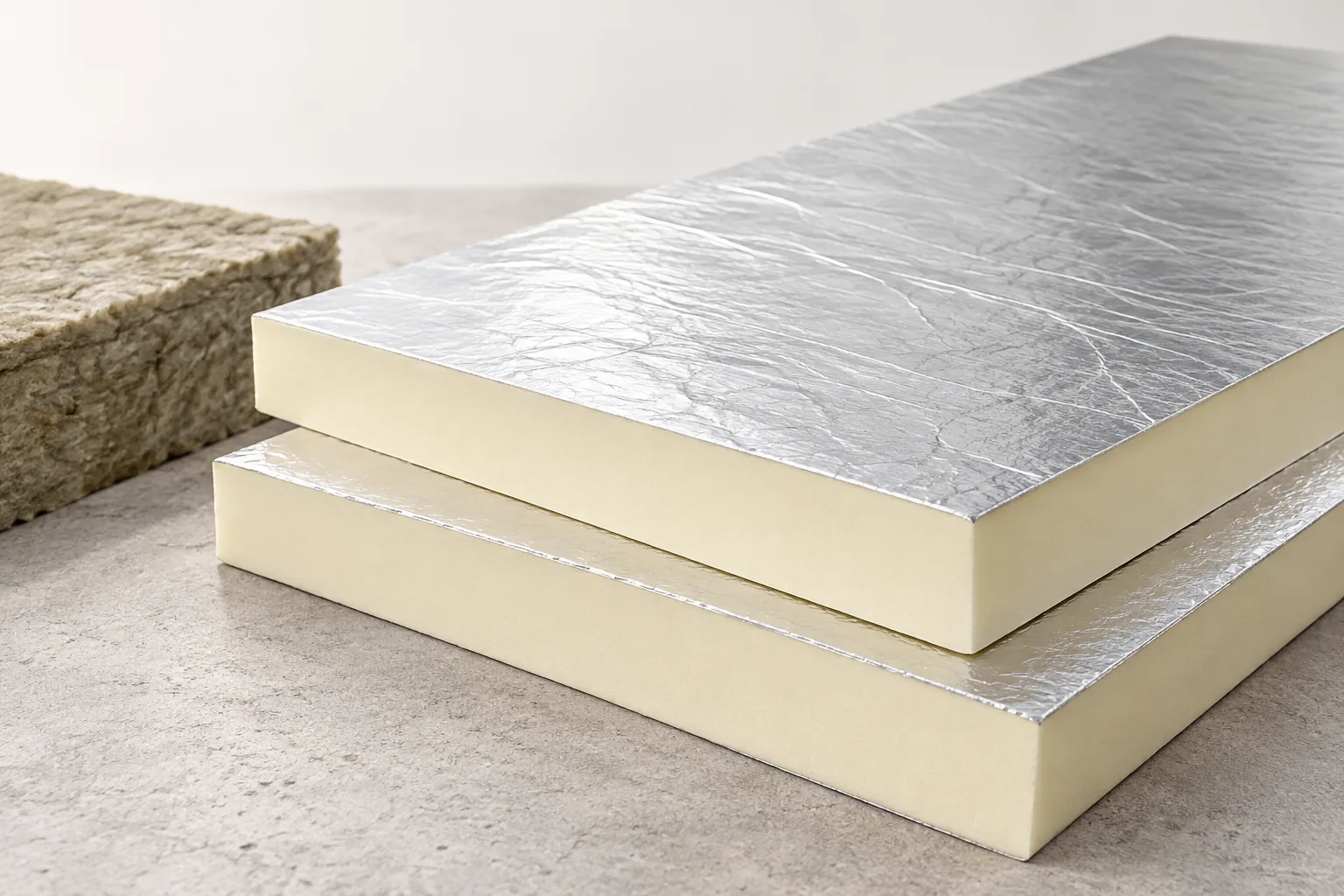
PIR is useful where the available thickness is limited. Rigid boards can form a continuous layer above the rafters or on a flat roof. In some products with an aluminium facing, the declared lambda is 0.022 W/(m·K). The exact parameter must be checked for the selected variant.
In an above-rafter assembly, the way loads are transferred through the fixings to the structure is important. The insulation board does not itself replace load-bearing elements. On a flat roof, the support and compatibility with the waterproofing must be checked. Maintaining dryness during installation is equally important. Low water absorption does not allow the material to be left unprotected in the rain.
When is mineral wool a practical choice?
Mineral wool in the appropriate form fills the space between the roof structure members well. Its resilience makes it easy to fit to typical rafter spacing. This does not mean, however, that it can be pressed in at will. Excessive compression changes the actual thickness, and inaccurate cutting leaves gaps.
The fire and acoustic properties of the building envelope matter. Mineral wool has different characteristics in this respect from foams, but the result for the whole roof also depends on the facings and joints. A soft mat intended for between the rafters cannot be used without assessment where the insulation carries pressure from the service layers. The form of the product must match the application.

Where does EPS prove itself, and where does XPS?
EPS is available in variants with different lambda values and mechanical resistance. In flat roofs, a product intended for this application should be selected. A façade board is not automatically suitable beneath a loaded covering. The approved adhesives and contact with other materials are also important.
XPS has a closed structure and is used in systems requiring appropriate resistance to moisture and pressure. An example is certain inverted roofs. Selecting it for such a roof requires checking the entire system. XPS must not be replaced with any PIR or EPS simply because a lambda comparison favours another board.
How to compare thickness and cost?
For a homogeneous layer, thermal resistance is calculated by dividing the thickness in metres by the lambda value. This allows the quantity of different materials needed for a similar effect to be compared. However, the calculation does not account for thermal bridges, rafters, fixings or the other layers.
Cost should be compared for the designed building envelope. Insulation also involves a vapour barrier, membranes, fixings and labour. A thinner board can simplify detailing or preserve space beneath the roof. This benefit is sometimes more important than the price per metre of the material alone. Conversely, where a large thickness is available, another solution may prove equally effective and economical.
What documents and arrangements do you need?
Before purchase, it is worth gathering the roof cross-section, the required thermal performance and the data for the selected product. Its intended use, lambda value, reaction to fire and mechanical and moisture-related parameters should be checked. For boards, the facing, edges and effective coverage area are also important.
The material must be assessed together with the layer providing airtightness from the interior. Leaky penetrations at walls and services can introduce moisture into the roof despite good insulation. In ventilated solutions, a clear ventilation gap must be maintained. The choice of insulation should therefore conclude with a drawing of the layers and details, not merely an indication of the pack thickness.
It is also worth defining the sequence of works. Insulation carried out together with replacement of the covering offers different possibilities from retrofitting insulation from inside without dismantling the roof. Matching the technology to the scope of the renovation helps avoid purchasing material that cannot be correctly installed.
7 branches. Materials closer to your project.

- SEROCK — Dzierżenin 34 E
- BŁONIE — ul. Sochaczewska 138A
- RADOM — ul. Grobickiego 8
- ŁÓDŹ — Natolin 8
- OLSZTYN — Barczewo, ul. Prosta 9
- WROCŁAW — ul. Jerzmanowska 10C
- GORZÓW WLKP. — ul. Zielona 33/34