Polystyrene and thermal insulation
How to choose an adhesive for EPS on bituminous waterproofing
At a glance
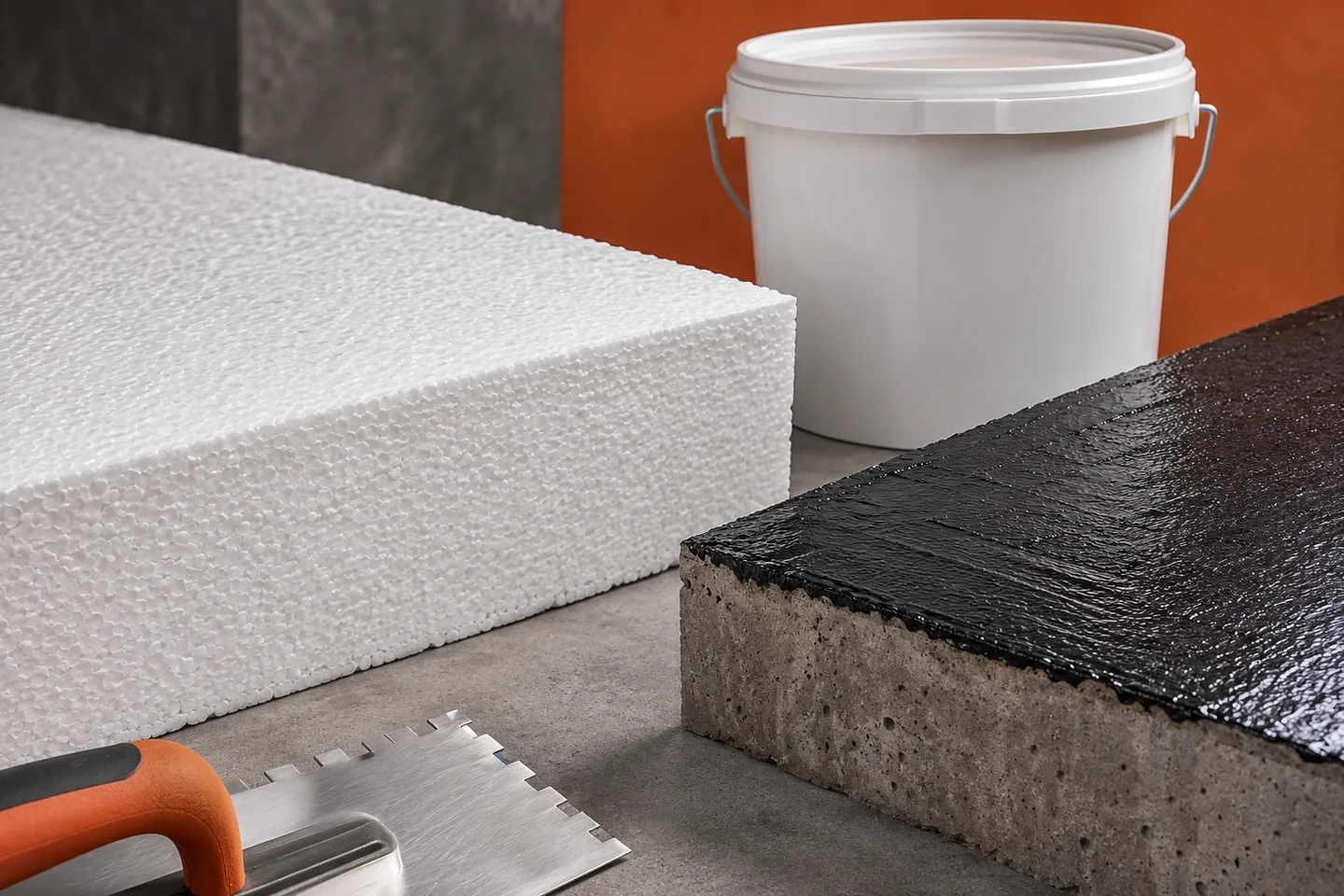
Adhesive for polystyrene on bituminous waterproofing must be compatible with both layers. A label saying “for EPS” or “bituminous” is not enough. What matters is the product’s composition, the condition of the coating, the bonding conditions and the loads envisaged. Before installation, the instructions for the entire system must be checked. An unsuitable adhesive can damage the boards or weaken the protection of the foundation. The adhesive is in contact with polystyrene on one side and with the protective coating of the wall on the other. It may bond well to EPS and at the same time interact poorly with the waterproofing. It may also adhere to the bitumen but contain ingredients that damage the boards. Confirmation should therefore cover the specific materials and where they are used, not just the general category of adhesive.
Why does compatibility need to be checked twice?
The most reliable starting point is the solution specified by the manufacturer of the waterproofing or described in the design. The permitted substrates, the required preparation and the waiting time must be read off. If the name of the coating is not known, its compatibility with the new adhesive must not be assumed. In the case of renovation, it may be necessary to identify the existing layer and carry out an on-site trial.
What can damage polystyrene?
EPS is not resistant to a range of organic solvents. Contact with an unsuitable preparation can lead to the material dissolving or swelling. This applies not only to the adhesive itself, but also to primers, cleaning agents and residues of other products on site. The assessment should be based on the instructions, not on the smell or colour of the compound.
Not every bituminous product contains solvents, but the word bituminous alone does not confirm safety for EPS. The manufacturer should expressly permit direct contact. A water-based product must also be used in accordance with the requirements, including those relating to drying and temperature. Good chemical compatibility does not remove the need for the joint to be executed correctly.
When is the coating ready for bonding?
The waterproofing layer must reach the condition required before further work. The time depends on the product, thickness, temperature and humidity. A dry surface does not always mean that the entire layer is ready to be loaded. Bonding the boards too early can hinder drying, deform the protection or cause the thermal insulation to shift.
Before covering, the continuity of the waterproofing must also be accepted. Corners, pipe penetrations and terminations are checked. The board adhesive should not be treated as a repair for missing coating thickness. If damage is found, it must be removed using a method permitted for the waterproof protection. Only then can the installation of the thermal insulation continue.
How should the adhesive be applied and the boards pressed into place?
The application pattern depends on the system and the water conditions. The instructions may specify strips, spots or another method of covering the surface. The bonding pattern should not be transferred from the façade to the foundation without checking. The quantity of product, open time and contact pressure are also important. The board should achieve a stable position without damaging the substrate.
The joints between boards should be fitted together, and the edges should not be accidentally filled with adhesive forming conductive strips. Large unevennesses must not be levelled with arbitrarily thick dabs if the product does not permit this. The evenness of the substrate should be prepared beforehand. A tight EPS joint reduces gaps in the thermal insulation but does not constitute additional waterproofing.
What about the mechanical fixings and the backfill?
On the façade, mechanical fasteners may be part of the system. Below ground level the situation is different, because penetrating the waterproof coating may open a path for water. Mechanical fixings should not be added simply because the adhesive sets slowly. The method of holding the boards in place before backfilling and any fixings must follow from the design and the instructions for the layers used.
Backfilling may begin once the conditions specified for the adhesive and the coverings have been met. The pressure of the ground will not repair a badly prepared joint. It may, however, displace the boards or damage the coating if the work was carried out too early. Suitable backfill and a method of compaction must be ensured. At acceptance, it is worth documenting the materials and the dates of the successive stages.
How do you put together an unambiguous enquiry?
State the type of waterproofing, the EPS type, the condition of the substrate and the expected conditions at the foundation. Ask about compatibility, preparation, setting time and method of application. Also check temperature limits and how to proceed during rain. This information is more useful than a general question about the strongest adhesive. Higher adhesion does not replace the compatibility of the entire system.
In the documentation, keep the data sheets for both materials and the recommendations for combining them. If the manufacturer requires confirmation for an unusual coating, it is worth obtaining it before buying a larger quantity. A prepared sample can help assess the workmanship, but it does not replace approval for the given conditions. The final result also depends on the condition and adhesion of the waterproofing itself to the masonry.
EPS variants are produced by, among others, Ekobud, Justyr, Polstyr and Izoterm. Choosing an adhesive additionally requires checking the recommendations of the manufacturer of the waterproofing used.
7 branches. Materials closer to your project.

- SEROCK — Dzierżenin 34 E
- BŁONIE — ul. Sochaczewska 138A
- RADOM — ul. Grobickiego 8
- ŁÓDŹ — Natolin 8
- OLSZTYN — Barczewo, ul. Prosta 9
- WROCŁAW — ul. Jerzmanowska 10C
- GORZÓW WLKP. — ul. Zielona 33/34