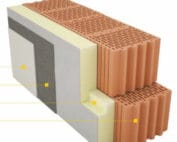
PIR insulation
Lambda 0.019 for termPIR MAX 19 AL: interpreting the figure correctly
At a glance
The value 0.019 in the termPIR MAX 19 AL designation is the declared thermal conductivity λ of the board, not a measure of surface temperature and not a promise of a specific percentage saving. The board is made of rigid PIR foam and faced on both sides with a gas-tight laminate of aluminium, paper and polyethylene, and this level of thermal conductivity is precisely its distinguishing feature. The figure can only be read meaningfully once it is known how much space for insulation the existing detailing leaves and which layers accompany it. The material designation alone therefore does not say how the entire building element will behave.
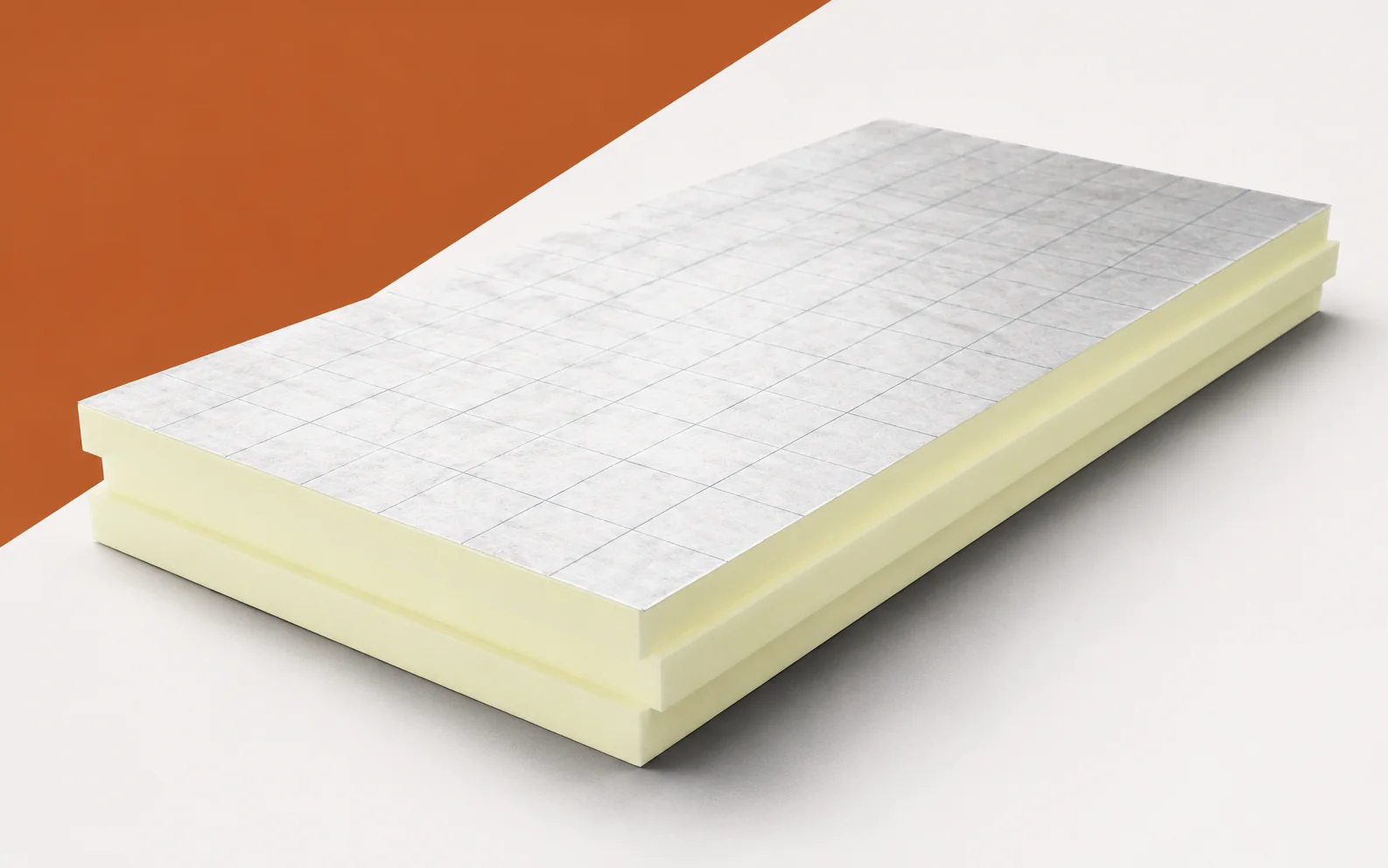
The product’s construction explains its application
When assessing an existing building, separate the properties of the board from the performance of the entire building envelope: a low lambda does not remove the limitations of the substrate or of adjacent layers. PIR will only exploit the advantage of its small thickness if the detail allows it. During the inspection, compare the available cross-section height and the scope of work needed to increase it with the documentation or with the condition before the change.
What lambda alone does not say
The value 0.019 W/(m·K) applies to termPIR MAX 19 AL in the thickness range 80–220 mm. This is the thermal conductivity, so with an assumed thermal resistance of the building component it allows you to calculate how thin this layer can be; on its own it does not determine the result for the whole assembly.
Compare polyurethane boards on the same basis; in the calculation example the layers were compared at an assumed resistance of 5.0 m²K/W. The product of R and lambda gives a theoretical thickness that may not be available for delivery, so match the result to the termPIR MAX 19 AL variant actually available. Selecting the foam alone does not give a U-value; once the thickness is chosen, check the whole building component again.
The figure 0.019 for termPIR MAX 19 AL answers the question of heat conduction. It does not, however, explain whether a given pressure will be permissible for the whole assembly. That requires other data and an assessment of the layers. Likewise, a fire class cannot be derived from lambda. Reading three separate pieces of information is more useful than the general belief that a product with one better parameter will be better in every category.
Moisture must be recognised, not merely covered up
The termPIR MAX 19 AL board is sensitive to mechanical damage before installation and during the works, so it requires protection at these stages. The gas-tight laminate makes it harder for vapour to pass through the plane of the board, but it does not itself seal joints and perimeters.
A low lambda does not compensate for the flow of moist air through an unsealed insulation perimeter. Check the connection of the gas-tight laminate to the intended sealing of the wall and of every service penetration. Inspect the assembly together with its history of moisture and the method of protecting the material during work breaks, instead of assessing airtightness by the metallised appearance.
Edge profiles and joint continuity
termPIR MAX 19 AL is available as FIT, LAP and TAG. The subsequent designations refer to the edge: square edge, shiplap and tongue and groove, which affects how adjacent boards are joined.
On an uneven substrate, the TAG tongue-and-groove edge will not level the position of adjacent boards. Before assessing the joint, check the flat support, the condition of the profiled sides and the width of the gap. The joint should not be closed by forcing the board into position, because an even finished surface can conceal a mismatch beneath it.
Limits of the conclusions from the product data sheet
Separate from heat conduction is the declaration for termPIR MAX 19 AL: CS(10/Y)100 and fire reaction class E. When assessing an existing assembly, it must therefore be established whether these values refer to this very board and not to another one with a similar facing.
For termPIR MAX 19 AL, read CS(10/Y)100 and class E from the documentation for the precisely selected product. Lambda 0.019 describes heat conduction and does not mean greater mechanical resistance. Requirements for compressive loads and reaction to fire must be checked independently of the benefit resulting from thinner insulation.
Practical inspection of the completed assembly
The available formats of termPIR MAX 19 AL are 600 × 1200 and 1200 × 2400 mm, with a coverage adjustment resulting from the shiplap edge. When comparing offers, the thermal effect is compared first, and only then the other elements.
Compare the cost of thinner insulation with the cost of rebuilding the elements that limit the section height, for the same thermal effect and functional purpose. The higher price of the board may pay off in processing or finishing, which two full calculations covering the cutting layout, fixing and the effects of changing the layer geometry will show, with the material price separated from the labour.
7 branches. Materials closer to your project.

- SEROCK — Dzierżenin 34 E
- BŁONIE — ul. Sochaczewska 138A
- RADOM — ul. Grobickiego 8
- ŁÓDŹ — Natolin 8
- OLSZTYN — Barczewo, ul. Prosta 9
- WROCŁAW — ul. Jerzmanowska 10C
- GORZÓW WLKP. — ul. Zielona 33/34