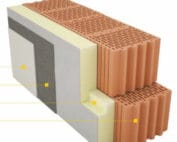
PIR insulation
Why is termPIR ETX installed with the printed side facing the wall?
At a glance
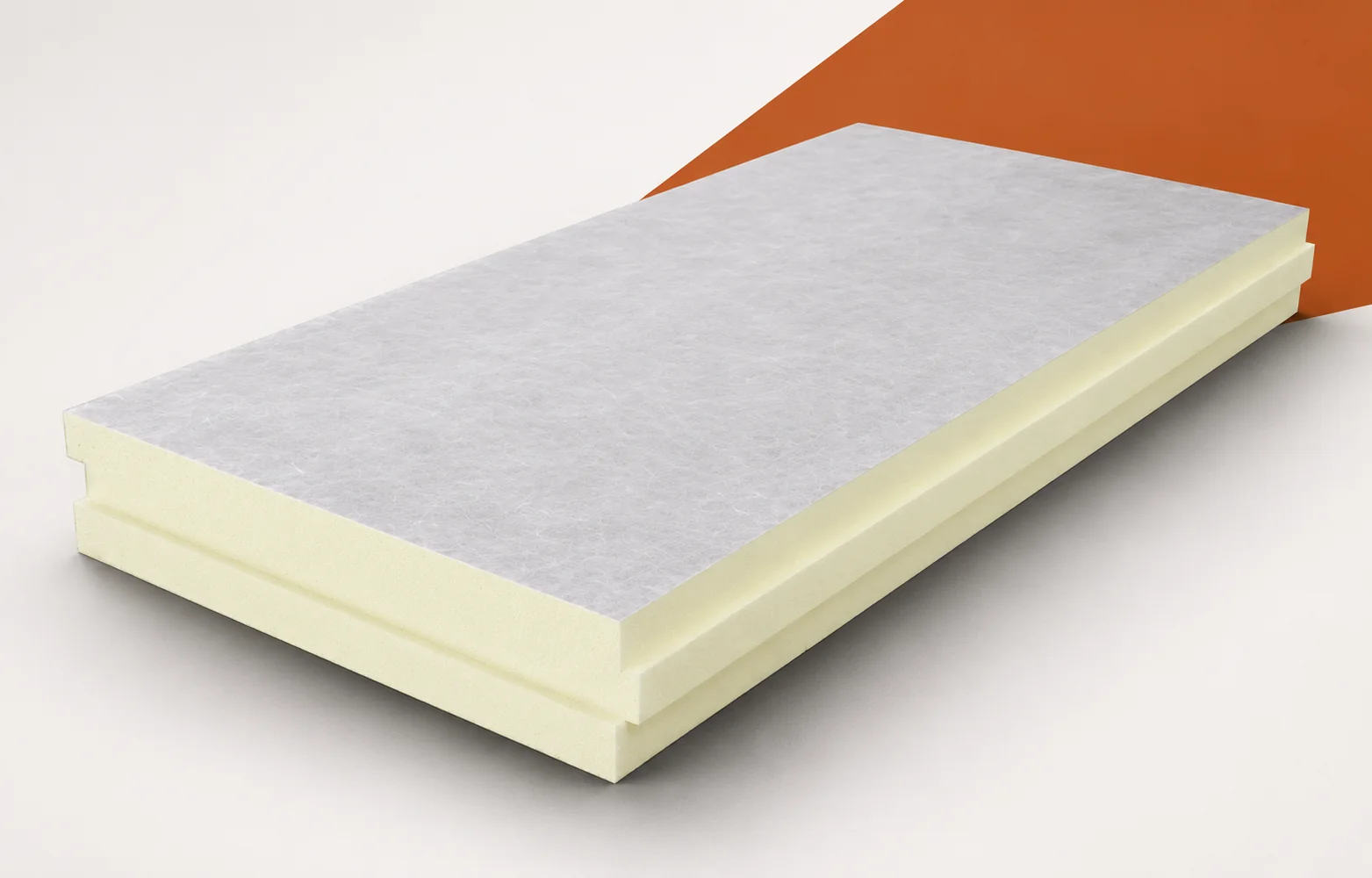
termPIR ETX is a PIR board faced on both sides with a gas-permeable glass fleece, intended for two-layer walls in the ETICS system. According to the manufacturer’s instruction, the printed side is laid facing the wall. The similar appearance of both surfaces is therefore not enough to determine the board’s orientation. When assessing an existing façade, the product marking, its position and its interaction with the adhesive and the other system layers must be checked. The reveal requires separate attention: the insulation thickness in the wall field does not prove that the insulation is continuous at the frame. The guide explains the choice of installation direction, the locations of potential gaps and the data needed before repairing the window junction.
From the name to the actual board
First, it is established whether a complete ETICS with a board covered with glass fleece was used, instead of assessing the surface alone. The system name and the scope of application on the given substrate are compared with the documentation or with the condition before the change. This makes it possible to distinguish the continuity of the thermal insulation at the window resulting from a correct product selection from the effect of an accidental replacement of the facing.
How to read thermal parameters
For termPIR ETX, the thermal conductivity coefficient is not a single constant value: below 80 mm it is 0.027 W/(m·K), in the range from 80 to less than 120 mm – 0.026, and from 120 to 250 mm – 0.025. When asking about the direction of installation with the print facing the wall, this relationship is a reminder that the thermal assessment concerns the specific thickness of the board used in a given part of the façade, and not the product name alone.
The lambda of termPIR ETX changes at the thresholds of 80 and 120 mm, so it is read for the thickness actually used in a given section of the façade. Adopting 0.025 for a board thinner than 120 mm would overstate the thermal resistance of its layer. Comparing variants requires the thickness of each section at the full wall, the reveal and the narrowings, and not a single figure from the offer.
In the case of termPIR ETX, the question of façade durability must begin with the entire connection to the wall. The rigidity of the board alone does not confirm the load-bearing capacity of the old plaster. Similarly, a smooth finishing layer does not automatically reveal the method of fixing. For the assessment, information about the preparation of the substrate and the components of the system is needed. This makes it possible to separate a property of the product from a problem of workmanship or the condition of the wall.
Moisture must be recognised, not merely covered up
Before termPIR ETX is bonded, the substrate must be dry, load-bearing, level and clean. Efflorescence, loose paint and remnants of weak plaster require assessment even before bonding, because what remains under the board affects the durability of the entire connection, and not just the appearance of the laid layer.
Moisture in a termPIR ETX assembly requires establishing whether the source lies in the masonry or in the board itself. Old render may appear to hold while debonding from the substrate; in that case, weak layers are removed before bonding, and the condition of the masonry is checked before blame is attributed to the board or its facing. The durability of the bond also depends on the layer left under the adhesive, so before the façade is covered, the assessment of the substrate, traces of efflorescence and areas repaired before installation are compared with the earlier occurrence of the problem.
Where do problems at the junction come from?
According to the termPIR ETX instructions, the print is to face the wall, and the boards should form a flat plane with offset joints. This requirement concerns the orientation of the marked side relative to the masonry, not the sequence of finishing layers or the appearance of the surface after installation.
A local discontinuity requires checking the orientation of the print on the termPIR ETX board and the production date from the delivery marking. Installation begins no earlier than one month after production, even if the surface appears flat and neatly finished; work carried out too early does not become correct merely because the material is already on the scaffold. Delivery is therefore planned in advance, and the marked side is directed towards the wall; when assessing the insulation at this point, the production date, the readiness of the substrate and the offset of the joints between rows are considered together.
The limits of conclusions from the product data sheet
In termPIR ETX, the compressive strength is described by the symbol CS(10/Y)120. For reaction to fire, the boundary between the declared classes is the thickness: the range 20–49 mm is assigned to F, and 50–250 mm to E. The label must be read for the correct variant; the class of the board alone does not determine the classification of the finished façade.
The compressive strength parameter of the termPIR ETX board does not specify the number or type of fasteners, which is why at the corner of a building the fixing is selected to suit the wall, the façade zone and the requirements of the adopted system. The assessment of the product, the fixing and the behaviour of the entire thermal insulation during a fire are separate issues; in the event of discrepancies, a fastener layout design is needed, together with conformity of the reinforced layer with the adopted system, rather than a general assurance about the quality of the board.
What to gather before assessment or repair
When accepting termPIR ETX, compare the façade layout with the external dimension of 600 × 1200 mm, taking into account the effect of the rebate on the coverage. At the same time, confirm that the adhesive and the subsequent layers belong to the agreed ETICS solution. Conformity of the size alone is not enough to replace a system component.
The bill of quantities for termPIR ETX should include cut pieces at window corners, sills and the top termination of the wall, as well as reinforcing materials, fasteners and preparation of the wall. Price the flashings and edge closures separately: omitting them in execution can open a path for water behind the thermal insulation. Only a scope described in this way allows complete façades to be compared.
7 branches. Materials closer to your project.

- SEROCK — Dzierżenin 34 E
- BŁONIE — ul. Sochaczewska 138A
- RADOM — ul. Grobickiego 8
- ŁÓDŹ — Natolin 8
- OLSZTYN — Barczewo, ul. Prosta 9
- WROCŁAW — ul. Jerzmanowska 10C
- GORZÓW WLKP. — ul. Zielona 33/34