PIR insulation
The silver facing on termPIR AL: its function and limitations
At a glance
In termPIR AL, the thermal insulation is provided by a rigid PIR foam core, while the gas-tight laminate of aluminium, paper and polyethylene on both faces provides the surface functions. The silver appearance therefore does not turn the board into a heat-reflecting screen, and its presence does not determine the performance of the whole building element. Answering the question in the title requires separating the role of the core from that of the facing, and checking how the junction performs at a low door threshold, where the thickness of the layers is limited. Continuity of the wall and floor insulation, with no exposed strip, is a condition that the laminate alone cannot fulfil.
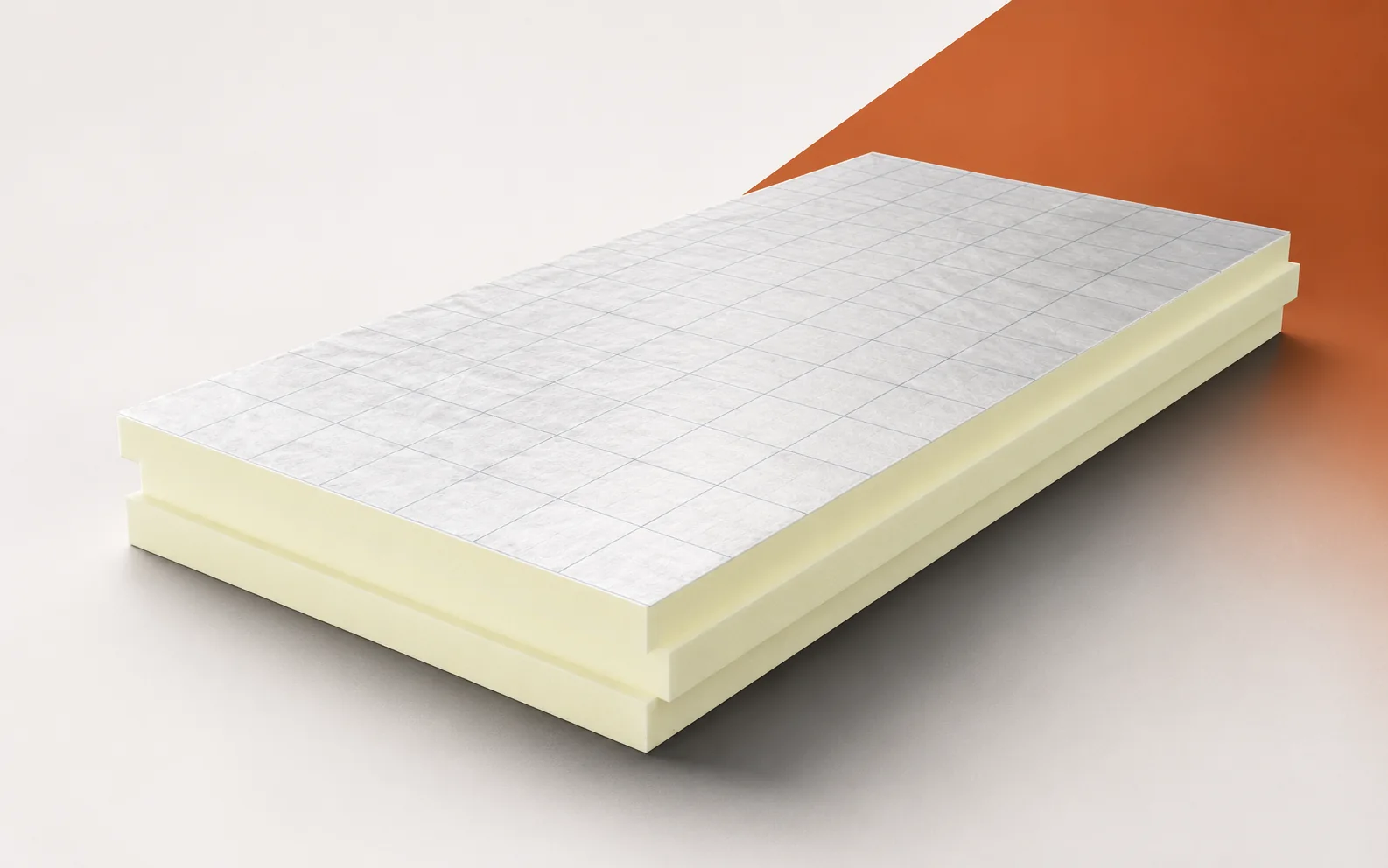
Product construction explains its application
Assessing an existing building includes checking whether raising the floor will narrow the passage through the opening. PIR boards of a suitably selected thickness provide the required thermal resistance without unnecessarily raising the floor level. During the inspection, the clear space between the substrate and the planned finish is compared with the documentation or with the condition before the change.
What lambda alone does not say
The lambda value of termPIR AL is 0.022 W/(m·K) and applies to products with a thickness of 20–250 mm. The parameter describes only heat conduction through the board itself, so it does not determine the thermal resistance of the whole building element, nor whether the silver facing will replace other layers.
For a layer 100 mm thick, the quotient d/λ gives approximately 4.55 m²K/W, which allows boards to be compared on a common basis. However, the thickness of termPIR AL results from a previously established thermal resistance of the layer, not from the number in the offer alone. The result for a homogeneous board does not include the corner or the effect of the fixing, so the benefit of the lambda must be separated from the effect of the other layers of the building element. Separate R values for the insulation and U values for the whole cross-section show what the savings promise relates to.
If the section at the threshold remains cold after termPIR AL has been laid, the lambda itself should not immediately be blamed. The run of the layer and its termination at the wall must be checked. Air leakage and a gap in the thermal insulation are different possible problems. Diagnosis requires information about how the detail was executed. A photograph of the board’s silver surface alone does not show the condition of the joints hidden under the finish.
Leak, vapour or gap
The termPIR AL laminate with aluminium is gas-tight, which increases the resistance to vapour diffusion through the board surface. However, it does not close gaps, cuts or service penetrations — these places require a separate solution, otherwise the tightness of the facing itself does not translate into the tightness of the building element.
The penetration of a conduit through the termPIR AL layer requires sealing in line with the vapour and air control system. The intact laminate does not close the gap around the installation. When identifying moisture, check this junction, the condition of the substrate before it was covered, and when the symptoms appeared; the material name alone cannot indicate the source of the problem.
Where problems at the junction come from
The edges of termPIR AL come in three variants: FIT is a square edge, LAP is an overlapping edge, and TAG is a tongue-and-groove edge. The edge type affects how the boards are joined, so when assessing an existing installation it is necessary to establish which variant was used and whether the joint has retained its profile.
After termPIR AL has been cut to fit at the wall, the factory rebate may disappear from one side. Check the width of the last strip, its support and how the new edge has been closed. Pressing in narrow strips or wedging boards does not ensure continuity of the thermal insulation, even when the finished surface looks even.
How to understand hardness and fire class
The termPIR AL documentation separates mechanical and fire properties. The designation CS(10/Y)120 corresponds to a compressive stress of at least 120 kPa at 10% deformation; it does not define the load-bearing capacity of a floor in use. In reaction to fire, the 20–49 mm range has class F, while 50–250 mm has class E. Neither of these statements replaces an assessment of the complete building component.
The 120 kPa value should not be converted directly into a permissible equipment weight. The test result relates to a deformation greater than is usually accepted in service. For a floor over termPIR AL, assess the actual bearing area, the duration of the load and the designed load-distributing layer.
What to gather before an assessment or repair
When determining the scope of a repair or an order, record the termPIR AL formats: 600 × 1200 and 1200 × 2400 mm, taking into account the loss of coverage caused by edge profiling, as well as the thickness, edge type and intended use. This data allows the condition of the existing joints to be linked to the documentation of the actual cutting plan.
When cutting 600 × 1200 or 1200 × 2400 mm boards on a surface with several changes of direction, it is necessary to establish how many full boards and usable offcuts will cover the successive rows, and how much material will be added around the perimeter. The larger format reduces the number of joints, but in a tight space it is harder to lay, so the square metreage alone does not determine whether an order is complete. Without setting out the scope on the plan, you cannot assess the cost-effectiveness of an offer covering only a general square metreage.
7 branches. Materials closer to your project.

- SEROCK — Dzierżenin 34 E
- BŁONIE — ul. Sochaczewska 138A
- RADOM — ul. Grobickiego 8
- ŁÓDŹ — Natolin 8
- OLSZTYN — Barczewo, ul. Prosta 9
- WROCŁAW — ul. Jerzmanowska 10C
- GORZÓW WLKP. — ul. Zielona 33/34