PIR insulation
Does lower thermal conductivity always mean a warmer building?
At a glance
A single good number can obscure the rest of an insulation specification. With PIR boards, that number is usually lambda. To assess its significance properly, you need to look at its relationship to thickness and to the thermal resistance of the layer. Determining the parameters of the whole building component and the conditions inside the building is a separate step. The lambda coefficient is given in W/(m·K). A lower value means less heat conduction under comparable conditions. It is a material property determined under defined test and declaration conditions. It does not express the room temperature or the annual heating costs of a specific house. It is worth checking the unit that accompanies the stated value. Lambda is the thermal conductivity of the material, not a temperature or a percentage of savings.
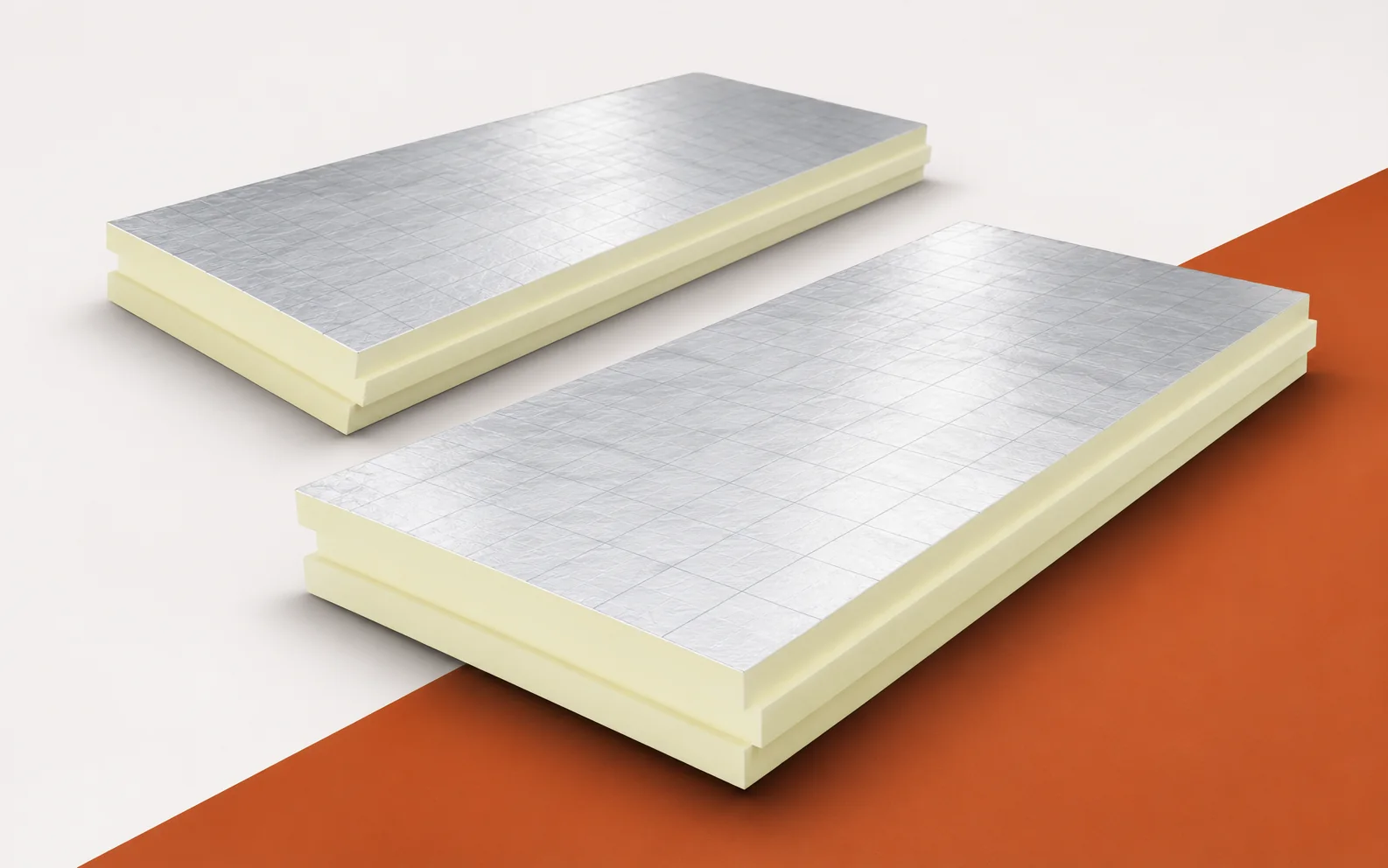
What the lambda of a specific product says
It therefore cannot be converted into comfort using a single universal formula. Polyurethane boards are described by a set of characteristics. Pulling one number out of this set makes it easy to create seemingly simple comparisons. A reliable description should explain which product and which conditions the parameter refers to.
The thermal resistance of a selected layer
For a homogeneous layer, the relationship R = d/λ applies. The thickness d must be given in metres. When d is 0.10 m and lambda is 0.022, the result is approximately 4.55 m²K/W. This simple calculation shows the mechanism, but when selecting a product, the declared R value for its thickness must also be checked.
The formula R equals d divided by lambda shows the relationship between two quantities. Doubling the thickness of the same homogeneous layer doubles its calculated thermal resistance. However, this does not mean that the savings for the whole house double. That second conclusion would require taking the other heat flow paths into account. It is precisely the step from material to building where many short pieces of advice lose their validity.
How to read the U-value of the entire building component
Fasteners, the structure and gaps in the thermal insulation can worsen the result compared with an ideal layer. Linear thermal bridges at the perimeter are assessed separately in accordance with the appropriate method. A large thickness in the middle of the roof slope alone will not solve a weak connection to the wall. It is worth devoting just as much attention to it.
If someone specifies the U-value of the loose board alone, it is worth asking about the assumed calculation boundary. In construction practice, the U-value is used to assess the building component. Alongside the insulation, it contains other layers and surface heat transfer resistances. Specific detail effects are also included. Polyurethane insulation can clearly improve the result, but it should not be credited with the entire description of the assembly as its own property. Separating these concepts brings order to the comparison of offers.
Thickness and space constraints
For a purely numerical illustration, take thermal conductivities of 0.022 and 0.035 W/(m·K). A ten-centimetre layer of the former has approximately the same thermal resistance as a 15.9 cm layer of the latter. Equal R is the basis of this comparison; the result cannot serve as a general thickness conversion for all PIR products, mineral wool or XPS boards.
The popular statement that PIR is always twice as thin as other insulation requires verification. The ratio of required thicknesses depends on the lambdas of the specific products. If we compare other variants, the proportion will also change. There is no single factor that fits all mineral wool, all XPS and all PIR boards. An honest example states both values and the assumed objective. Only then can the calculation be verified.
Limits of conclusions from calculations
Doubling the thickness of homogeneous insulation doubles its R at an unchanged lambda. It does not mean doubling the financial savings. For the entire building component, it changes differently, and this component is responsible for only part of the building’s losses. It is worth calculating further variants instead of drawing a conclusion from the multiplication alone.
In hot weather, surface temperature must not be confused with a material’s thermal conductivity. These are different quantities. Polyurethane foam, like other insulators, operates under varying thermal conditions. How a room behaves also depends on the mass of the partitions, the windows and ventilation. Advice that explains everything solely by the surface temperature ignores these elements. The right question is therefore: which assembly was calculated and what data describe its use?
From parameters to correct execution
Before covering up, check the joints and the consistency of the thickness. Measuring a few points does not replace checking the entire surface, but it does help catch delivery errors. Polyurethane boards must also be fitted at the perimeter. Leaving a wide gap under the flashing does not become correct just because it is not visible.
A gap between boards is an installation phenomenon that a better figure in the catalogue does not eliminate. Insulation with polyurethane requires continuity to be maintained wherever a layer is envisaged. Analysis of the material should therefore lead to checking the detail. If the comparison stops at lambda and says nothing about the joints, it describes only part of the problem. Parameters are needed, but their meaning becomes apparent in a correctly built assembly.
How to draw the correct conclusion
A thermal image shows a cool spot where the wall meets the roof. In itself, this does not prove that the insulation’s lambda is too high. The cause may be the detail or air flow. First establish the measurement conditions and the layer build-up before you choose thicker boards.
When checking advice, note next to each number its meaning and unit. Separate material, layer, building component and the whole building. This simple division makes it possible to catch many unjustified shortcuts. PIR boards do not need exaggerated promises to justify their use where thickness is limited. A correct comparison of products is enough. If the author derives a specific calculation or temperature from lambda, they should show the additional assumptions needed for such a conclusion.
7 branches. Materials closer to your project.

- SEROCK — Dzierżenin 34 E
- BŁONIE — ul. Sochaczewska 138A
- RADOM — ul. Grobickiego 8
- ŁÓDŹ — Natolin 8
- OLSZTYN — Barczewo, ul. Prosta 9
- WROCŁAW — ul. Jerzmanowska 10C
- GORZÓW WLKP. — ul. Zielona 33/34