Metal fence pickets and fences
Metal picket fences and wind: why gaps are only part of the picture
In brief
Gaps between pickets preserve the open character of the fence. They do not, however, stop the wind from acting on it. Every element has a surface area, and forces are transferred through the fixings to the structure. This is worth remembering, especially with a tall fence and on an open plot. Metal fence pickets must be selected as part of the whole system, not merely as coloured infill. A picket resists the flowing air. Its behaviour depends on, among other things, its shape, orientation and neighbouring elements. The free spaces change the flow conditions but do not eliminate all loads. Therefore it cannot be assumed that an open bay requires no wind assessment.
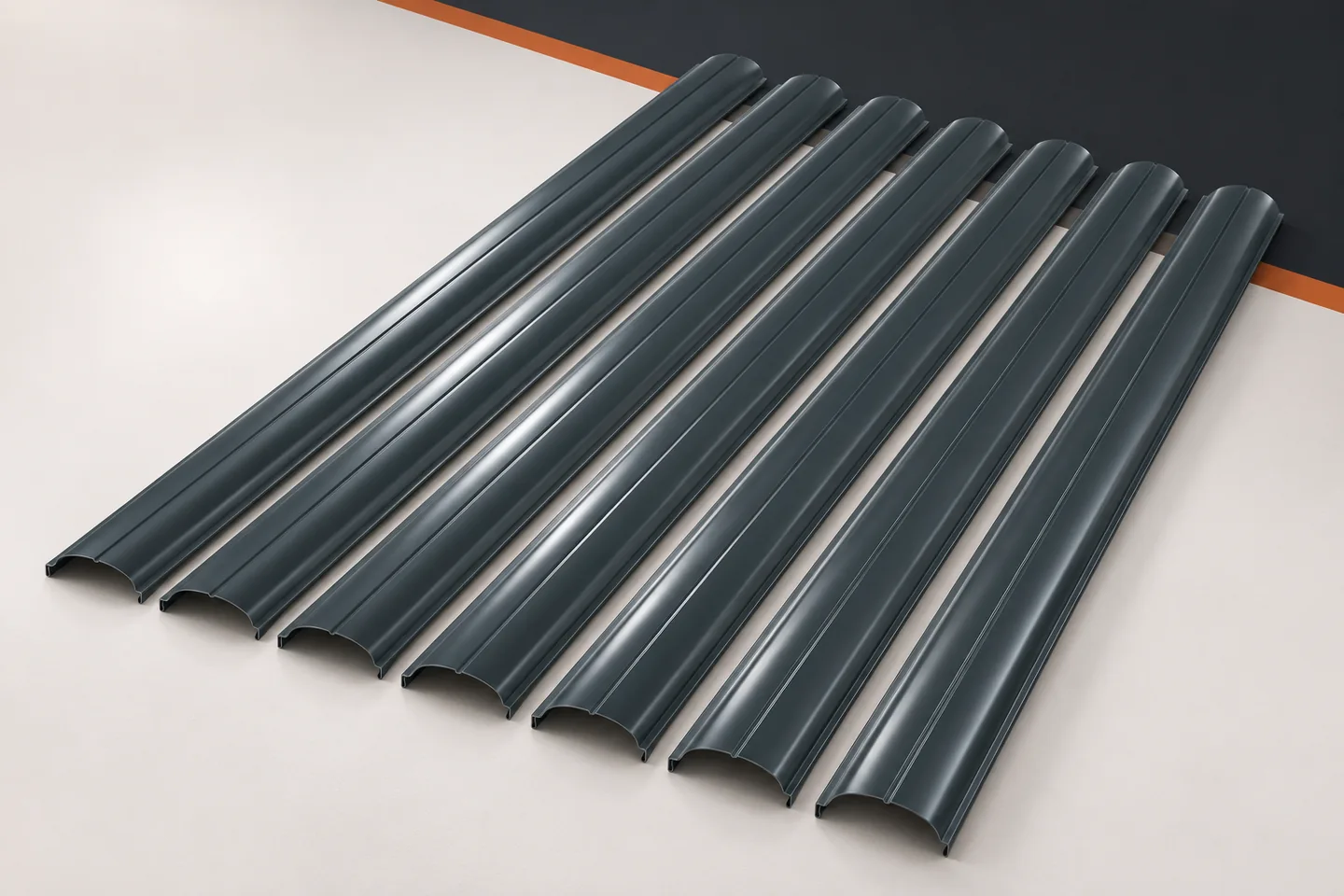
Wind also acts on individual elements
The percentage of open area shown in a drawing is not a ready-made coefficient for structural calculations. A double row complicates matters further. A proper assessment requires the right assumptions for the whole fence. An aesthetic drawing shows the rhythm of the pickets, but on its own it does not prove the load-bearing capacity of the posts and foundations.
A picket transfers forces through the connectors
The infill is connected to the rails or other supports. These connections transfer the load onwards. Even a well-chosen section will not solve the problem of an unsuitable screw, a poorly prepared hole or damaged support. The properties of the thin sheet and the points where it is fixed are equally important.
A fastener should not be chosen solely by the colour of its head. It must suit the combination of materials and the method of installation. The number of fixing points and their positions are specified in the documentation for the particular system or in the design. A detail found for a different picket model does not automatically become correct for every project.
Posts and ground are part of the same task
Forces from the bays are transferred to the posts and their fixings. The height of the fence, the width of the panels and local conditions all matter. The whole structure cannot be assessed by looking at just a sample picket. That is why replacing a light infill with dense sheet metal pickets should begin with checking the existing supports.
The absence of visible leaning on a calm day does not prove that an old fence is suitable for a new use. The condition of the connections, corrosion and the way the posts are set must be taken into account. Where documentation is lacking, an assessment is needed from someone who can verify the structure on site. A product description alone will not replace it.
A denser layout requires a fresh look
Reducing the gaps between the pickets may improve privacy. However, it changes the geometry of the bay exposed to the wind. Adding a second row has a similar effect. Such changes should be considered together with the structure. They are not merely a decorative adjustment or a simple increase in the number of items in the basket.
It is worth establishing the target density before ordering the supports and constructing the foundations. A later change may require additional work. Where the design specifies open metal fence pickets made of sheet metal, do not fill every gap yourself. The arrangement must retain the conditions for which its components were selected.

Add-ons also change how the bay performs
A mat, banner or dense vegetation can obscure the spaces between the pickets. The fence then behaves differently from its original state. This also applies to seasonal additions. Before attaching them, check whether the structure is suitable and whether the method of fixing damages the coating.
The pickets should not serve as incidental supports for heavy planters or garden equipment. Such a load can cause local deformation and additional forces in the connectors. A decoration is not technically irrelevant just because it looks light. Its effect must be assessed before it is hung.
Noise and vibration are a signal to check
If new knocking occurs during gusts, it is worth locating its source. The cause may be a loose connection, contact between components or movement of the entire bay. The symptom should not immediately be attributed to sheet metal that is too thin. Different problems can produce a similar sound. First, the fixing and the surroundings need to be checked.
Tightening all screws with great force is not a safe universal repair. Thin sheet metal and the connection can be damaged this way. The repair should correspond to the established cause and the instructions. If the connection is worn or the structure moves, merely correcting the clamping force may not solve the problem.
How to prepare data for a proper assessment
Provide the location, fence height, field widths and picket arrangement. Describe whether the terrain is open, whether you plan two rows and whether screens will be added. Include documentation of the profile and fixings. Such information allows the infill to be considered together with the structure, instead of relying on a general assurance of resistance.
The advantage of metal pickets is the freedom to shape an open bay. However, this freedom must be used consciously. A well-chosen material and correctly designed support form a coherent whole. The gaps help achieve a specific appearance and clearance, but they do not exempt you from assessing what happens to the fence during gusts.
7 branches. Materials closer to your project.

- SEROCK — Dzierżenin 34 E
- BŁONIE — ul. Sochaczewska 138A
- RADOM — ul. Grobickiego 8
- ŁÓDŹ — Natolin 8
- OLSZTYN — Barczewo, ul. Prosta 9
- WROCŁAW — ul. Jerzmanowska 10C
- GORZÓW WLKP. — ul. Zielona 33/34