Installation and details
Planning a safe route onto and across a pitched roof
In brief
First decide whether anyone needs to step onto the roof. Photographs or a view from ground level or a safe window may show what you need. If access is necessary, have a person trained in work at height assess the covering, supporting structure and equipment already fitted. The access route and fall protection depend on what they find. Roof steps and walkways provide a route across the slope. A safety line needs an anchor specifically designed for that purpose.
Is roof access necessary at all?
A roof inspection can begin from the ground, from a safe window or with the help of photographs. This reveals skewed flashings, dirty gutters or a missing covering element. Such a review does not provide a full diagnosis, but it helps establish the scope of the roofer’s visit. There is no reason to go onto the roof solely to check a detail that can be seen from elsewhere.
If a repair is needed, the access method must suit the building and the task. This may be scaffolding, a lift or a designed roof access. The decision depends on the height, the condition of the structure, the work location and the surroundings. A casually placed ladder does not solve the problem of reaching the roof slope or moving around on it.
What to check before starting work?
First, the condition of the covering, the structure and the installed equipment is assessed. Corrosion, damp timber, unknown repairs and damaged supports may rule out access. Doubts should be resolved by a person with appropriate knowledge. The mere fact that a roof holds snow does not prove that any given point can withstand the pressure of a foot or the base of equipment.
The work must be adapted to the weather. Wet steel sheet, frost, ice and strong wind increase the risk of losing balance. Dew is also significant, even when it is not raining. The area below the work must be secured against access by persons. Tools and small parts must not slide onto the driveway, the entrance to the house or workers positioned below.
How does fall protection work?
The method of protection is selected before going onto the roof. Where possible, solutions protecting the entire work zone are used, for example suitable railings and platforms. Personal protection requires a complete, correctly selected set and training. Merely putting on a harness without a defined method of use does not provide effective protection.
The anchor point must be intended for this purpose and properly fixed. It must not be assumed that a gutter, chimney, snow guard or ordinary chimney platform is suitable for attaching a rope. The work plan should also cover the possibility of assistance after an incident. The selection of equipment and the organisation of such work should be entrusted to persons prepared for work at height.

Why are chimney steps and walkways installed?
The steps define the access route, and the platform creates a place for servicing the chimney or equipment. Their layout should connect the starting point with the work location without bypassing obstacles over random sections of the roof. The supports are selected for the covering profile and the intended substrate. A similar colour of two sets does not indicate their technical compatibility.
Loads must be transferred to the appropriate structural elements. A screw anchored only in thin sheet metal may not provide sufficient fixing. Penetrations through the covering require sealing in accordance with the system. After installation, stability, completeness of connections and condition of the surface are checked. A loose or corroded roof walkway is not a safe access route.
How can steel sheet and sandwich panels be protected from damage?
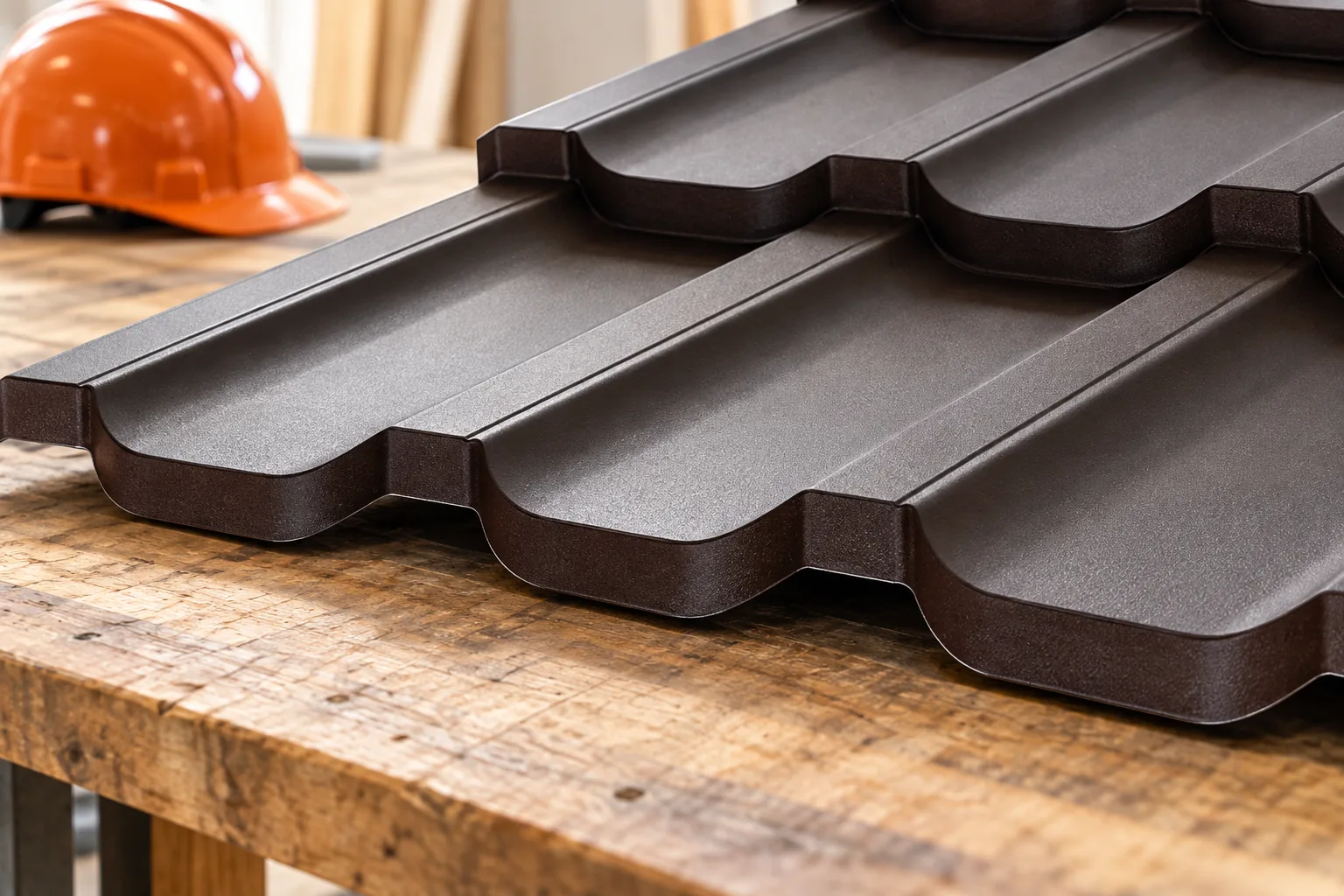
The rules for load transfer derive from the instructions for the specific covering. For tile-effect metal roofing and trapezoidal steel sheet, the position of the supports is important. There is no universal rule that one may stand on every crest or in every trough of the profile. Where necessary, designed platforms are used that distribute the load and protect the surface.
For sandwich panels, the span, the thickness of the facings and the permissible installation loads are important. Skylights, unfixed sheets and openings require separate protection. Clean footwear with a suitable sole reduces scratches but does not increase the load-bearing capacity of the roof. A metal swarf embedded in the sole can drag a long scratch across a new coating.
What should remain after the work is completed?
After servicing, metal swarf, fixing remnants and other contamination are removed. Access points, flashings and the surfaces on which equipment rested are checked. A dent or damage to the paintwork should be recorded immediately. A left-behind tool may later slide off the roof slope, which is why tidiness is part of the handover of the work.
For regular inspections, it is worth keeping an access plan and documentation of the installed safety equipment. The next team should know which elements serve for movement and which have another purpose. A well-planned route reduces the number of entries onto random sections of the covering and makes it easier to carry out the necessary servicing.
7 branches. Materials closer to your project.

- SEROCK — Dzierżenin 34 E
- BŁONIE — ul. Sochaczewska 138A
- RADOM — ul. Grobickiego 8
- ŁÓDŹ — Natolin 8
- OLSZTYN — Barczewo, ul. Prosta 9
- WROCŁAW — ul. Jerzmanowska 10C
- GORZÓW WLKP. — ul. Zielona 33/34