Costs and formalities
How to estimate labour for installing sheet metal roofing
In brief
In Poland, the labour cost of laying sheet metal on a roof depends primarily on the roof’s shape and the scope of work, not solely on the number of square metres of slope. Before comparing quotes, check whether the price covers substrate preparation, membrane, counter-battens and battens, or only the laying of sheets, and whether valleys, ridges, chimney flashings and gutter installation are priced separately. For a renovation, add removal of the old covering, protection of the building and waste disposal. Without this list, a rate per metre says little.
What should the scope of the quote include?
Establish whether the price includes preparation of the substrate, membrane, counter-battens and battens, or only laying the sheet metal. Roof valleys, ridges, chimney flashings and gutter installation may be billed separately. In a renovation, dismantling of the old covering, protection of the building and clearing away of waste are added. Without this list, the rate per square metre says little.
Delivery and transport of the material onto the roof must also be specified. Not every quote includes scaffolding, a lift or a crane. With long sheets, the organisation of the lifting operation is of great importance. If the client is to provide equipment or assistance with unloading, this should follow from the arrangements and not appear only on the day of delivery.
Why do two roofs of the same area cost differently?
A simple roof slope allows similar operations to be repeated. Roof valleys, dormers and numerous penetrations require measurements, cutting and the execution of details. A roof with a small area but a complex shape may require more work than a larger gable roof. Access to the building and the height at which the works are carried out also matter.
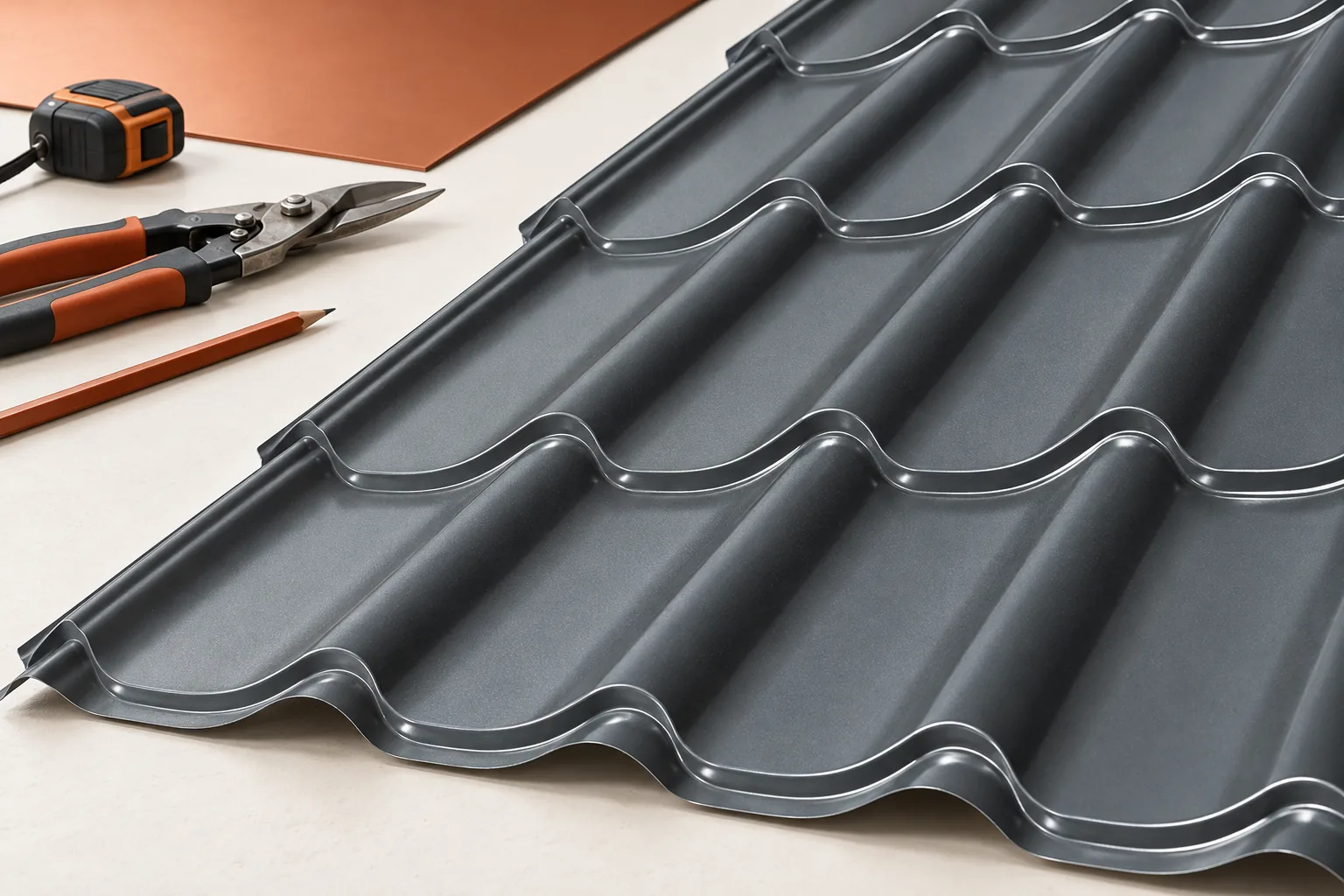
The type of covering changes how the work is organised. Modular tile-effect metal roofing consists of smaller elements, while sheets cut to size can cover long sections of the roof slope. Trapezoidal steel sheet requires its own arrangement of overlaps and fixings. One should not assume that one material is always the fastest. What decides is the combination of product and roof geometry.
How should the rate per square metre be read?
Ask whether the basis is the roof slope area, the area of the ordered material or another quantity. A pitched roof has a larger area than its horizontal projection. Overlaps and waste, in turn, increase the amount of steel sheet purchased. The contract should clearly state the method of measurement and the rules for billing openings and small sections.
Linear items must be counted separately if they are not included in the basic rate. This applies, for example, to specific flashings or gutters. For a chimney or window, a price per detail unit is more often useful. Such a breakdown makes it possible to understand where the total comes from and limits disputes at acceptance.

What does a simple calculation example look like?
Assume, purely as an exercise, 160 m² of roof slope and an agreed rate of €18.52 net per m² for a clearly described scope. The product gives €2963.20 net. This is not information on current market prices. It merely shows the method of calculation. Every item excluded from the scope must be added in accordance with a separate agreement.
If we additionally assume €462.90 net of VAT for the agreed machining and €347.17 net of VAT for the equipment, the total will be €3773.27 net of VAT. The tax must be determined for the actual service. One rate must not automatically be added to every situation. Before signing the contract, ask for the final gross amount and the full scope of the service.
What should be done about works that cannot be assessed in advance?
During renovation, after the covering has been removed, damage to the battens or structure may come to light. It is worth setting out in the contract how these are to be documented and approved. It should be clear who assesses the scope of the repair, how the cost estimate is produced and when the crew may begin additional work. A financial reserve does not replace such a procedure.
Not all changes are unpredictable, however. Curved geometry that is visible before work begins should be discussed at the measuring stage. A well-prepared crew points out the assumptions and limitations of the quote. If the estimate was based solely on an area given over the phone, treat it as a preliminary estimate.
How to assess a quote beyond the price alone?
Compare the scope of responsibility, the deadline, the acceptance procedure and the terms for remedying defects. Check experience with the selected covering system. Ask for a discussion of the difficult details of your roof. A specific answer about the eaves, roof valley and chimney says more than a general assurance of many years’ practice.
Divide payments according to the agreed stages and document changes in scope. Acceptance should also cover elements that will later be covered up. A reasonable labour price results from clearly described work. The lowest amount from a short message is not yet a comparable quote for a finished, watertight roof.
Keep the price schedule and the correspondence concerning changes. For a larger scope, a cost estimate with quantities and units is helpful. It allows you to check whether the increase results from a larger measured quantity, an additional detail or a change in rate. This makes budget control easier without negotiating at every minor task.
7 branches. Materials closer to your project.

- SEROCK — Dzierżenin 34 E
- BŁONIE — ul. Sochaczewska 138A
- RADOM — ul. Grobickiego 8
- ŁÓDŹ — Natolin 8
- OLSZTYN — Barczewo, ul. Prosta 9
- WROCŁAW — ul. Jerzmanowska 10C
- GORZÓW WLKP. — ul. Zielona 33/34